
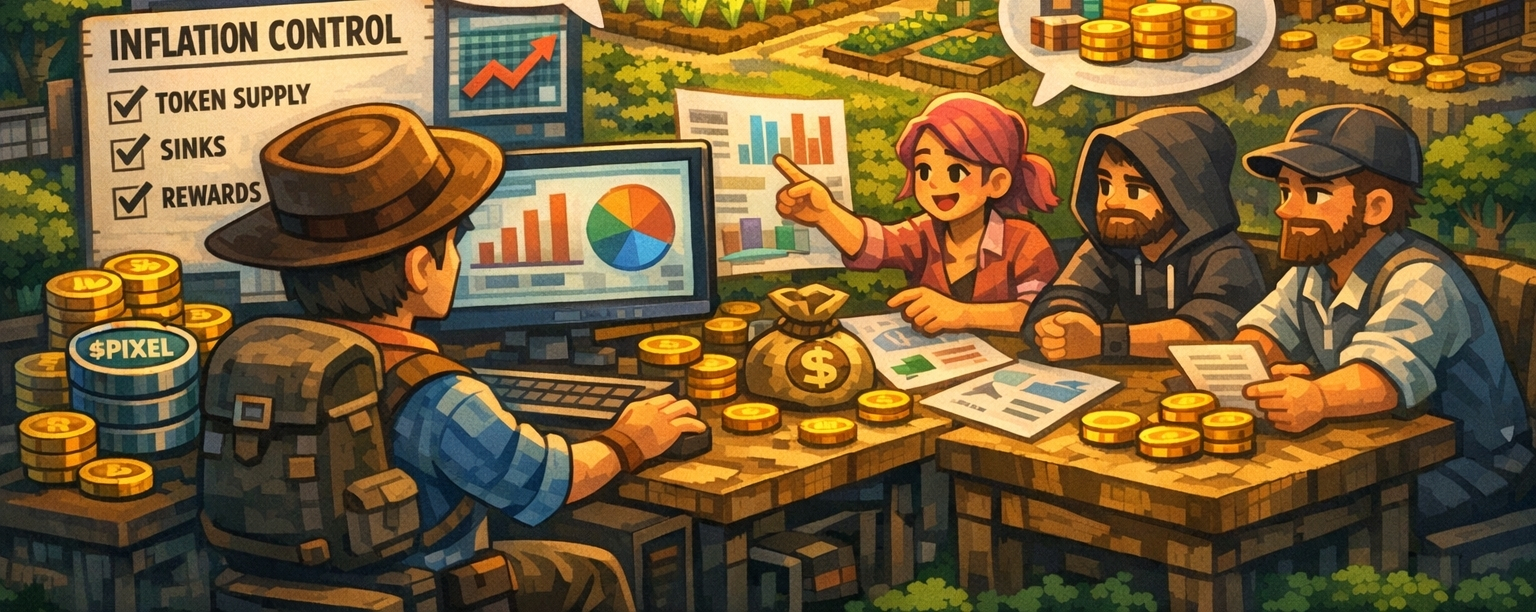
I’ve been watching Pixels evolve for a while now, and one thing has become impossible to ignore—inflation isn’t just a background mechanic anymore, it’s the conversation. What used to be a quiet concern buried under gameplay updates has now moved right to the center of the community. Players aren’t just farming, trading, and grinding anymore; they’re thinking like economists. They’re asking why rewards feel different, why token value shifts, and what it actually means for the long-term health of the game. And honestly, I think this shift says a lot about how far Pixels has come.
At its heart, Pixels isn’t just a game—it’s an economy people participate in every single day. When I look at how players interact with the $PIXEL token, I don’t just see in-game currency; I see a system where time, effort, and decision-making translate into real value. That’s powerful, but it also creates pressure. If too many rewards flow into the system without enough ways to balance them out, things start to break down. Tokens lose meaning, grinding feels less rewarding, and players begin to question whether their time is actually worth it. I’ve seen that pattern before in other Web3 games, and Pixels seems determined not to repeat those mistakes.
Earlier versions of the ecosystem made that challenge pretty clear. Back when multiple tokens were in play, especially with systems like $BERRY, rewards felt abundant but not always meaningful. It was easy to earn, but harder to hold value. I remember thinking that something felt off—not because the game wasn’t fun, but because the economy didn’t feel grounded. When the shift happened and the system consolidated around $PIXEL, it wasn’t just a technical update. It felt like a statement. It said the team understood that inflation wasn’t just a side effect—it was a core issue that needed to be addressed head-on.
What I find most interesting now is how the community itself has changed. Players aren’t just reacting to updates; they’re actively analyzing them. I see discussions about emission rates, token sinks, and long-term sustainability happening alongside regular gameplay chatter. That’s not something you usually see in traditional games. Here, players understand that their actions—whether they’re holding tokens, spending them, or staking—actually shape the economy. It’s not just about “what can I earn today?” but “what kind of system am I helping build?”
L
Token sinks have become a huge part of that conversation, and honestly, they make a lot of sense. If tokens only flow in and never flow out, inflation is inevitable. But when players spend $PIXEL on upgrades, cosmetics, guild features, or staking, they’re not just progressing—they’re helping stabilize the system. I like that because it turns spending into something meaningful. It’s not just a cost; it’s a contribution to the overall balance of the game. And the more I think about it, the more I realize that this kind of design encourages healthier behavior. Players aren’t just extracting value—they’re reinvesting it.
The introduction of more structured reward systems has also changed how I see progression in Pixels. It’s no longer about how much you can earn as quickly as possible. Instead, it’s about how sustainable those rewards are. If rewards are tied to actual activity and value within the ecosystem, they feel more legitimate. They’re not just numbers appearing out of nowhere; they’re part of a cycle that makes sense. I think that’s why the idea of balanced reward distribution has gained so much traction—it aligns with what players are starting to care about.
Another thing I’ve noticed is how multi-game expansion is influencing the inflation conversation. Pixels isn’t just one game anymore; it’s becoming a broader ecosystem. And with that comes new ways to use $PIXEL, especially through staking across different experiences. I find that particularly interesting because it introduces choice. Players aren’t locked into a single path—they can decide where their tokens go and what they want to support. At the same time, staking naturally reduces circulating supply, which helps manage inflation. It’s one of those systems where gameplay and economics actually reinforce each other instead of competing.
What’s really changed, though, is the mindset of the community. I remember when higher rewards were always seen as a good thing. More tokens meant more excitement, more engagement, more everything. But now, there’s a growing understanding that too much of a good thing can backfire. Players are starting to appreciate balance, even if it means slower progression. That’s a big shift, and I think it’s a healthy one. It shows that people are thinking beyond short-term gains and focusing on long-term value.
Recent updates seem to reflect that same philosophy. Instead of just adding new ways to earn, there’s a clear effort to refine how the economy works as a whole. Reward systems are being adjusted, new sinks are being introduced, and there’s a noticeable focus on making sure everything connects in a sustainable way. From what I can see, the goal isn’t just to keep players engaged today—it’s to make sure the game still feels rewarding months or even years down the line.
Of course, none of this is easy. Inflation control isn’t something you solve once and forget about. It’s an ongoing process, and it requires constant attention. Player behavior changes, new features get introduced, and external market conditions can shift unexpectedly. I think that’s why community involvement matters so much. When players understand the system, they’re more likely to make decisions that support it. And when developers listen to that feedback, the system becomes stronger over time.
Looking ahead, I see a lot of potential in how Pixels is handling this. If inflation stays under control, it creates a more stable environment for everyone. Players can plan long-term strategies without worrying that their rewards will suddenly lose value. New players can join without feeling like they’ve missed out. And the ecosystem as a whole becomes more attractive, not just for gamers but for anyone interested in sustainable digital economies.
I also think this focus on inflation control could shape how future Web3 games are built. Pixels is essentially experimenting in real time, figuring out what works and what doesn’t. If it succeeds, it won’t just benefit its own community—it could influence the entire space. Other projects might adopt similar approaches, prioritizing balance and sustainability over rapid growth and short-term hype.
At the end of the day, what stands out to me is how natural this shift feels. Inflation control isn’t being forced into the conversation—it’s emerging from it. Players care because they see the impact directly. They feel it in their rewards, their trades, and their overall experience. And that makes the discussion more meaningful. It’s not just theory; it’s something that affects how the game actually feels to play.
So when I think about Pixels right now, I don’t just see a farming game or a Web3 experiment. I see a community learning how to manage its own economy in real time. It’s messy at times, and there are still challenges ahead, but it’s also incredibly dynamic. Inflation control has become a major topic because it touches everything else—progression, value, trust, and future growth. And if the current direction continues, I think Pixels has a real chance to turn that challenge into one of its biggest strengths.