
I keep coming back to a simple idea when I think about Pixels because a game has to survive as a game before it can survive as an economy. My first instinct with anything in the crypto gaming world used to be skepticism because so many projects seemed to confuse activity with enjoyment and they treated repeated clicking and harvesting and extraction as proof of life even when that had very little to do with play. What stands out to me about Pixels is that it has become more direct about this problem instead of hiding it behind a cheerful farming skin. In its own whitepaper the team says the ambition was always bigger than one farming game and one of its central ideas is basically fun first which means games need an internal reason for people to care about them before any reward system can mean much. I find that helpful because it shifts the question away from how much users can earn and toward why anyone would still want to be there if the earning became smaller. To me that is a much healthier question and in this space it still feels a little rare.
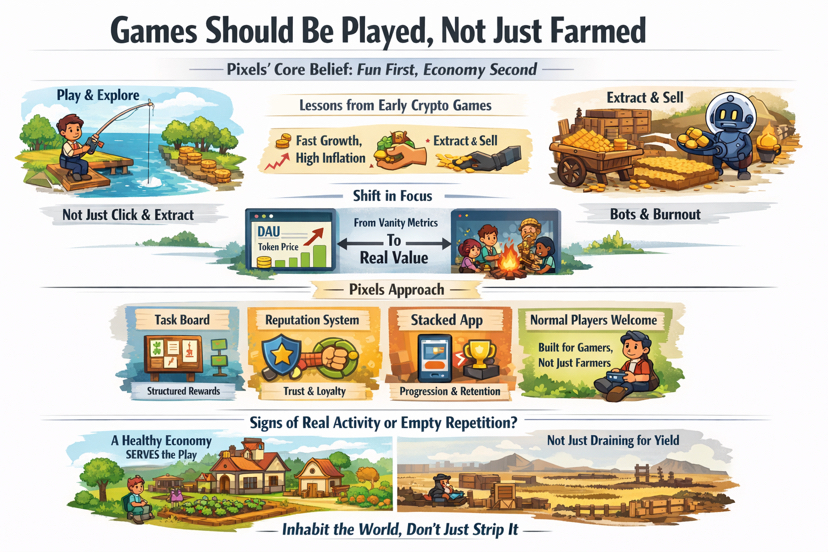
What makes the idea feel more believable is that Pixels has also been unusually open about where the earlier model went wrong. In its revised vision the team describes the familiar problems plainly with fast growth followed by inflation and sell pressure and reward systems that often aimed at brief bursts of engagement instead of real long term value. That matters because farming is not just a cute theme here. It is also the trap. When a system rewards extraction too easily people begin to treat the world like a field to strip instead of a place to inhabit and that change in attitude slowly drains the life out of the whole thing. You can see Pixels pushing back on that in small practical ways. The game’s Task Board is the main path for earning the PIXEL token in game and the rules around it are structured and limited instead of endlessly open ended. Its reputation system is also there to separate loyal players from bad actors. None of that sounds romantic and I think that is exactly the point because a game that wants to last has to care about who is actually playing and who is only automating and which actions help the world feel inhabited instead of hollowed out.
That is also why I think this angle is getting more attention now than it would have five years ago. The market has had time to learn sometimes painfully that vanity metrics do not tell the whole story and that a big number on a dashboard does not mean much if the world underneath it feels thin. In a late 2025 interview Luke Barwikowski said the big shift was away from obsessing over daily active users and token price and toward sustainable businesses that actually create value and keep people around. He also said pretty bluntly that the way forward is to build for normal players instead of only crypto native ones. More recently Pixels pushed that thinking further by launching Stacked which is a separate rewards app meant to reward progression and consistency and referrals and retention across multiple games instead of raw playtime alone. Even the way that launch was framed says a lot because the problems were described in plain terms such as bots and farmed quests and bad payout design and reward loops that do not make practical sense. At the same time the main Pixels site says the game is in temporary maintenance while major updates are being implemented which suggests that the project is still in the middle of changing itself instead of pretending the design is already settled.
I do not read any of this as proof that Pixels has solved the problem and I do not think the team is pretending otherwise. What surprises me is that it seems more interested in naming the problem correctly which is often where serious improvement begins. Barwikowski has even argued that once you put on chain assets into a game you have created a form of real money gaming whether you meant to or not. I think that honesty matters because it leaves room for the tension instead of pretending it will disappear. Some players will always optimize for extraction and some reward systems will always invite people to game the rules. But if Pixels’ core belief is that games should be played not just farmed then the real test feels simple to me. Do the systems reward signs of actual life inside the world or do they reward empty repetition that only looks busy from a distance. That is the line I keep using to make sense of it. Not whether the economy exists but whether the economy is serving the play. When that order gets reversed the game starts draining away and when it stays in place there is at least a chance that people are not just passing through for yield but sticking around because the world still feels worth inhabiting.
