

I used to think “free to play” was a solved idea. You either paid to unlock things faster or you didn’t Simple tradeoff. But watching Pixels (@Pixels) move into Chapter 3: Bountyfall, it’s clear the system is more nuanced than a simple pay-to-win gate. The entry is free, yes. That part is obvious. What’s less obvious is how the system decides who actually moves forward with any kind of momentum.
When you sit inside the game for a while, the pacing starts to feel uneven in a way that’s hard to point at directly. Nothing blocks you. There’s no moment where the system says “stop, pay here.” You just move slower. This is where $PIXEL makes sense, but not in the way people usually describe it. It isn't just a utility token; it’s a tool that prices resistance. If you use it, the loop smooths out. Actions feel less delayed. Progress feels less sticky. You don’t notice it immediately, but once you do, it’s hard to unsee.
Two players can technically do the same things same tasks, same effort but they don’t arrive at the same place at the same time. One gets there earlier, securing better positioning in the new Union leaderboards or grabbing high-tier assets like Mirage Eggs before the market shifts. Speed isn’t advertised as the main advantage, but it quietly is. It reminds me of how market systems work: whoever moves first, even by a small margin, tends to shape what comes next.
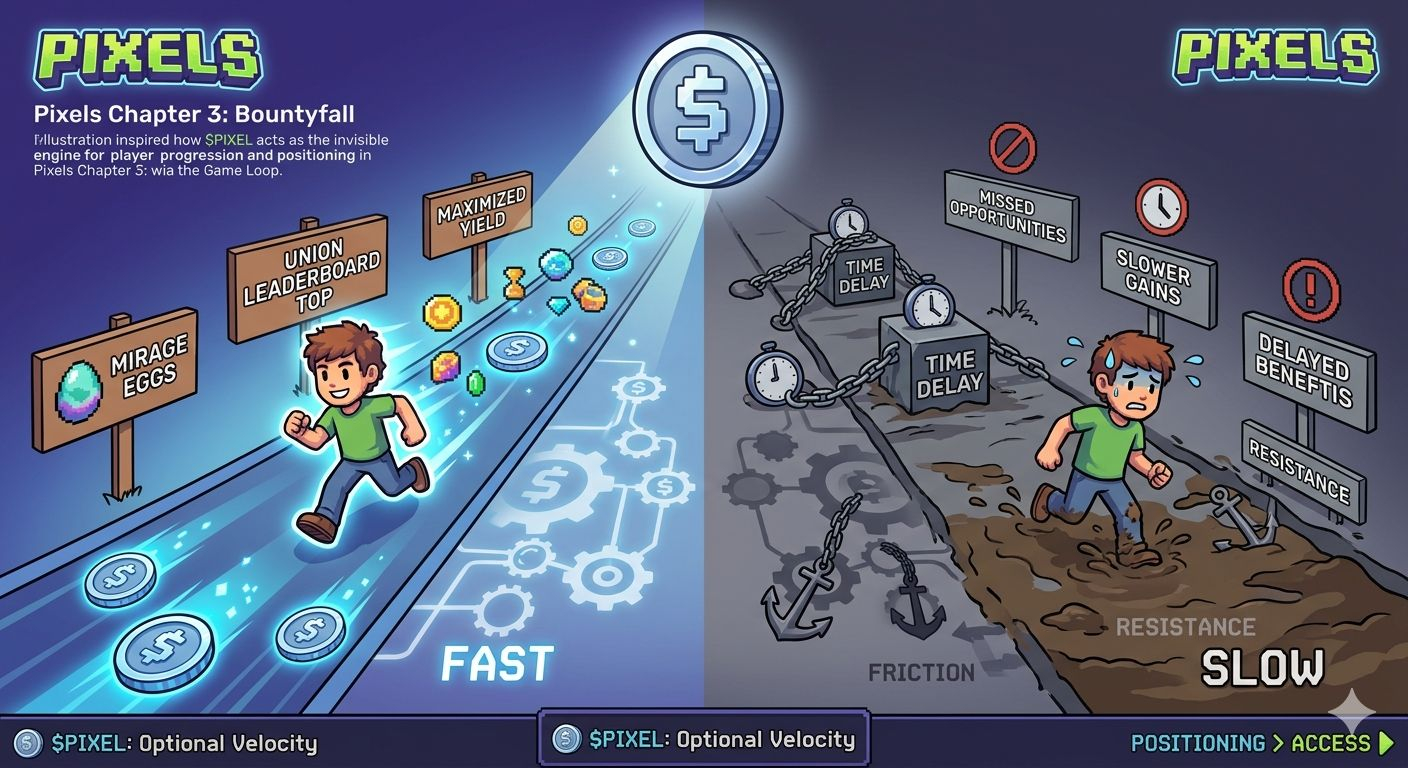
Pixels doesn’t say this out loud; the structure does it anyway. Optional doesn’t always stay optional in crypto. Gas priority and staking tiers all start as tools, then slowly become expectations because competing without them starts to feel inefficient. Pixels is drifting in that direction, but in a softer way. Instead of locking content, it stretches time. Instead of saying “you can’t,” it says “you can, just slower.”
Psychologically, that builds a different kind of pressure. It doesn't trigger resistance; it builds discomfort. If progression speed is uneven, then opportunity distribution becomes uneven too. Early movers get access to better loops, which generate more output, feeding back into stronger positioning. It compounds.
So the token isn’t just about spending. It’s about positioning yourself relative to everyone else. The question shifts from “do I need this to play” to “how far behind am I willing to be.” In the Chapter 3 era of competition, that grey zone is where $PIXEL lives. It isn't deciding who can play that part is already solved. It’s deciding who gets to move faster once they’re inside. 🚀🚀