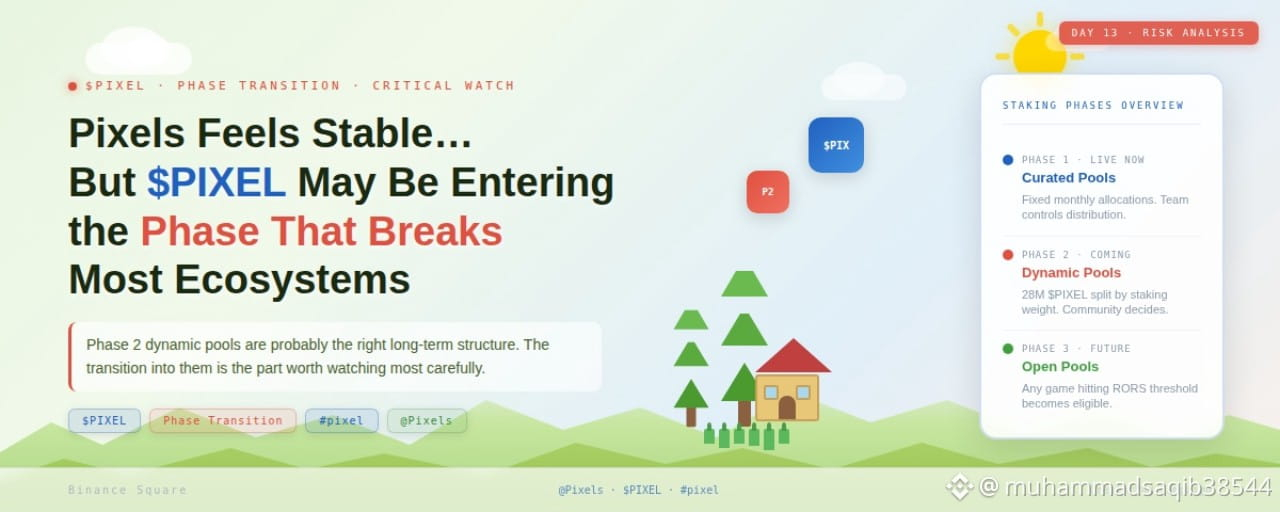
I've watched enough ecosystems move through their early stages to know that the dangerous moment isn't launch. It isn't the first bear market either. It's somewhere in the middle, when things are working well enough that confidence starts to build, but the underlying structure hasn't yet been tested by the kind of pressure that only arrives when real money and real behavior start interacting with a system that was designed under calmer conditions.
That's the moment I keep thinking about when I look at where @Pixels is right now....
Not because anything looks broken. The opposite actually. Things look coherent enough that it's easy to stop asking uncomfortable questions. And that's usually when the uncomfortable ones matter most.
As...The staking system is currently in Phase one. Fixed monthly allocations per game. Core Pixels gets twenty million PIXEL per month. Pixel Dungeons gets two million. Forgotten Runiverse gets five million. The team controls where the emissions go. Players participate within that structure but don't determine it. It's curated. Stable. Predictable in the ways that early systems need to be predictable.
Phase 2 changes that completely.
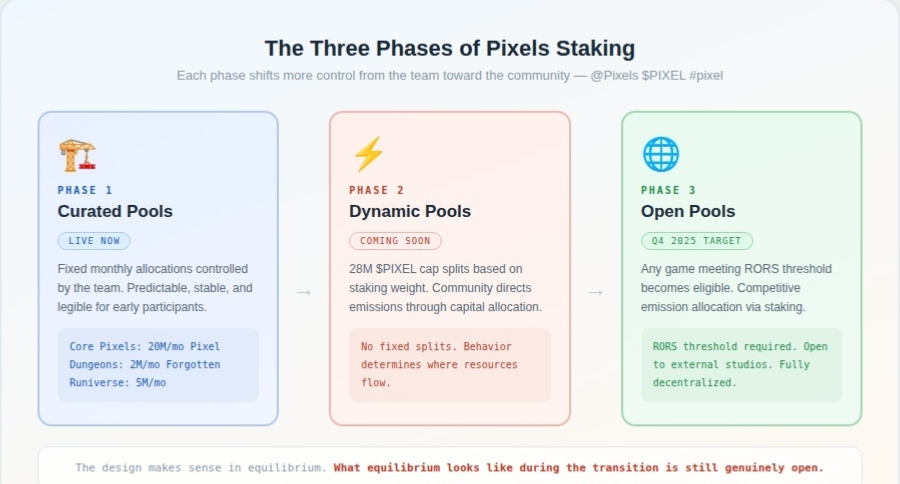
The global cap stays at twenty-eight million month. But instead of fixed allocations, that budget splits dynamically based on how much PIXEL is staked to each game. The community effectively decides through capital allocation where the emissions flow. A game that attracts more stakers gets more resources. A game that doesn't attract stakers starts receiving less than it did under the fixed model.
That transition from curated to community-determined isn't just a technical upgrade. It's a change in who's responsible for the outcome.
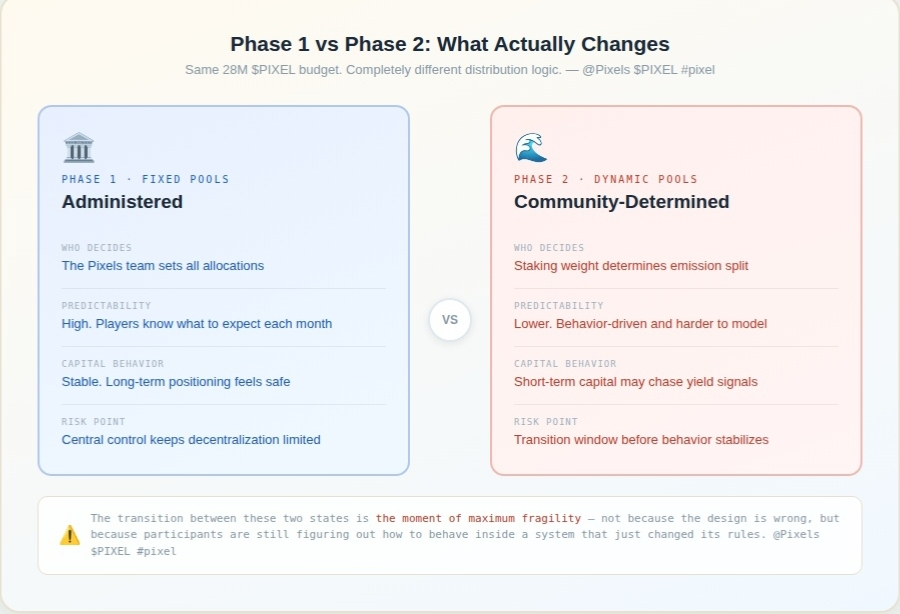
And that shift, in my experience watching systems like this, is where most of the fragility lives.
I kept thinking about something I read a while back about urban planning. Certain city departments spent years or decades managing land use through fixed zoning. This area is residential. This area is commercial. This area stays industrial. The structure was rigid but it was also legible. Everyone knew what would happen where and could plan accordingly.
Then some cities moved toward market-responsive zoning. The idea was sensible enough. Let demand shape development rather than trying to predict it from the top. Allow the city to become what it actually needs to be rather than what planners thought it would need twenty years ago.
What happened in practice was more complicated. Capital didn't distribute evenly across what the city needed. It concentrated in the zones that were already valuable and likely to produce returns. The areas that genuinely needed development received less attention after the transition than they had under the fixed model. Flexibility served whoever had the most capital to be flexible with.
I don't know if Phase 2 in Pixels follows the same pattern.
But the structural similarity is close enough to take seriously.
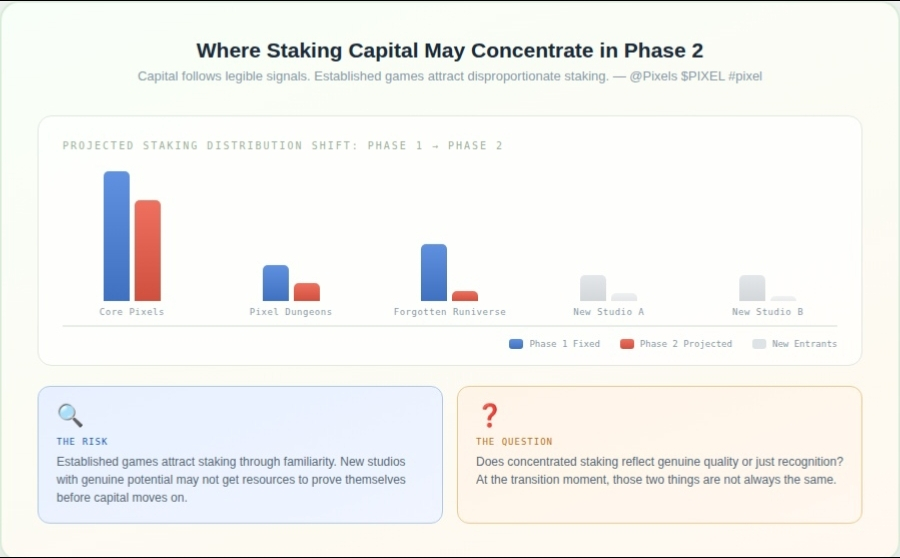
When staking weight determines emission allocation, the games that are already prominent have an advantage in attracting stakers that new or smaller games don't. Stakers follow signals, and the most legible signals are existing track records, existing communities, existing liquidity. Core Pixels will likely attract disproportionate staking in Phase 2 simply because it's the game people already understand. That might be exactly the right outcome. It also might mean that games with genuine long-term potential but smaller existing profiles don't get the resources they need to demonstrate that potential.
There's also the behavior of short-term capital to think about.
Under fixed allocations, the staking environment is relatively stable. Yields are predictable enough that players make long-term positioning decisions. When allocations become dynamic, short-term capital starts chasing yield signals across game pools in ways that create volatility that didn't exist before. A game that briefly shows strong RORS might attract a wave of staking that then destabilizes when those stakers move to wherever the next signal appears.
That isn't a design flaw exactly. It's just what happens when a system transitions from administered to market-determined. The market adds information but it also adds noise. And the noise tends to be loudest right after the transition, before participants develop the intuitions needed to read it correctly.
What I keep coming back to is whether Pixels has thought carefully about the transition period itself, not just the destination.
The whitepaper describes Phase 2 clearly. What it describes less clearly is what the ecosystem looks like in the weeks immediately after the switch.
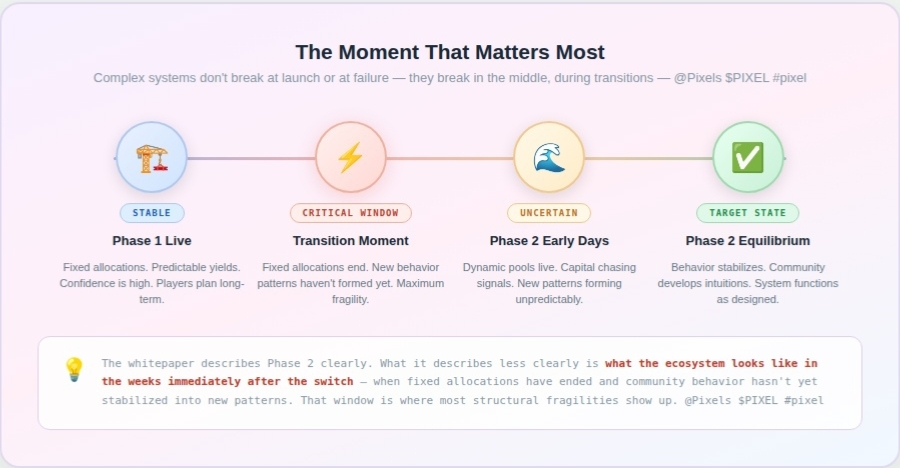
when fixed allocations have ended and community behavior hasn't yet stabilized into new patterns. That window is where most structural fragilities show up. Not because the design was wrong but because participants are still figuring out how to behave inside a system that just changed its rules.
I'm not arguing against Phase 2. The dynamic model is almost certainly the right long-term structure. A system where the community directs resources based on actual performance is healthier than one where a central team makes all the allocation decisions indefinitely.
But healthy long-term outcomes and difficult short-term transitions aren't mutually exclusive. They happen simultaneously all the time in complex systems.
The question worth sitting with isn't whether Phase 2 is the right direction. It's whether the ecosystem has enough distributed understanding of how the new mechanics work that participants can make genuinely informed staking decisions when the transition arrives. Or whether most people will simply follow the most obvious signals, which creates concentration patterns that the system wasn't designed to produce.
I don't think Pixels has fully answered that yet.
What they've done is design a structure that makes sense in equilibrium. What equilibrium looks like during a transition is a different question. And transitions, in markets and in ecosystems and in any complex system where human behavior is the variable, rarely look exactly like what the people who designed them were expecting.
That's not a warning. It's just an observation from watching enough of these moments to know where to pay attention.
@Pixels $PIXEL