
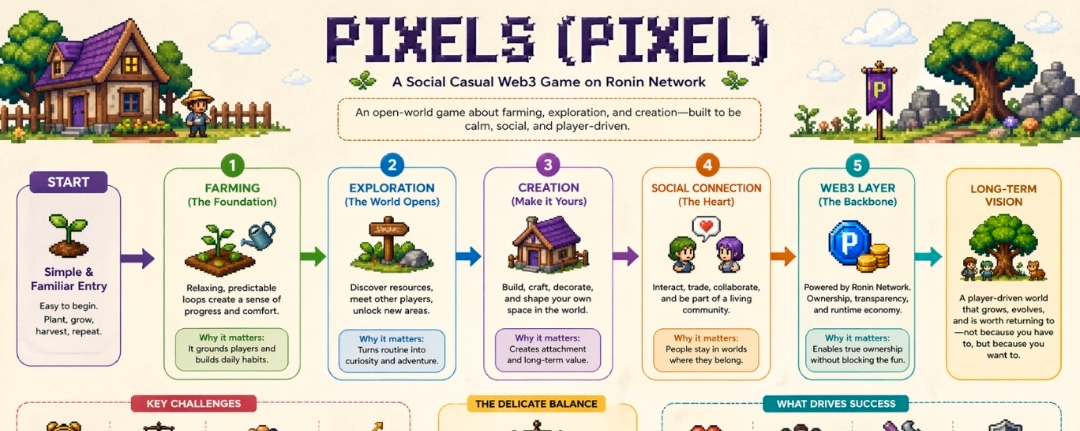
I’ve been thinking about PIXELS in a slightly more everyday, almost casual way—not like some big “Web3 innovation” everyone keeps talking about, but like a place you quietly return to after a long day. You know that feeling when you don’t want intensity, you just want something simple, something steady? That’s kind of where this game sits in my mind. Pixels (PIXEL), running on the Ronin Network, is built around farming, exploration, and creation, but when you actually spend time with it—even just mentally imagining the loop—it feels less like a system and more like a routine trying to form.
At first, nothing about it feels overwhelming. And honestly, that’s a relief. There’s no immediate pressure, no sense that you’re already behind. You just… start. You plant something, you wait, you harvest. It’s slow, but not in a boring way. More like the kind of slow that gives your mind space. Thoda sa peaceful lagta hai. And I think that’s intentional. In a world where most games try to grab your attention and hold it tightly, PIXELS feels like it’s saying, “it’s okay, take your time.”
The farming part is where everything begins, and maybe that’s why it feels so familiar. Even if you’ve never touched real soil, there’s something instinctive about planting and growing. It doesn’t need explanation. You just get it. That simplicity is doing a lot of heavy lifting here. Because let’s be honest, Web3 games can sometimes feel confusing or overly technical. Wallets, tokens, networks—it can all feel a bit much. But here, the entry point is basic: grow something, collect something, repeat. Seed lagao, wait karo, phir harvest. There’s comfort in that loop.
But if it was only farming, it probably wouldn’t hold attention for long. That’s where exploration comes in. The world opens up a little. You’re not stuck in one spot—you can move around, see what’s out there, maybe bump into other players doing their own thing. That small sense of movement makes a difference. It turns the game from a routine into a space. And spaces feel different. They feel like something you can belong to, even if just a little.
Then there’s the creation side, which feels like it has the most long-term potential. The idea that you can build, shape, and leave your mark—it gives the game a bit of depth beyond just repeating actions. It’s like decorating a room. At first, it’s just functional. But over time, it starts to reflect you. And that’s where attachment begins. But at the same time, I keep wondering—will players actually invest that kind of energy here? Because for creation to matter, people need to feel like the world itself is worth investing in.
And of course, underneath all of this is the Web3 layer. The Ronin Network, the token, the idea of ownership—it’s all there, quietly supporting everything. But interestingly, it doesn’t scream for attention. And maybe that’s a good thing. Because when games focus too much on earning or rewards, they start to feel like work. Aur phir maza kam ho jata hai. People don’t log in to relax—they log in to optimize. And once that shift happens, the whole experience changes.
PIXELS seems to be trying to avoid that, or at least soften it. It feels like it wants you to enjoy the world first, and only later think about value. But the tension is still there, even if it’s not obvious. Can a game really balance fun and financial incentives without one taking over? That’s a difficult question. Because if people start playing only for rewards, the charm fades. But if rewards don’t matter at all, some players might not stay. It’s a delicate balance, and honestly, it’s something no one has fully figured out yet.
Another thing that stays in my mind is how long this kind of experience can last. Right now, the simplicity works. It makes the game easy to approach, easy to understand. But over time, will that same simplicity feel limiting? Players usually want something more after a while. A bit of challenge, a bit of surprise, something new to discover. Otherwise, even the most relaxing loop can start to feel repetitive. You reach a point where you think, “okay… ab kya?” And that’s a dangerous moment for any game.
Still, there’s something quietly appealing about PIXELS. It doesn’t try too hard. It doesn’t overwhelm you with features or complexity from the start. It feels… patient. Like it’s okay growing slowly, figuring itself out along the way. And maybe that’s why it feels more human than many other Web3 projects. It’s not just trying to impress—it’s trying to settle.
If I zoom out a bit, it feels like PIXELS is part of a bigger shift. A move away from loud, fast, hyper-competitive digital spaces toward something softer and more personal. Not everything has to be intense. Not everything has to be about winning. Sometimes, people just want a place to exist for a while, to do small things that feel meaningful in their own way. And that’s what this game seems to be exploring.
But whether it can actually succeed in the long run—that’s still uncertain. A lot depends on how the community grows, how the developers evolve the world, and how well it maintains that balance between simplicity and depth. Because it’s easy to start calm and grounded. It’s much harder to stay that way as expectations grow.
For now, though, PIXELS feels like an idea in motion. Not fully defined, not fully tested, but quietly trying to become something people care about. And maybe that’s enough for this stage. Not a finished answer, but a work in progress.
And I guess that’s where I keep landing with it—not with a strong conclusion, but with a kind of ongoing curiosity. Like checking in on something that’s still finding its shape, wondering what it might turn into over time.