
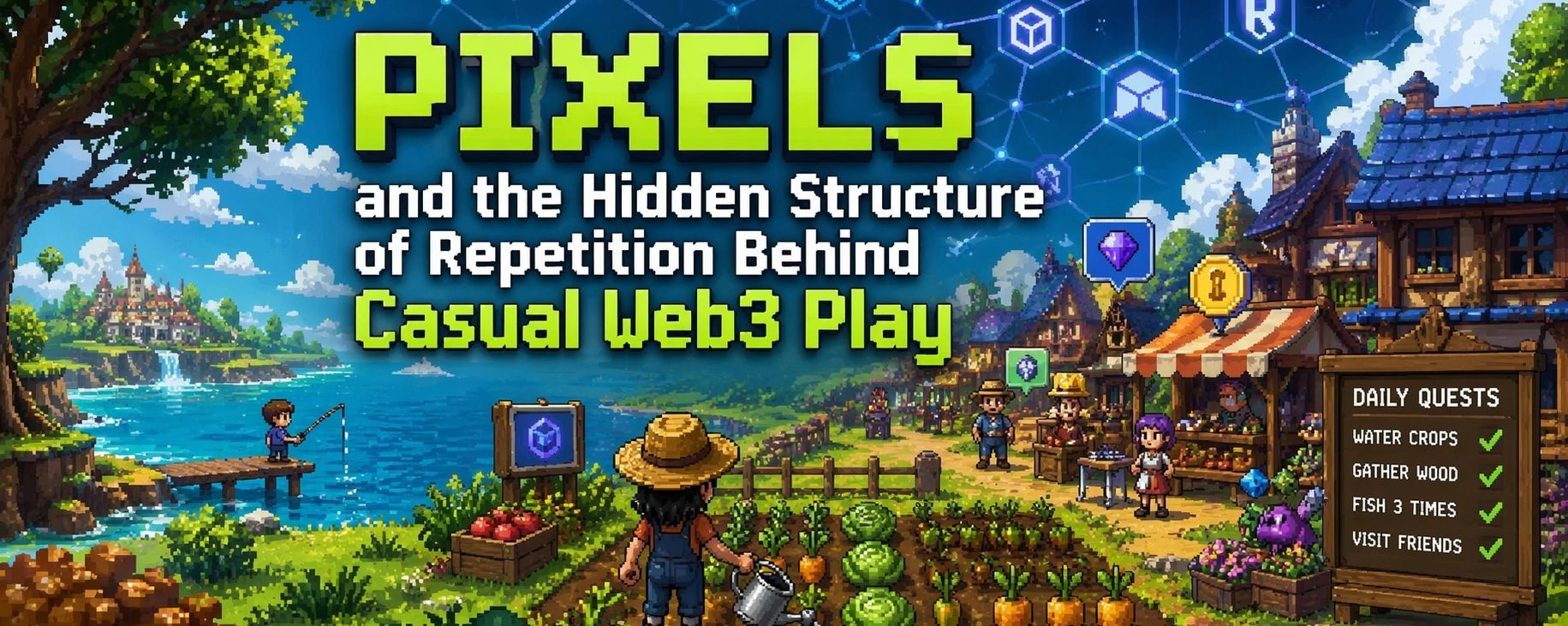

I’ve been thinking about Pixels for a while, and the more I think about it, the harder it becomes for me to see it as just a game. On the surface, it is easy enough to describe. Pixels is usually framed as a social casual Web3 game built around farming, exploration, and creation. That description is not wrong. But the more I sit with it, the more I feel that it leaves out the most important part. What keeps pulling me back is not the category it belongs to. It is the behavior it keeps making easy.
That is the part I cannot stop coming back to. The longer I watch Pixels, the less it feels like entertainment in the ordinary sense and the more it begins to feel like infrastructure. I do not mean infrastructure in the usual technical language people use when they talk about networks, throughput, or scalability. I mean infrastructure in a quieter sense. I mean a system that trains repetition. A system that gently teaches people to return, to act, to stay in motion, and to do it all without feeling much friction. And the more I watch that pattern, the more significant it starts to seem.
I think a lot of people still approach Pixels as a game first and an economy second. I understand why. The farming loops are visible. The resource gathering is visible. The social layer is visible. The casual progression is visible. But the more I think about it, the more I feel that this framing misses the deeper story. None of those pieces is especially new on its own. What feels important to me is the way they are arranged. Pixels does not really stand out because it invented some entirely new mechanic. It stands out because it makes repeated, low-friction participation feel normal.
That difference matters more than people sometimes admit. I keep coming back to the same thought: users behave differently when they stop feeling the weight of every action. Earlier blockchain products, especially games, often made every move feel heavy. The economic layer sat too close to the surface. People were not just playing; they were constantly aware that they were optimizing, extracting, measuring outcomes, and trying to stay one step ahead of the system. There was always a certain self-consciousness to it. Pixels, at least to my eye, handles that differently. It softens the feeling of financial activity by wrapping it inside familiar behavior. Farming comes first. Collecting comes first. Crafting comes first. Coordinating with other players comes first. The economy is there, obviously, but it does not keep interrupting the experience to announce itself.
And I think that is one of the smartest things about it. The more I observe digital systems, the more I feel that the strongest ones are often the ones that do not immediately feel like systems. They feel easy first. They feel natural first. They reduce resistance before they ask for commitment. That is how Pixels reads to me. It does not begin by demanding that the user understand complexity. It begins by making return feel simple. In a space where so many products still lose people early by confronting them with too much friction, that is not a minor design choice. It is a serious strategic advantage.
I have also been thinking about how much this depends on continuity. When activity becomes smooth enough, users stop treating each action as a separate decision. They begin to move almost rhythmically. And once a product reaches that point, it starts to matter in a different way. This is where I think Pixels becomes more interesting than its visual simplicity might suggest. It is not just creating engagement. It is creating habit. And habit, in digital markets, is not a decorative feature. It is often where long-term value starts to gather.
That is also why I think the environment around the game matters so much. When transactions are smoother and the underlying system allows repeated in-game activity without constantly breaking the user’s flow, behavior changes. Something that might have felt slow, costly, or mentally interruptive elsewhere begins to feel routine. I have come to think that routine is one of the most underrated forces in these markets. People often talk about innovation as if novelty alone is enough. I do not think that is true. Novelty attracts attention, but routine holds it. And over time, capital tends to settle not only around what excites people, but around what they keep returning to.
Another thing I keep thinking about is how Pixels seems to create a broader feeling of continuity around identity, assets, and progress. The experience does not feel like it is meant to live inside one isolated moment. It feels as though it wants participation to carry forward. Whether that larger vision is fully realized or still forming is almost secondary to the impression it creates. It encourages users to treat their presence inside the system as ongoing. Their time matters. Their effort matters. Their place inside the loop feels like it persists. And to me, that is one of the clearest signs that something is behaving like infrastructure. It becomes important not because one single moment inside it is extraordinary, but because more and more moments begin to depend on it.
At the same time, I do not think this should be read too romantically. In fact, the more I think about Pixels as infrastructure, the more seriously I think its economic discipline has to be judged. Repetition alone is not enough. A system can be very good at bringing users back and still fail if the underlying balance is weak. That is the risk with any loop that becomes powerful. The same repetition that creates strength can also create exhaustion if there is not enough utility, enough balance, and enough reason for users to remain beyond pure momentum. I keep returning to that point because I think it matters. A busy system is not automatically a durable one. Activity by itself does not prove sustainability.
So when I look at Pixels now, I do not really see a farming game in the narrow sense anymore. I see a system built around rhythm, reduced friction, and repeated participation. I see a product that understands something many Web3 projects still struggle to understand: people stay where behavior feels natural. That, to me, is where Pixels becomes genuinely interesting. It is not simply offering gameplay. It is shaping a pattern of return. And the more I think about that, the more I feel that the project deserves to be read with more seriousness than its soft, casual exterior might suggest.
If I had to put my own view into one clear line, it would be this: I think Pixels matters because it is quietly teaching users how to stay inside a loop without making that loop feel heavy. That is why I keep coming back to the word infrastructure. Not because it sounds impressive, but because it feels accurate. Entertainment can attract people. Infrastructure keeps them moving. And the more I watch Pixels, the more I feel that it is trying to become the second thing while still looking like the first.