
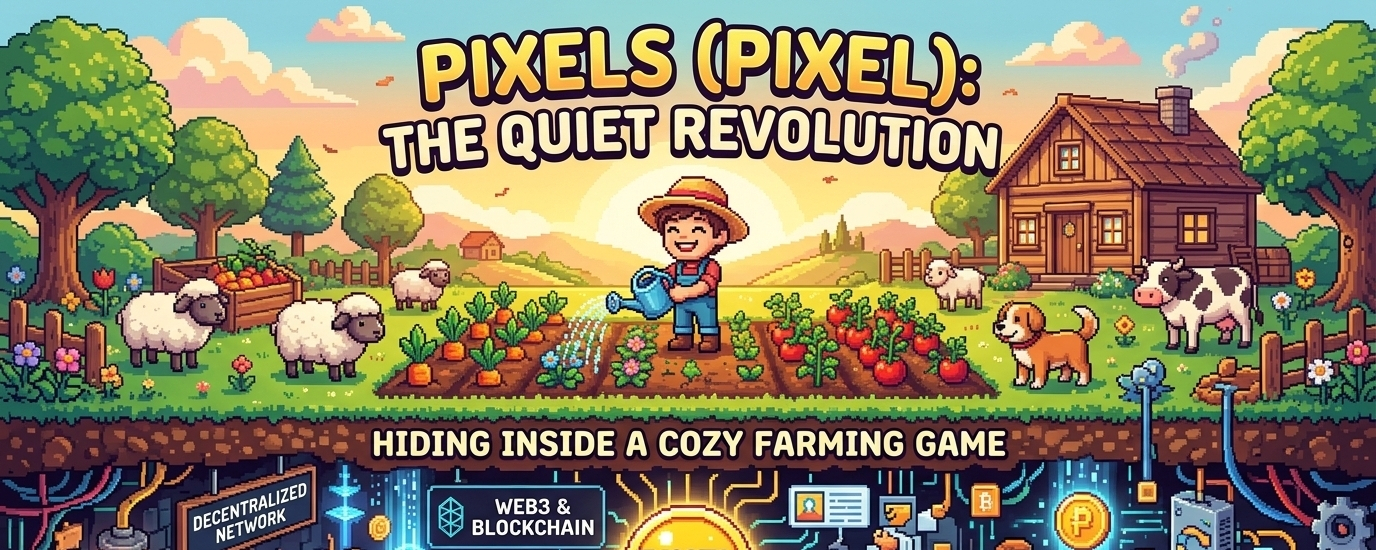
At first glance, Pixels looks like something you’d play to unwind after a long daya soft, pixel-art world where you plant crops, wander through forests, and chat with neighbors. It doesn’t scream “blockchain innovation.” It doesn’t try to impress you with jargon. And that’s exactly why it’s interesting
Because beneath its relaxed, almost nostalgic surface, Pixels is quietly experimenting with something much bigger: a player-owned economy that actually feels playable, not theoretical
Built on the Ronin Networkthe same ecosystem that powered the rise of Axie InfinityPixels is part of a second wave of Web3 games trying to fix what the first wave got wrong
And to understand why Pixels matters, you have to look beyond farming
A Game That Doesn’t Feel Like “A Web3 Game
Let’s be honestmost blockchain games have struggled with one core issue: they feel like financial tools disguised as games
You log in, grind tokens, check prices, and log out
Pixels flips that dynamic
You log in because you want to play
The world is alive in a way that feels closer to classic browser MMOs than crypto platforms. You’re not just chasing rewardsyou’re tending land, crafting items, trading with other players, and exploring a map that keeps expanding
There something oddly familiar about it. If you’ve ever spent hours in games like Stardew Valley or Harvest Moon, you’ll recognize the rhythm immediately: plant, wait, harvest, upgrade
But Pixels adds a twistwhat you earn and create can actually belong to you
The Economy: Where Things Get Interesting
The backbone of Pixels is its player-driven economy, powered by the PIXEL token
Unlike many Web3 projects where tokens feel disconnected from gameplay, PIXEL is woven into nearly every action
Crafting advanced tools
Upgrading land
Participating in events
Trading resources with other players
But here’s the subtle shift: the economy doesn’t dominate the experienceit supports it
You’re not constantly reminded of token prices. Instead, the economy emerges naturally from what players choose to do
For example
A player who focuses on farming might sell crops to others
A builder might specialize in crafting rare items
Explorers might gather resources from distant regions
It starts to resemble a real-world economy in miniaturemessy, dynamic, and driven by human behavior rather than rigid systems
Why Ronin Network Matters
Pixels didn’t land on the Ronin Network by accident
Ronin, developed by Sky Mavis, was built specifically for gaming. It solves two problems that have historically killed blockchain gameplay
High transaction fees
Slow confirmation times
In traditional blockchains, even a simple in-game action can feel like paperwork. Ronin strips that friction away, allowing interactions to feel almost instantand more importantly, invisible
That’s crucial for Pixels. If players had to think about blockchain every time they planted a crop, the illusion would break instantly
Instead, Ronin sits quietly in the background, doing its job while the game takes center stage
Land Ownership: Not Just a Buzzword
Web3 games love to talk about “ownership,” but Pixels makes it tangible
Players can own landreal in-game plots that they can develop, customize, and monetize. But ownership here isn’t just about bragging rights or flipping NFTs
It changes how you play
If you own land
You decide how it’s used
You can generate income through activity on it
You can collaborate with other players
Some players treat their land like businesses, optimizing production and trade routes. Others turn it into creative spacesgardens, social hubs, or experimental layouts
It’s less like owning an item and more like owning a piece of the world
The Social Layer: The Real Engine of Pixels
What truly separates Pixels from many Web3 projects isn’t the token or the techit’s the community behavior
The game encourages interaction in subtle ways
Shared markets
Resource dependencies
Events and competitions
Player-to-player tradig
You’re not isolated. You’re part of a living network
And something interesting happens when you combine social gameplay with real economic incentives: cooperation and competition both intensify
Players form informal alliances. Market trends emerge. Certain items become unexpectedly valuable because of player demandnot developer design
It’s unpredictable in the best way
Lessons Learned from Axie Infinity
It’s impossible to talk about Ronin without mentioning Axie Infinity. That game exploded in popularity, especially in countries like the Philippines, where people used it as a source of income
But it also exposed the weaknesses of early Web3 gaming
Over-reliance on token rewards
Unsustainable economic loops
Gameplay that felt secondary
Pixels feels like a response to those lessons
Instead of leading with “earn,” it leads with “play
The earning aspect is still therebut it’s not the hook. It’s the byproduct
That shift might sound small, but it’s fundamental. It’s the difference between a game people tolerate and a game people love
Accessibility: Why Pixels Is Growing Fast
Another reason Pixels is gaining traction is how easy it is to start.
You don’t need deep crypto knowledge. You don’t need expensive assets upfront. You don’t even need to think about wallets right away
You just… log in and play
That might not sound revolutionary, but in the Web3 space, it is
By lowering the barrier to entry, Pixels opens the door to players who would normally avoid blockchain games entirely
And once they’re inside, the Web3 elements reveal themselves graduallyalmost organically
The Psychology of Ownership and Effort
There’s something deeply human about investing effort into something you own
In traditional games, your progress exists within the boundaries of the platform. If the game shuts down, everything disappears
Pixels challenges that idea
When players know their assets have value beyond the game itself, their behavior changes
They plan more strategically
They invest more time
They engage more deeply
It creates a stronger emotional connectionnot just to the gamebut to the world they’re helping shape
Where Pixels Might Be Headed
Pixels is still evolving, and that’s part of its appeal
The developers continue to expand
New regions to explore
More complex crafting systems
Deeper economic mechanics
Enhanced social features
If it succeeds, it could become something bigger than a farming gamea kind of digital society where gameplay, economy, and community blend seamlessly
Not a “metaverse” in the buzzword sense, but something more grounded and playable
Final Thoughts: A Game That Understands Restraint
Pixels doesn’t try to overwhelm you with innovation. It doesn’t shout about being revolutionary
Instead, it does something far more effectiveit focuses on making a good game first
And in doing so, it quietly demonstrates what Web3 gaming could be
Not a grind for tokens
Not a speculative playground
But a living, breathing world where ownership, economy, and fun coexist
That restraint might be its greatest strength
Because if the future of gaming really does include blockchain, it probably won’t look like a financial dashboard
It’ll look more like Pixelssimple on the surface, but surprisingly deep once you step inside