
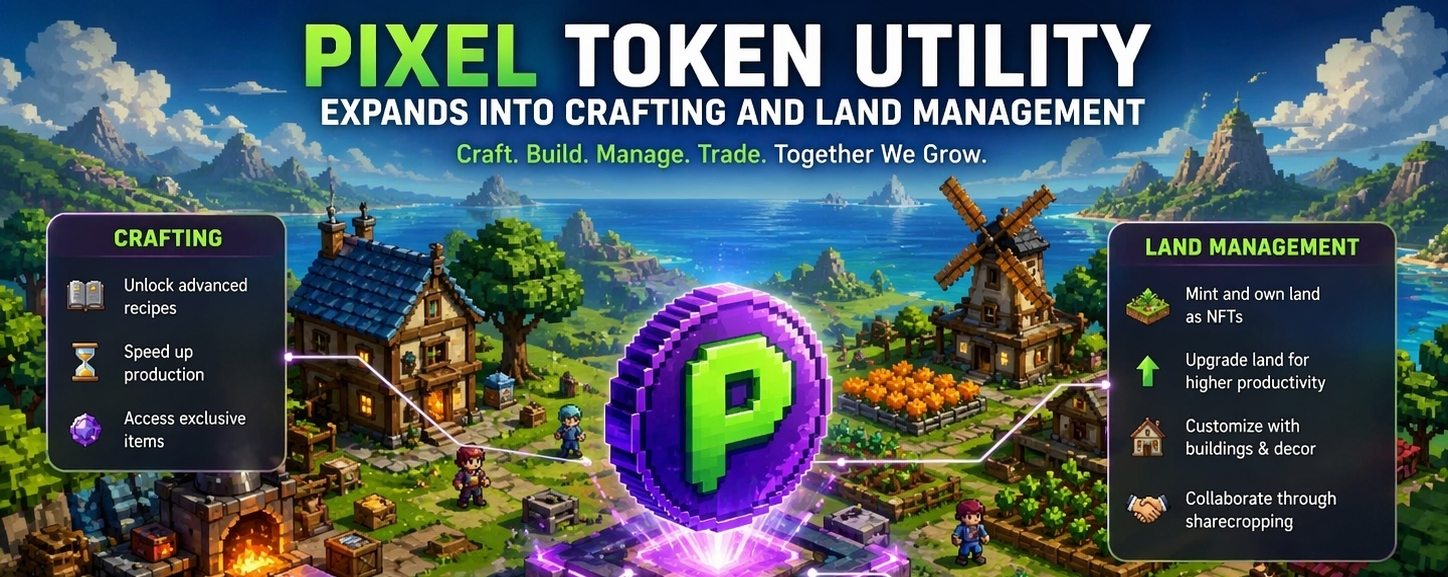
I see the expansion of PIXEL’s utility into crafting and land management as a clear signal that the Pixels ecosystem is trying to move beyond the typical “earn-first, utility-later” model that defined earlier GameFi projects. Instead of relying on inflated rewards to attract users, it feels like the design is pushing toward a system where the token actually matters because of how often I need to use it while playing. That shift might sound subtle, but I think it fundamentally changes how players interact with the economy.
When I look at crafting in Pixels, it doesn’t feel like a side mechanic—it feels like the backbone of the entire gameplay loop. I gather resources, process them, and eventually turn them into more valuable items. What stands out to me is how $PIXEL is woven into that process. It isn’t just a shortcut; it’s more like a lever. If I want to unlock better recipes, craft faster, or access higher-tier items, I end up using PIXEL. That creates a situation where I’m constantly making decisions: do I grind a bit longer, or do I spend tokens to move ahead? That tension between time and value is what gives the token real purpose.
I also notice that crafting creates a natural demand cycle. If I’m producing items, I need inputs. If others are crafting too, the demand for raw materials increases. That pushes more players into gathering and farming, which then feeds back into crafting again. PIXEL sits right in the middle of this loop. I don’t see it as just a currency—I see it as a catalyst that keeps the cycle moving. Without it, progression would still exist, but it would feel slower and less dynamic.
Land management, in my view, is where things get even more interesting. Owning land in Pixels isn’t just about status—it’s about productivity. When I think about managing land, I’m not just placing objects or decorating; I’m making decisions about efficiency, output, and long-term growth. PIXEL plays a big role here because I need it to upgrade my land, expand its capabilities, or even customize it. That means the more serious I am about optimizing my space, the more I rely on the token.
What I find particularly compelling is how land turns into a kind of economic engine. If I own a well-developed plot, I can generate resources, collaborate with other players, or even create opportunities for shared production. In that sense, PIXEL becomes part of a broader coordination system. I’m not just spending it for myself—I’m using it to interact with others, to build something larger than a single player experience. That social layer adds depth, and I think it’s one of the reasons the ecosystem feels more alive compared to more isolated GameFi models.
Another thing I’ve been thinking about is how PIXEL connects to time. In many games, time is the main limiting factor. I have to wait for crops to grow, items to craft, or buildings to finish. Here, PIXEL lets me influence that timeline. If I want to speed things up, I can. But it’s not always an obvious choice. Sometimes I’d rather save my tokens and wait, especially if I’m planning a bigger upgrade later. That constant trade-off keeps me engaged because I’m always weighing my options.
I also see a psychological angle to this. When I spend PIXEL to accelerate something, it feels like I’m investing in my own progress rather than just paying to skip content. That distinction matters. If it feels like I’m skipping the game, I lose interest. But if it feels like I’m optimizing my strategy, I stay involved. The way PIXEL is integrated seems to lean toward the latter, which I think is a smarter approach.
Customization is another area where I think PIXEL quietly adds value. On the surface, cosmetic items might seem less important, but in a multiplayer environment, they carry social weight. When I customize my land or avatar, I’m expressing identity. That can influence how others perceive me, especially in a shared world. PIXEL becomes the tool that enables that expression. It’s not essential for gameplay, but it enhances the experience in a way that keeps players invested over time.
From an economic perspective, I think the balance between token inflow and outflow is critical. PIXEL is distributed through gameplay, but it’s also constantly being spent on crafting, upgrades, and land development. That creates a kind of equilibrium. If players are active, tokens circulate. If they stop engaging, the system slows down. To me, that suggests the token’s value is closely tied to player activity rather than external hype. It’s a risky approach, but it’s also more sustainable if the game can maintain its user base.
I’ve also noticed that PIXEL’s role encourages long-term thinking. If I’m planning to expand my land or unlock advanced crafting options, I need to manage my tokens carefully. I can’t just spend them impulsively. That introduces a layer of strategy that goes beyond moment-to-moment gameplay. I’m thinking about future returns, potential upgrades, and how my decisions today will affect my progress later. It starts to feel less like a casual game and more like managing a small digital economy.
At the same time, I don’t think the system is perfect. The reliance on token utility means that if the gameplay loop becomes repetitive or loses appeal, the demand for PIXEL could drop. Everything is interconnected, so the strength of the token depends heavily on the strength of the game itself. That’s both a strength and a vulnerability. It forces the developers to keep improving the experience, but it also means there’s less room for error.
Overall, I see the expansion of PIXEL into crafting and land management as a meaningful step toward a more integrated GameFi model. It’s not just about earning tokens anymore—it’s about using them in ways that feel natural within the game. When I craft, manage land, or interact with other players, PIXEL is there as a tool that enhances what I’m already doing. That’s what makes it feel relevant.
If the ecosystem continues to evolve—adding more features, deepening social interactions, and refining economic balance—I think PIXEL could become a strong example of how utility-driven tokens should work. But it all comes back to engagement. If players like me keep finding reasons to craft, build, and collaborate, then the token will keep its value. If not, no amount of design will be enough to sustain it.