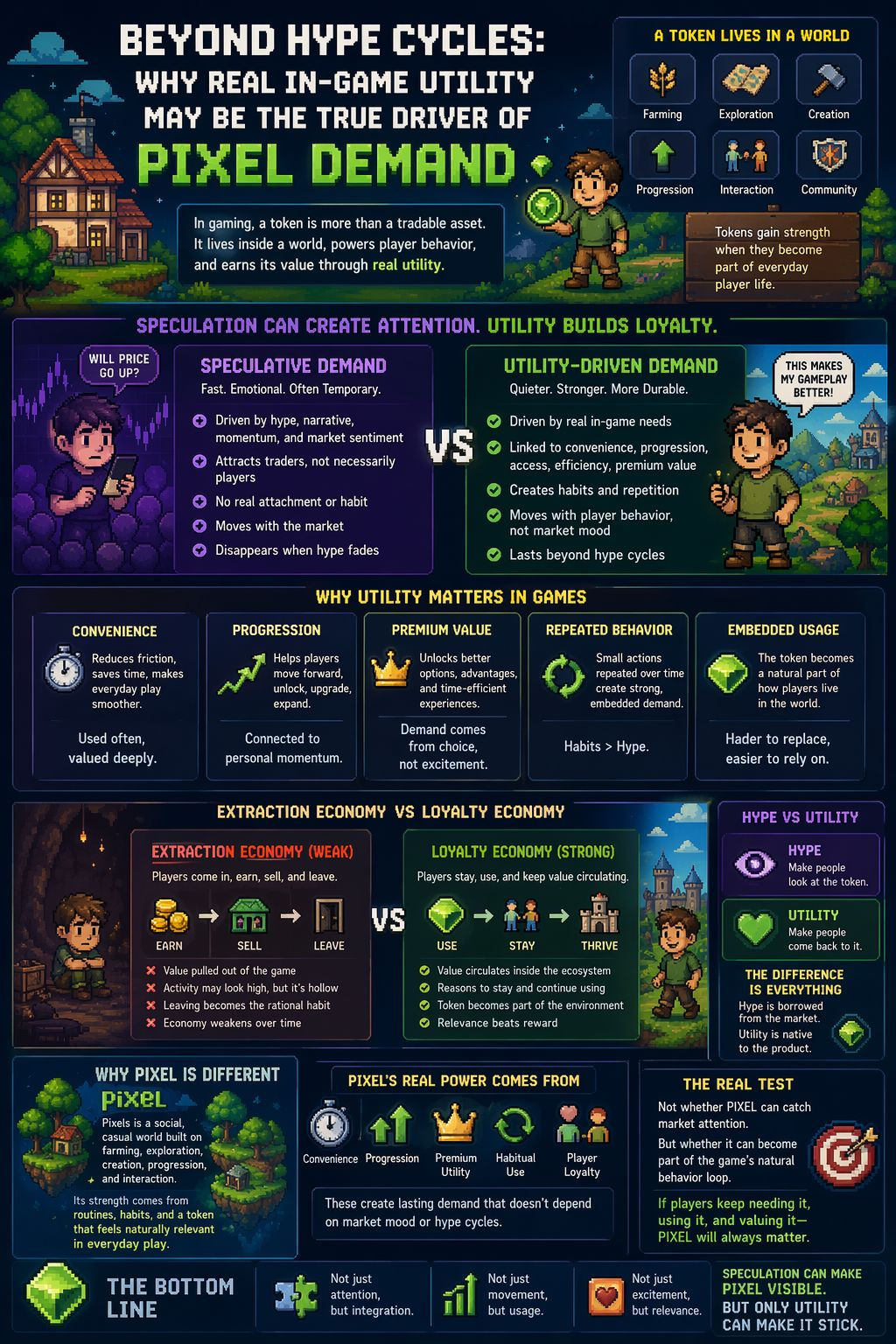
In crypto, people usually talk about tokens the same way they talk about everything else in the market: price, hype, momentum, listings, sentiment, upside.
That works for many assets.
But gaming tokens are different.
Or at least, they should be.
A gaming token is not just something people buy and sell on an exchange. It also lives inside a world. It exists inside routines, player behavior, progression loops, friction points, and small decisions made over and over again. That means its real demand cannot be understood through speculation alone. You have to look at how people actually use it.
That is what makes PIXEL interesting.
If you only look at it like a normal crypto asset, then the story becomes very shallow very quickly. You start asking the usual questions. Is attention rising? Is volume strong? Is the narrative back? Are people bullish again?
But those are not the most important questions.
The better question is much simpler: why would players keep needing PIXEL in the first place?
That is where the real conversation begins.
Speculation can absolutely bring energy to a token. It can create movement, attract attention, and turn a project into a market conversation. In crypto, that matters. Visibility has value. Momentum has value. Narrative has value.
But speculation is not loyalty.
It is not attachment. It is not habit. And it is definitely not the same thing as utility.
Speculative demand is fast, emotional, and often temporary. It appears when people believe a token is about to matter more tomorrow than it does today. That belief can drive price. It can drive content. It can pull in traders who have no relationship with the actual product at all.
But utility-driven demand works differently.
Utility is quieter. It does not always look exciting from the outside. It does not depend on constant storytelling. It grows when a token becomes genuinely useful inside the product itself. When people want it not because they are chasing a chart, but because it helps them do something better, faster, easier, or more often.
That distinction matters a lot in gaming.
Because in games, demand is not just created by belief. It is created by behavior.
A token becomes strong when it is tied to things players actually care about. Progression. Convenience. Access. Efficiency. Premium advantages. Time saved. Better positioning inside the game. Smoother play. Stronger participation in the economy.
That kind of demand is much harder to fake.
And more importantly, it is much harder to replace.
This is why gaming tokens should never be judged only through the lens of market speculation. If the token’s role inside the game is weak, then the market narrative may still carry it for a while, but only for a while. Eventually people notice the difference between a token that is being talked about and a token that is being used.
That is the core tension around PIXEL.
The long-term strength of PIXEL does not come from whether people can create short bursts of excitement around it. It comes from whether Pixels can make the token feel naturally relevant inside the everyday life of the game.
And that is a much more serious test.
Pixels is not built around a one-time thrill. It is a social, casual world. Farming, exploration, creation, progression, interaction. The nature of the game itself matters here, because it means value is not only created through moments of excitement. It is also created through repetition. Through routines. Through habits that become part of how players move through the world.
That is where utility becomes powerful.
In a game like this, convenience is not a minor feature. Convenience can become a source of real demand. If a token helps reduce friction, speed things up, unlock better options, or make everyday play smoother, that utility can be much more meaningful than people realize. Not because it sounds impressive on paper, but because people repeat that behavior constantly.
And repeated behavior is what gives a token weight.
The market often underestimates this because it prefers dramatic stories. Big announcements are easier to talk about than small habits. Narrative is easier to market than convenience. Hype is easier to measure than embedded usage.
But embedded usage is what lasts.
A player who buys PIXEL because they think the chart looks good is participating in speculative demand. A player who keeps using PIXEL because it improves their in-game experience is participating in something much more durable.
The first person is reacting to the market.
The second person is responding to the product.
That difference is everything.
The same applies to progression. In gaming, progression is one of the strongest behavioral anchors there is. People do not just play to receive rewards. They play because they want to move forward. They want their time to mean something. They want to unlock, improve, upgrade, expand, or gain an advantage that feels earned.
If a token becomes part of that loop, it starts to matter in a deeper way.
It becomes connected to momentum inside the player experience.
Not abstract momentum. Personal momentum.
And personal momentum is powerful because players feel it directly. It is not just a theory about future value. It is something they experience every time they play. Every improvement, every convenience, every premium edge reinforces the token’s relevance.
That is how demand becomes embedded.
This is also why premium utility should not be dismissed so easily in crypto gaming conversations. People often act as if only purely financial utility counts, while everything else is secondary. But that is not how games work. In games, premium utility can be extremely strong if it maps to what players genuinely want.
If people are willing to spend because something feels useful, desirable, or time-efficient, then that is real demand. Not artificial demand. Not narrative demand. Real demand.
And in many cases, that kind of demand is more valuable than hype because it comes from choice, not excitement.
Hype can make people look at a token.
Utility can make them come back to it.
That is a much harder thing to build.
At the heart of this conversation is a deeper divide that many Web3 games still struggle with: extraction versus loyalty.
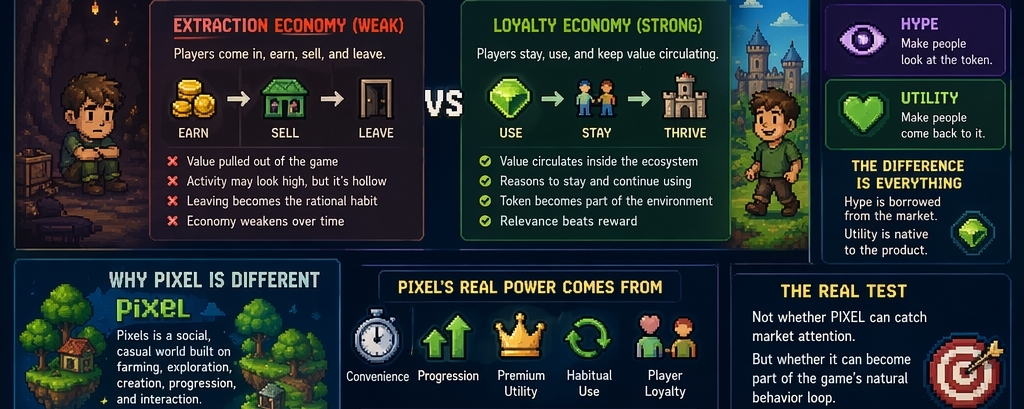
A weak token economy encourages extraction. Players come in, earn, sell, and move on. Activity may look high for a period of time, but it is hollow. The token becomes something people pull value out of, not something that keeps value circulating inside the game. In that kind of system, the smartest behavior is often to leave.
And once leaving becomes the rational habit, the economy starts to weaken no matter how much activity it appears to have on the surface.
A stronger token economy does the opposite. It creates reasons to stay. It makes players feel that using the token inside the ecosystem is not a sacrifice, but a sensible choice. That shift is crucial. It means the token is no longer just a reward object. It becomes part of the environment itself.
That is where relevance starts to beat reward.
Reward can attract users, but relevance is what gives a token staying power.
This is why I think PIXEL should be judged less as a standalone crypto asset and more as an economic instrument inside a living game world. The question is not simply whether it can catch market attention. The question is whether it can become part of the game’s natural behavior loop strongly enough that players continue to need it, use it, and value it even when the hype cycle cools down.
That is the real threshold.
Because if demand is mostly speculative, then PIXEL rises and falls with narrative energy. But if demand is tied to convenience, progression, premium value, and habitual in-game use, then the token has something much stronger beneath it. It has a reason to matter that does not depend entirely on market mood.
And that is what sustainable token design should aim for.
Not just attention, but integration.
Not just movement, but usage.
Not just excitement, but relevance.
The strongest gaming tokens are not the ones that generate the loudest noise. They are the ones that quietly become part of how players live inside the game. They become normal. Necessary. Embedded. And once that happens, demand stops feeling borrowed from the market and starts feeling native to the product.
That is the real difference between speculation and utility.
Speculation can make PIXEL visible.
But only utility can make it stick.
And in the long run, sticky demand is the only kind that really matters.