
Look, I’ve seen this movie before.
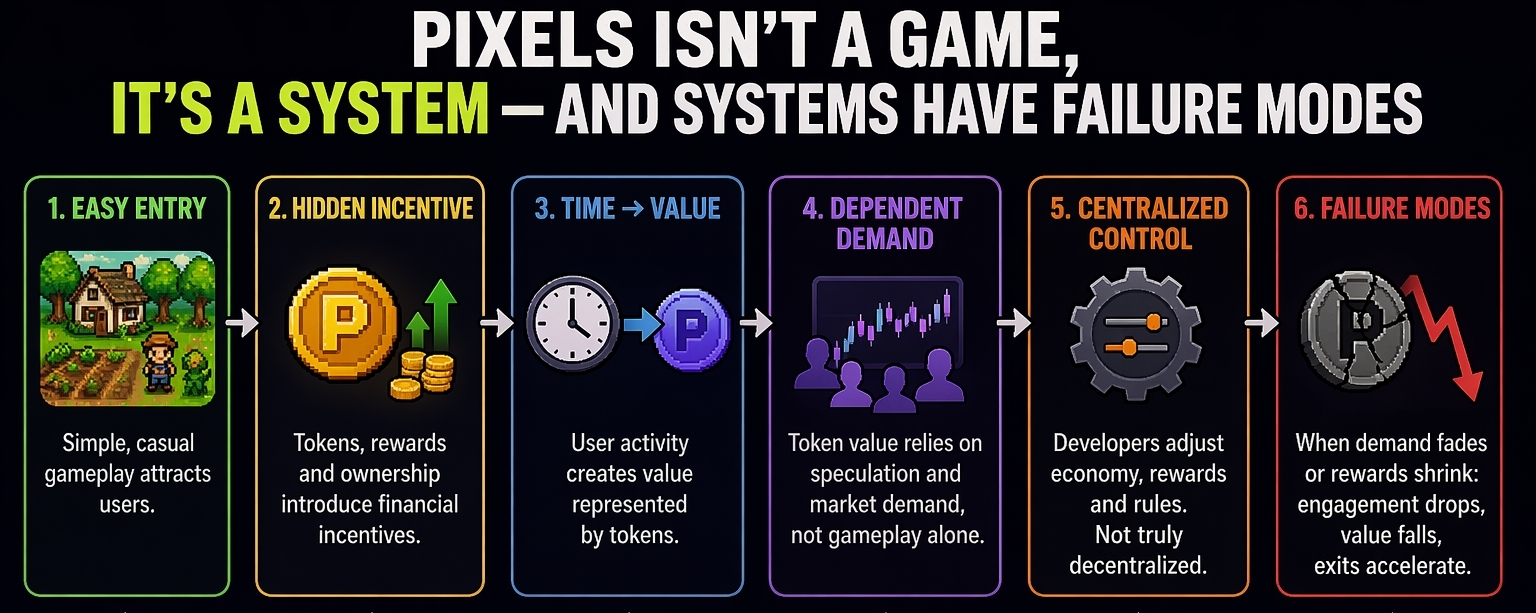
A simple game shows up. Friendly visuals. Low barrier to entry. Nothing intimidating. Then you notice the fine print. There’s a token. There’s an economy. There’s “ownership.” And suddenly, what looked like a farming simulator starts behaving like a financial experiment.
That’s exactly what’s happening with Pixels.
On the surface, it’s harmless. You plant crops. You gather resources. You wander around a colorful world that doesn’t ask much from you. It feels casual. That’s intentional. Because the moment it stops feeling casual, the whole pitch gets harder to sell.
Now, the core problem they claim to fix is actually real. Early play-to-earn games collapsed because they were too obvious about what they were doing. They paid users to show up. Users showed up for the money. When the money dried up, so did the users. End of story.
Pixels is trying to smooth that out. Make it feel less transactional. Less like a job. More like a habit.
Sounds reasonable. On paper.
But let’s be honest. They haven’t removed the incentive problem. They’ve just softened it.
Instead of shouting “earn money,” they whisper it. Instead of forcing you to invest upfront, they ease you in. Play a little. Earn a little. Stick around. Then maybe you start caring about the token. Maybe you start optimizing. Maybe you start treating it less like a game and more like… something else.
That’s not a fix. That’s a slower on-ramp to the same destination.
And the destination is still an economy that depends on people believing their time inside the system has external value.
Here’s where it gets messy.
The whole thing runs on the Ronin Network, which already has a track record. Not theory. History. Booms. Busts. Big inflows of users chasing rewards, followed by equally fast exits when the math stopped working.
So when Pixels says it’s different, what they really mean is they’ve adjusted the pacing. Not the structure.
The structure is still this: users generate value through activity, that value is represented by a token, and that token needs demand from somewhere. If demand holds, things look stable. If it doesn’t, everything starts to wobble.
And here’s the part people tend to ignore. Demand doesn’t come from gameplay alone. It comes from speculation. From traders. From people who may never touch the game but still influence the price of its token.
So now you’ve got a farming game whose internal health is tied to external market sentiment. Think about that for a second.
It sounds clever. It isn’t.
It’s fragile.
Then there’s the question nobody in the marketing material wants to dwell on. Who actually makes money here?
Early participants. Always.
People who get in when rewards are high and competition is low. They accumulate assets, tokens, land, whatever the system defines as valuable. Later users arrive to a more crowded environment, with thinner rewards and higher expectations. That’s not unique to Pixels. That’s how these systems tend to evolve.
So the pitch becomes: come play, earn, grow.
The reality often looks more like: come in, work, and hope you’re not late.
Now let’s talk about decentralization, because that word gets thrown around a lot.
Yes, assets are on-chain. Yes, ownership is recorded. But control? That’s a different story.
The developers still tune the economy. They adjust reward rates. They introduce new mechanics. They decide what gets scarce and what gets diluted. If something breaks, they intervene. If engagement drops, they tweak incentives.
That’s not a decentralized system in any meaningful sense. That’s a managed economy with blockchain rails underneath it.
And when it breaks—and systems like this always hit stress points—the blockchain doesn’t fix the problem. It just records it.
Then comes the human side of this.
What happens when rewards shrink?
Because they will. They always do.
Do players stay because they love the farming mechanics? Maybe some do. But most people drawn into these systems aren’t here for digital carrots. They’re here because those carrots convert into something else.
Take that conversion away, or weaken it enough, and behavior changes fast. Engagement drops. Liquidity thins. The exit door gets crowded.
I’ve watched it happen more than once.
Pixels is clearly trying to learn from those past failures. Lower the entry cost. Spread participation wider. Avoid the obvious boom-and-bust optics. It’s smarter than the first wave. No question.
But smarter doesn’t mean immune.
At its core, it’s still trying to balance two things that don’t sit comfortably together: a game that should be fun on its own, and an economy that needs to sustain financial expectations.
That tension doesn’t go away. It just hides better.
And when it surfaces, it usually does so all at once.
