
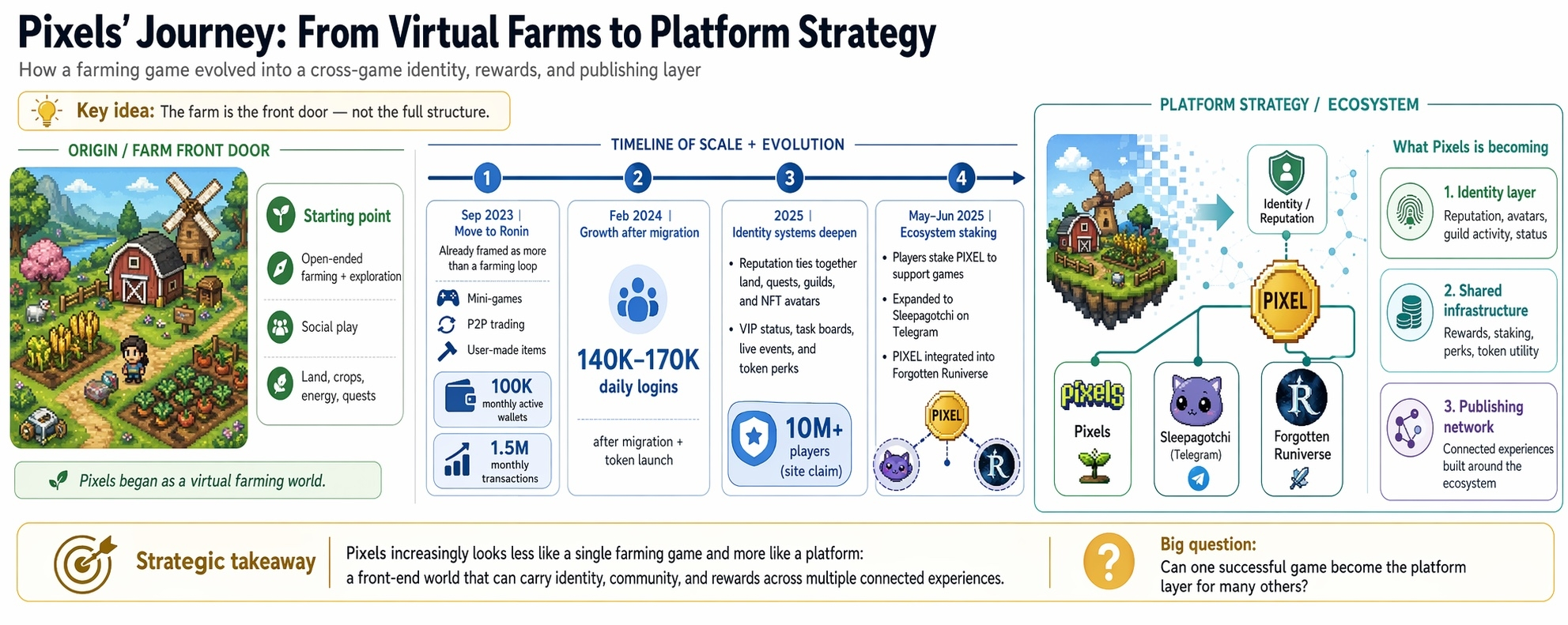
I keep coming back to the idea that Pixels makes more sense when I stop thinking of it as only a farming game and start seeing it as something larger that has been taking shape in plain view. My first instinct was to place it beside other cozy virtual worlds with familiar loops and a gentle social feel. The more I look at what the team has been building and how it describes its own direction though, the less that older frame seems to hold.
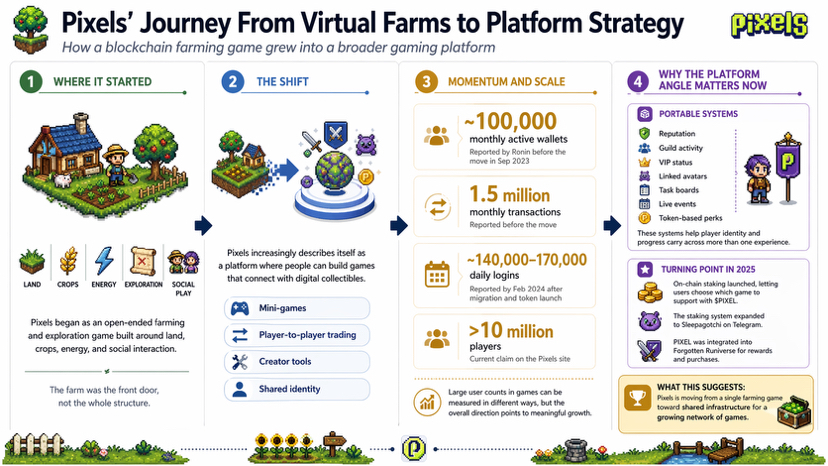
Pixels still presents itself as an open-ended farming and exploration game, but its broader description points toward a platform where people can build games that connect with digital collectibles in a native way. That shift changes the real question. What matters now is not only whether a crypto farming game can keep people engaged over time. It is whether a game that began with land, crops, energy, and social play can grow into a publishing and identity layer for other experiences that sit around it and build on what it already created.
I find it helpful to think of the farm as the front door rather than the full structure. Even back in 2023 when Ronin announced Pixels’ move from Polygon, the project was already being described as more than a simple cycle of planting and harvesting. Ronin pointed to mini-games, player-to-player trading, and tools that let users make their own items without deep technical skill. That matters because it suggests the broader ambition was not added later as a rescue plan or a marketing adjustment. It looks more like an idea that was present early on and became easier to recognize as the project grew.
What gave that ambition some weight was scale. Ronin’s numbers from September 2023 suggested Pixels already had real momentum, with about 100,000 monthly active wallets and 1.5 million monthly transactions before the move. By February 2024, it said daily logins had grown to around 140,000 to 170,000 after the migration and token launch. The Pixels site now says the game has attracted more than 10 million players. I would still treat the largest numbers with some caution because game projects often present user counts in ways that sound neater than they really are, but even with that caution the direction is hard to miss. Pixels had grown enough that staying only one game was starting to look less like focus and more like a ceiling.
I used to think platform strategy in games mostly belonged to app stores, engines, or very large publishers. Pixels makes the idea feel smaller and more specific. Inside the game much of the design work over the last year seems aimed at creating systems that can carry identity and status from one place to another. Reputation, guild activity, VIP status, linked avatars, task boards, live events, and token-based perks all point in that direction. These are not just features that fill out a game world. They are the kinds of structures you build when you expect progress and belonging to matter across more than one experience. Pixels’ own help pages say reputation is connected to land ownership, quests, guild activity, and integrated NFT avatars, and that these advantages will matter more as more games and experiences are introduced.
That is why 2025 feels like a real turning point instead of just another season of content updates. In May 2025 Pixels launched on-chain staking that lets users decide which game to support with $PIXEL. Not long after that the staking system expanded to Sleepagotchi on Telegram while PIXEL was also being integrated into Forgotten Runiverse for rewards and purchases. Once that starts happening the token no longer sits only inside one farming world as a reward mechanism. It begins to act more like shared infrastructure that links several games into a small but connected network.
To me that is the deeper reason this topic is getting more attention now than it would have five years ago. Back then most blockchain game discussion kept circling the same basic issues around speculation and ownership and whether either one meant much if the game itself felt thin. The pressure today is different and in some ways more practical. Projects have to show that the game works as a game, that the economy is not only extracting value, and that players have a reason to remain once the first wave of curiosity fades.
Pixels seems to be responding to that pressure by turning progression, rewards, and community identity into parts that can be reused rather than locked inside one setting. Ronin has also been moving in a related direction by presenting itself less as a chain focused only on gaming and more as a broader network meant to support builders. In that context Pixels’ movement from virtual farm to platform strategy feels less like a sudden pivot and more like the point of the whole experiment finally coming into view.
