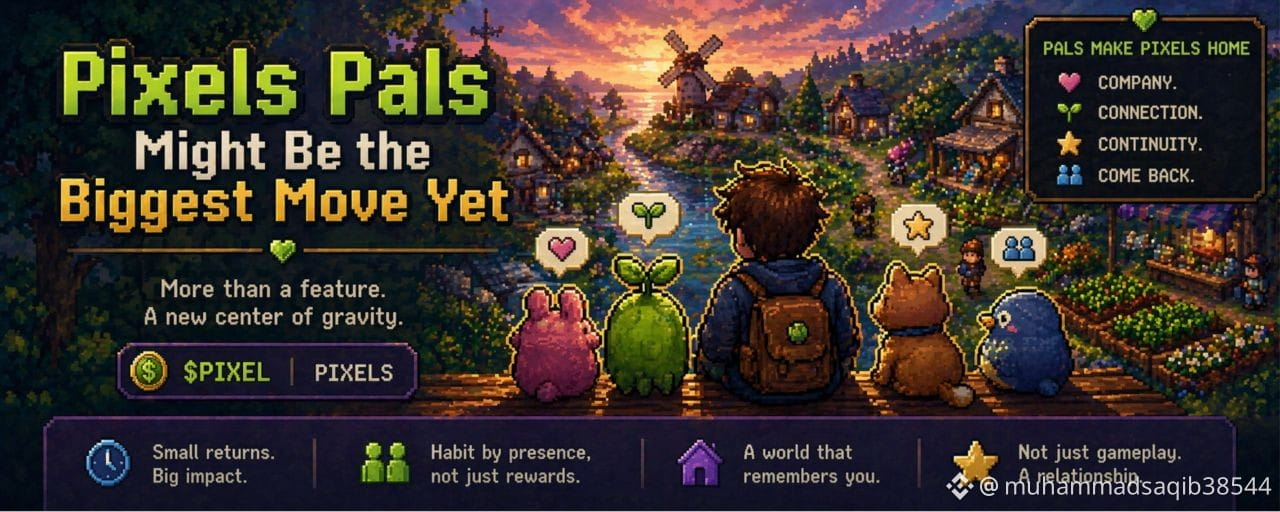
#pixel I keep coming back to a strange feeling with @Pixels .
At first, it looked simple. A lively game. A familiar loop. Small actions, steady movement, a world that feels designed to keep you inside it for a little longer than you planned. And lately, that feeling has started to shift. Not in a dramatic way. More like something underneath the surface has changed shape.
That is usually how it happens.
You do not always notice the moment a product stops feeling like a product and starts feeling like a direction.
With Pixels, the signal that keeps lingering in my head is Pixels Pals. On the surface, it sounds like one more feature. One more layer. One more thing to make the experience feel warmer, more alive, more social. But the more I sit with it, the more it feels like something else entirely.
Maybe it is not just an addition.
Maybe it is the clearest sign yet of where the whole experience is trying to go.
Because Pixels Pals does not feel like a random upgrade. It feels like a decision about what kind of world Pixels wants to be. And that matters. A lot more than it first appears to.
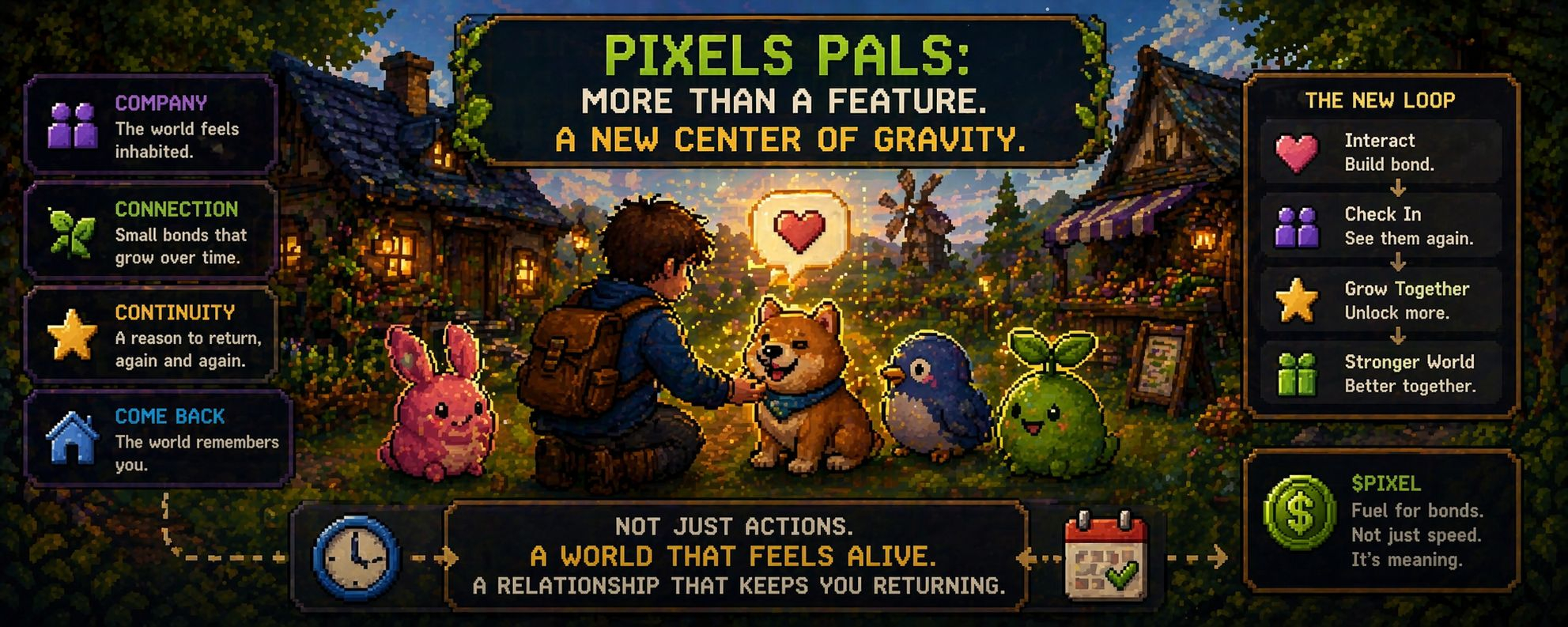
Games can be built around mechanics. Or they can be built around presence.
That difference sounds small, but it is not.
A mechanic gives you something to do. Presence gives you something to return to.
And that is where Pixels Pals starts to feel quietly important. Not because it is flashy. Not because it screams “big feature.” It feels important because it changes the emotional structure of the game. It adds company. It adds a sense that the world is not just active, but inhabited.
That is a different kind of product decision.
A mobile game can be fine on the strength of its loop alone. Tap, gather, craft, repeat. But a mobile game that actually lasts usually needs something softer underneath. Something that makes the player feel attached instead of merely engaged. Something that turns routine into relationship. I think Pixels Pals may be moving Pixels closer to that kind of design.
And once you see that, the whole thing starts to widen.
Because now the question is not just whether Pixels Pals is useful.
It is whether it is forming a new center of gravity.
Maybe that is the real move.
Not a feature. A center.
A mobile game lives or dies by repeat contact. That much is obvious. But repeat contact is not always built through rewards alone. Sometimes it is built through identity. Through familiarity. Through the feeling that the world remembers you. That something in it responds when you come back.
Pixels has always seemed interested in that deeper layer, even when the surface still looked like a standard game economy. But Pixels Pals feels like a more direct step toward it. Less abstract. More personal. More sticky in a way that is hard to measure cleanly, yet easy to feel.
And maybe that is why it matters.
Because if Pixels is becoming more mobile-game-like, then Pixels Pals may be the part that makes the transition work. Not just the gameplay. Not just the accessibility. The emotional glue.
That is the part people sometimes miss.
A team can add mobile-friendly mechanics and still not really become a mobile-first product. The real shift happens when the design starts to favor small returns, soft attachment, and frequent re-entry. When the world becomes something you check on rather than something you only visit.
Pixels Pals feels like it could sit right inside that shift.
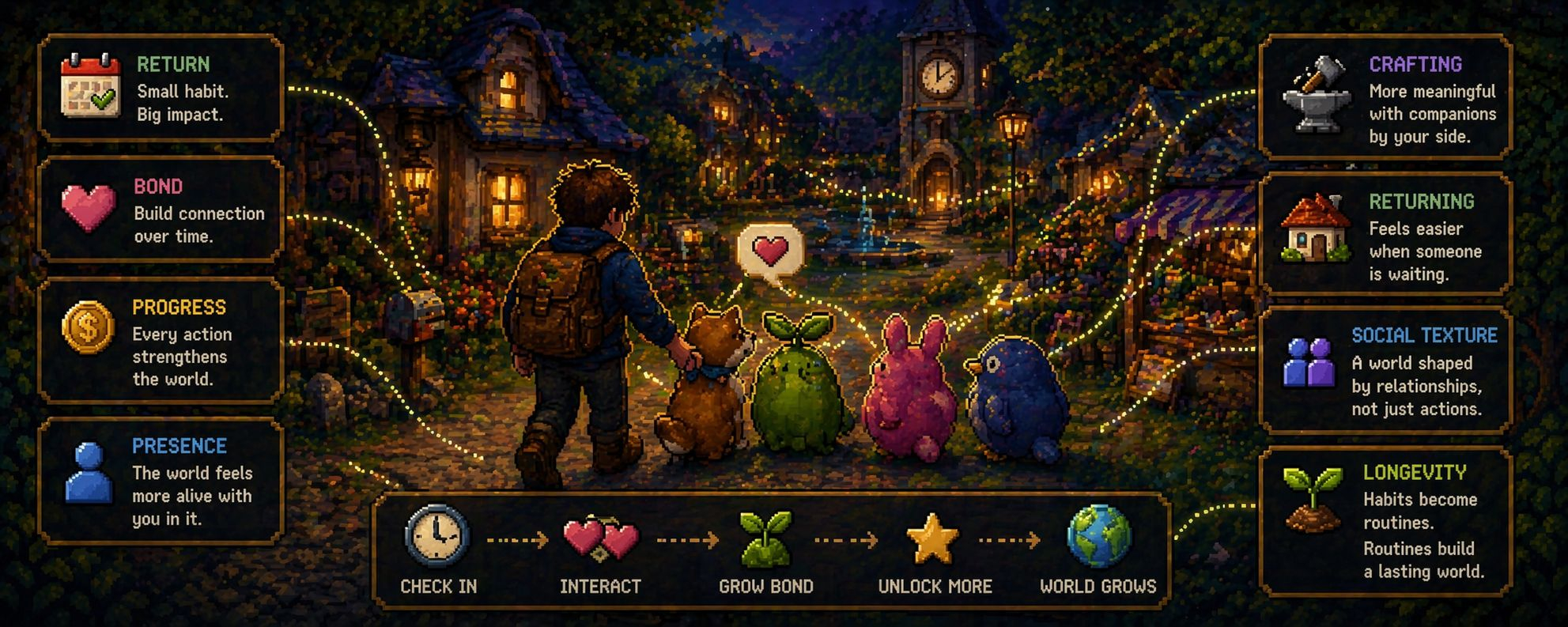
It is not hard to imagine the second-order effect here. Players do not just interact more. They begin to form habits around presence. Around checking in. Around maintaining a bond with the world, however small that bond is at first. And once that habit exists, the rest of the ecosystem gets pulled along with it.
Crafting feels more meaningful. Returning feels easier. The game stops being only a set of actions and starts becoming a place with social texture.
That is a quiet but serious change.
And it may also say something broader about the team’s thinking.
Maybe they are not only building features anymore. Maybe they are building continuity.
That feels like a more consequential direction than it first appears. Because continuity changes everything. It changes how often people come back. It changes how long the world stays alive in someone’s mind. It changes whether the product feels like a session or a routine.
Pixels Pals, in that sense, may not just be a cute layer on top of the game.
It may be a structural bet.
A bet that people stay longer when the game feels lived in. A bet that mobile-native behavior is not only about convenience, but about emotional repetition. A bet that the future of Pixels is not just more gameplay, but more attachment.
I am not sure that is exactly what is happening. But I keep circling it.
Because once you start looking at Pixels through that lens, the product decision feels bigger. Almost more strategic than it first seemed. Less about adding content. More about shaping behavior. Less about novelty. More about the kind of presence the game wants to create.
And maybe that is why Pixels Pals feels consequential.
Not because it is loud.
Because it is quietly changing the terms of the relationship.
That is usually where the most important product decisions live. Not in the thing everyone points at first. In the layer underneath. In the part that slowly teaches people how to stay.
With Pixels, I keep thinking that Pixels Pals may be one of those moves.
Not the final answer.
Just the beginning of a very different kind of game. $PIXEL