
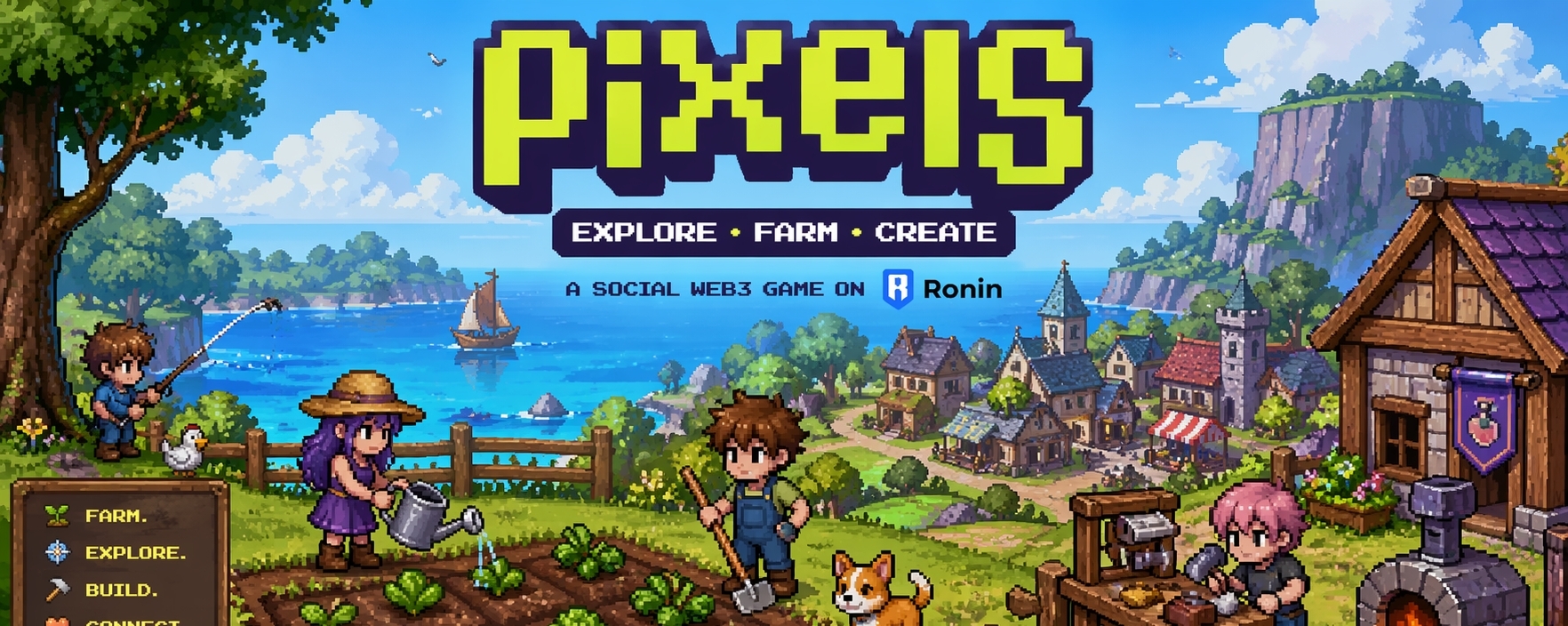
Pixels is something I’ve been watching for a while now, not because it’s the loudest project out there, but because it’s trying to do something that looks simple… and simple things tend to be harder than they seem. It’s positioned as a social Web3 game on Ronin, built around farming, exploration, and creation. Nothing too complex on the surface. Nothing that tries to overwhelm you. And maybe that’s exactly why I keep coming back to it, trying to figure out if there’s something real underneath or if it just feels calm because the space around it is so chaotic.
I’ve been noticing how Pixels doesn’t immediately push the usual pressure you see in most Web3 games. There’s no aggressive need to “optimize” everything from the first minute. It feels slower. More casual. Almost like it wants you to settle in rather than rush through it. But I can’t tell yet if that’s a strength or just a phase. Because in this space, a lot of things feel comfortable early on… until they don’t.
I keep thinking about how most Web3 games start strong. They bring in users, attention builds, the token gets activity, and for a while everything looks alive. But then something shifts. The routine becomes repetitive in a bad way, not a good one. The economy starts pulling players in directions that don’t feel natural. And slowly, without any big moment, people just stop showing up. Not all at once… just gradually. That’s usually how things break here. Quietly.
So when I look at Pixels, I’m not just looking at what it is today. I’m thinking about what happens when the initial curiosity fades. When logging in stops feeling new. When farming becomes routine instead of discovery. That’s the real test. Because a good game loop doesn’t just exist — it holds you without needing constant rewards to keep you there.
There’s something slightly different in how Pixels approaches this, though. It leans into familiarity. Farming, building, interacting — these are things people already understand. It doesn’t try to reinvent behavior. It tries to fit into it. And I think that matters. Because most projects in this space try to force new habits instead of working with existing ones. But again… I’m not sure if that’s enough.
The market around it makes things even more uncertain. Everything is driven by attention cycles. Fast narratives. Quick rotations. People jump in, extract value, and move on. In that kind of environment, a game that depends on consistency feels almost out of sync. And I keep wondering… can something slow actually survive in a fast market? Or does it eventually get ignored, no matter how solid it is?
I also can’t ignore how much of Web3 gaming still depends on incentives. Even when a game feels natural, there’s always that layer underneath — tokens, rewards, economies. And those systems don’t always behave the way they’re supposed to. Sometimes they push players to act differently than the game intends. Sometimes they turn a relaxing loop into something transactional. And once that happens, the whole experience starts to shift.
That’s another thing I’m watching closely with Pixels. Does it stay a game first… or does the economy slowly take over? Because I’ve seen that shift happen before, and it changes everything. What starts as something enjoyable turns into something calculated. People stop playing… and start extracting.
At the same time, I don’t want to dismiss what Pixels is building. There is something real in trying to create a space where people just exist, interact, and return without pressure. That’s not easy, especially here. And even if it doesn’t fully succeed, the attempt itself says something about where this space might be heading — or where it should be heading.
But I keep circling back to the same quiet question… what happens when fewer people are watching? When the numbers stabilize. When growth slows. When it’s no longer new. That’s where the real version of any project shows up. Not in the peak, but in the plateau.
So I’m still here, still watching Pixels, not trying to rush to a conclusion. It’s not clearly overhyped, but it’s not proven either. It sits somewhere in between, where things can go either way. And maybe that’s why it’s interesting. Because right now, it’s not about what Pixels says it is… it’s about what it becomes when time does its usual work.
And time, more than anything else in this space, has a way of revealing what actually holds up… and what was just passing through.