
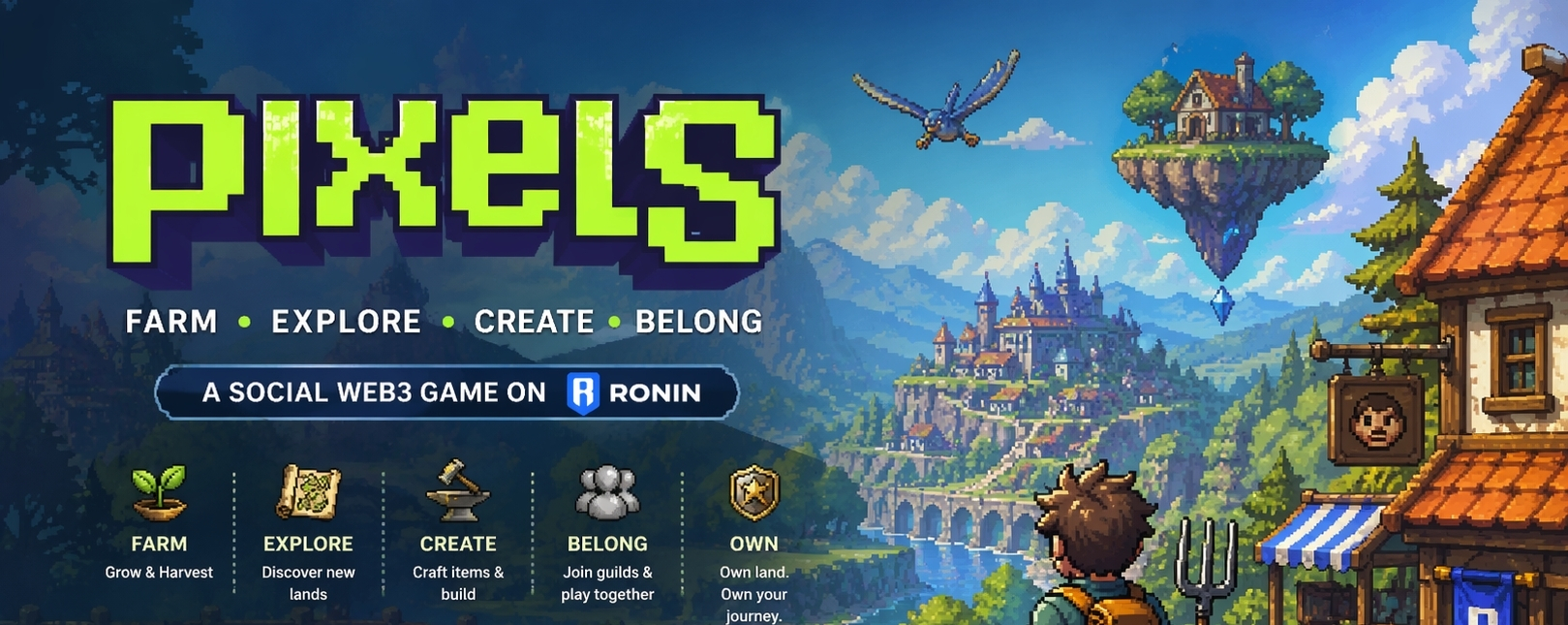
I wasn’t planning to spend this much time thinking about Pixels.
It started like most late-night dives do — one tab open turns into ten. A whitepaper here, a docs page there, a few threads, some scattered notes. You tell yourself you’ll skim it, just get the surface. But then something doesn’t quite fit the usual pattern, and suddenly you’re paying closer attention than you expected.
Pixels is easy to misclassify if you approach it with the usual Web3 lens. At a glance, it checks familiar boxes: token, land, NFTs, some kind of resource loop, migration to a gaming-focused chain. I’ve seen this structure too many times. DeFi wrapped in gameplay, gameplay wrapped in emissions, emissions wrapped in optimism. You start recognizing the shape before you even understand the details.
But Pixels doesn’t fully behave like that. Or maybe it’s trying not to.
The first thing that stands out is how unaggressive it feels. That’s a strange thing to say about a crypto project, but it’s noticeable. There’s no immediate pressure to optimize, no early moment where you’re pushed to “maximize yield” or “position early.” You drop into the world and… farm. You gather. You wander around. It almost feels like the system is intentionally under-explaining itself at the start, which is unusual in a space that usually over-promises from the first click.
And I keep asking myself — is that deliberate design, or just a softer wrapper over the same mechanics?
Because if you dig deeper, the familiar layers are still there. Land tiers, resource flows, progression loops, token utility. The usual economic skeleton hasn’t disappeared. It’s just less loud about it. Land still matters. Efficiency still compounds. Access still improves with ownership or positioning. That part hasn’t changed.
But the difference, I think, is in how tightly the economy is coupled to the experience.
A lot of GameFi projects start from the economy and then try to justify gameplay around it. Pixels feels like it’s attempting the reverse — start with something that people might actually play even without tokens, then slowly integrate ownership and incentives in a way that doesn’t break the illusion. I’m not saying it fully succeeds, but the intent is visible.
The land system is a good example of that tension. On paper, it could easily become exclusionary — higher-tier land, better yields, more control. That’s the standard trajectory. But Pixels introduces these softer entry points — free plots, renting, shared activity. It doesn’t eliminate hierarchy, but it diffuses it enough that the system doesn’t immediately collapse into a paywalled experience.
Still, I can’t ignore the question that always comes up: does this stay balanced once real capital and scale enter the system?
Because we’ve seen this before. Early stages feel open, cooperative, even charming. Then optimization kicks in. Players organize, capital concentrates, and suddenly the “world” starts behaving more like a market than a game. It’s not a design failure — it’s just what happens when incentives get serious.
Pixels seems aware of that risk. You can see it in how the economy has already been adjusted over time. The shift away from inflation-heavy structures, the attempt to refine token flow, the move toward something more controlled. That’s not the behavior of a team blindly chasing growth. It suggests they’ve seen what happens when emissions run ahead of engagement.
But awareness doesn’t guarantee success. It just means they’re paying attention.
The Ronin migration is another piece that’s hard to ignore. From a purely structural perspective, it makes sense. If you’re building a game that depends on frequent interaction, you can’t afford friction at the infrastructure level. Ronin already has a user base that understands game economies, digital ownership, and the basic mental model of Web3 gaming. So Pixels isn’t fighting that battle from zero.
At the same time, being inside an ecosystem like that comes with its own expectations. There’s an implicit pressure to perform, to retain users, to justify attention. It’s not just about building a good game anymore — it’s about sustaining an economy inside a very visible environment.
What I find myself circling back to, though, isn’t the tech or even the token. It’s the pacing.
Pixels is slow. Intentionally slow.
And in a space that has been defined by speed — fast capital, fast narratives, fast collapses — that slowness feels almost out of place. You’re not flipping assets. You’re planting something and waiting. You’re building incrementally. You’re returning the next day to continue where you left off.
That kind of design either becomes a strength or a liability. If the world feels meaningful, the slowness becomes calming, even addictive in a quiet way. If it doesn’t, it just feels like friction.
I’m not entirely sure which direction Pixels will settle into yet.
There’s also the social layer, which is harder to quantify but probably more important than it looks. Systems like guilds, shared land activity, and cooperative loops hint at something deeper than individual optimization. The project seems to want players to depend on each other, at least to some extent.
And that’s interesting, because most tokenized systems trend toward individual extraction. Cooperation only lasts as long as it’s profitable. Pixels is trying to embed collaboration into the structure itself, which is… ambitious. Maybe even a little optimistic.
The question is whether that holds when incentives get sharper.
I keep thinking about how many cycles this space has already gone through. DeFi summer, play-to-earn explosions, NFT mania, AI narratives layered on top of everything. Each wave comes with its own language, its own promises, its own version of “this time it’s different.”
Pixels doesn’t loudly claim to be different. If anything, it downplays itself. And that might be the most interesting part.
It’s not trying to convince you immediately. It just lets you exist in the system for a while.
And after spending hours reading through it, I still can’t reduce it to a simple conclusion. It’s not obviously revolutionary. It’s not obviously flawed either. It sits somewhere in between — a project that understands the mistakes of its predecessors, but is still exposed to the same underlying forces.
Maybe that’s the honest position.
Pixels isn’t trying to escape the gravity of Web3. It’s just trying to build something stable within it.
Whether that actually works… I don’t think you figure that out from a whitepaper.
You figure it out months later, when the hype is gone and the people who are still there are playing because they want to — not because they’re being paid to.