
I've read the official Binance AI Pro documentation and launch materials multiple times. I've read the Binance Academy guide, the official press release, the FAQ sections, and the third-party coverage that quotes official sources directly. I've been using Binance AI Pro for nearly four weeks, running live strategies in the AI Account sub-account. Here is a systematic inventory of the questions the documentation raises and does not answer.
On execution mechanics.
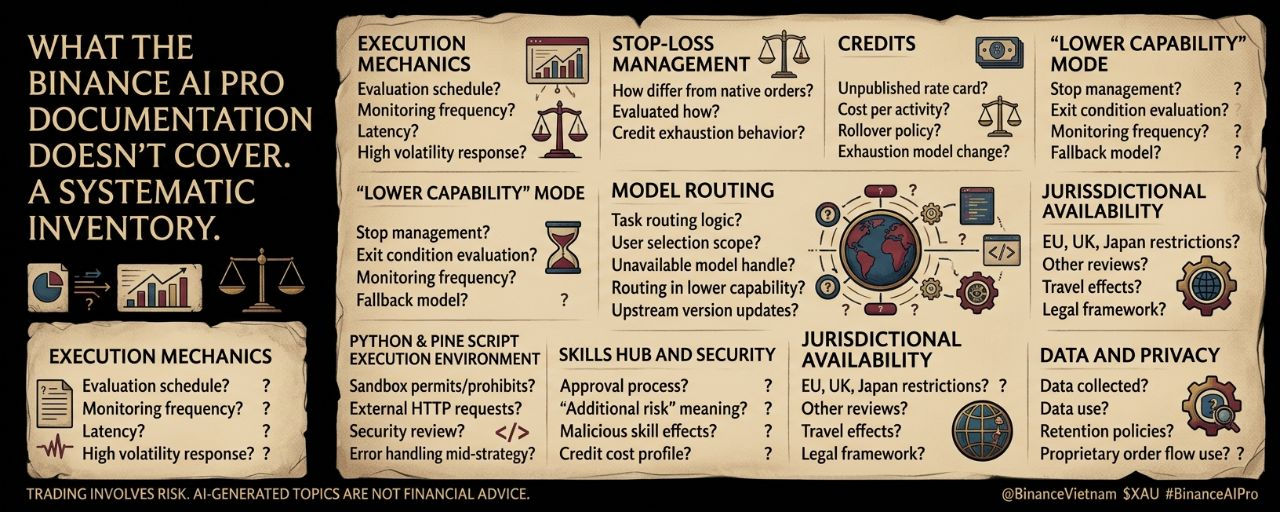
The documentation says Binance AI Pro handles "real-time market analysis" and monitors positions "around the clock." It does not specify on what schedule Binance AI Pro evaluates whether a strategy's conditions are met, whether monitoring is event-driven or interval-based, what the expected latency is between a market event and a Binance AI Pro response, or how the refresh cadence changes under high volatility. Any Binance AI Pro strategy that depends on execution timing needs answers to these questions. They are not in the documentation.
The documentation describes stop-loss management as a Binance AI Pro capability. It does not specify how AI Account stops differ from Binance's own native conditional orders, whether Binance AI Pro implements stops as standing exchange orders or evaluates them at each analysis cycle, or what happens to an AI-managed stop during credit exhaustion when Binance AI Pro enters "lower capability" mode.
On credits.
Binance AI Pro credits are consumed by AI-assisted activities. No published rate card exists. The documentation does not specify the credit cost of: a Binance AI Pro market analysis query, a strategy condition evaluation, a spot order placement, a perpetual contract position update, a Python or Pine Script strategy execution, an on-chain wallet query through the Skills Hub. Without this information, users cannot budget their usage or predict when the 5 million monthly allocation will be exhausted.
Third-party coverage confirms that Binance AI Pro credits do not roll over between months and that credit exhaustion automatically switches the product to basic AI models rather than degrading service gradually. Neither of these facts appears prominently in Binance's own official documentation. Users managing live leveraged positions need to know this before the switch happens, not after.
On "lower capability" mode.
This is the most significant documentation gap in the entire product. Binance AI Pro transitions into a different operational state when credits run out. That state is described in one phrase: "lower support and execution capability." A user running a leveraged perpetual position in their AI Account when this transition happens needs to know: does Binance AI Pro continue to manage stops in lower capability mode? Does it continue to evaluate exit conditions? Does monitoring frequency change? Which of the five AI engines does it fall back to? None of this is answered anywhere in Binance's official materials.
On model routing.
Binance AI Pro integrates five AI engines: ChatGPT, Claude, Qwen, MiniMax, and Kimi. The documentation does not specify how Binance AI Pro routes tasks across these models, whether the user's model selection applies uniformly to all Binance AI Pro functions or only to certain query types, what happens if the selected model is unavailable, whether model routing changes in lower capability mode, or how Binance handles upstream model version updates and whether those updates change the analytical behavior users have been calibrating their strategies against.
On the Python and Pine Script execution environment.
Binance AI Pro can write and execute code for complex strategy logic. The documentation does not specify what the Binance AI Pro execution sandbox permits or prohibits, whether code generated and run through the AI Account interface can make external HTTP requests, what security review the product applies to its own generated code before execution, what happens when code execution produces an error mid-strategy while positions are open, or what the credit cost profile for code execution looks like relative to standard Binance AI Pro operations.
On the Skills Hub and security.
The documentation describes Binance AI Pro's core skill set and states that skills approved internally can be imported from GitHub. Custom unvetted skills are flagged as carrying additional risk. The documentation does not specify: what Binance's internal approval process for Skills Hub contributions actually involves, what "additional risk" means for unapproved skills and what mechanisms limit that risk inside the AI Account environment, whether a faulty or malicious skill can affect the sub-account's position management, or what recourse a user has if a Binance Skills Hub component causes unintended execution.
On jurisdictional availability.
The documentation confirms Binance AI Pro is unavailable in the EU, UK, and Japan. It does not specify what regulations in those jurisdictions prevent access, which other jurisdictions are in review, whether users who activate in an eligible jurisdiction and then travel to an ineligible one retain access, or what the legal framework governing disputes over Binance AI Pro's execution is.
On data and privacy.
The documentation does not specify what behavioral data Binance collects from Binance AI Pro usage, how that data is used, what data retention policies apply to AI Account activity, or whether Binance AI Pro's analysis draws on Binance's proprietary order flow data or is limited to the same externally accessible market data any API user can reach.
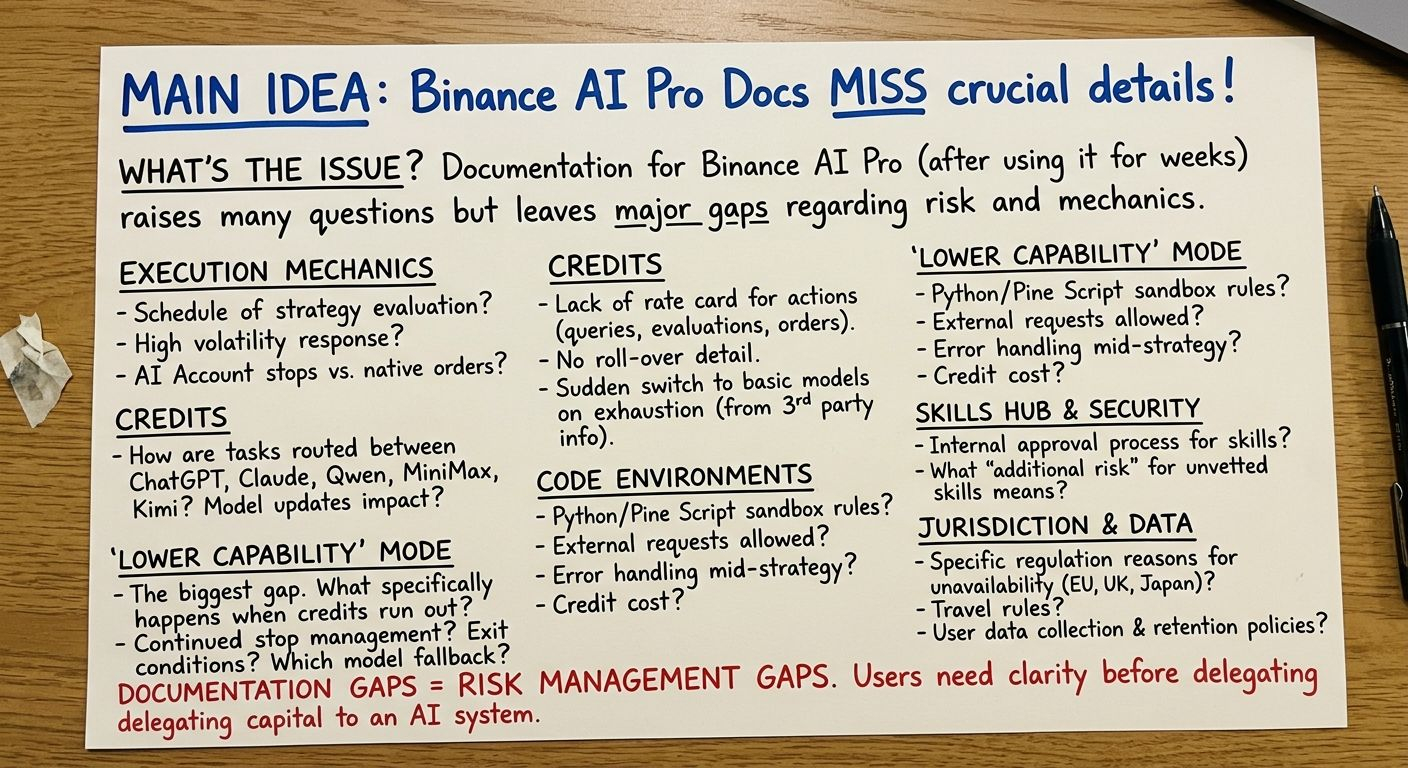
The documentation Binance AI Pro needs, before it can claim to be genuinely serving its users well, addresses all of the above. Not as fine print buried in terms of service — as the main product information. Users are delegating execution authority over real capital to an AI system on the world's largest crypto exchange. Binance AI Pro's documentation should make it possible for any reasonably attentive user to understand what the product will do in the conditions that matter most: credit exhaustion during an open leveraged position in the AI Account, a model update mid-strategy, a high-volatility event window, a Skills Hub error during active execution. None of those scenarios are currently answered. They are exactly the scenarios where the documentation gap becomes a risk management gap.
@Binance Vietnam $XAU #BinanceAIPro
Trading always involves risk. AI-generated topics are not financial advice. Past performance does not reflect future performance. Please check product availability in your region.