
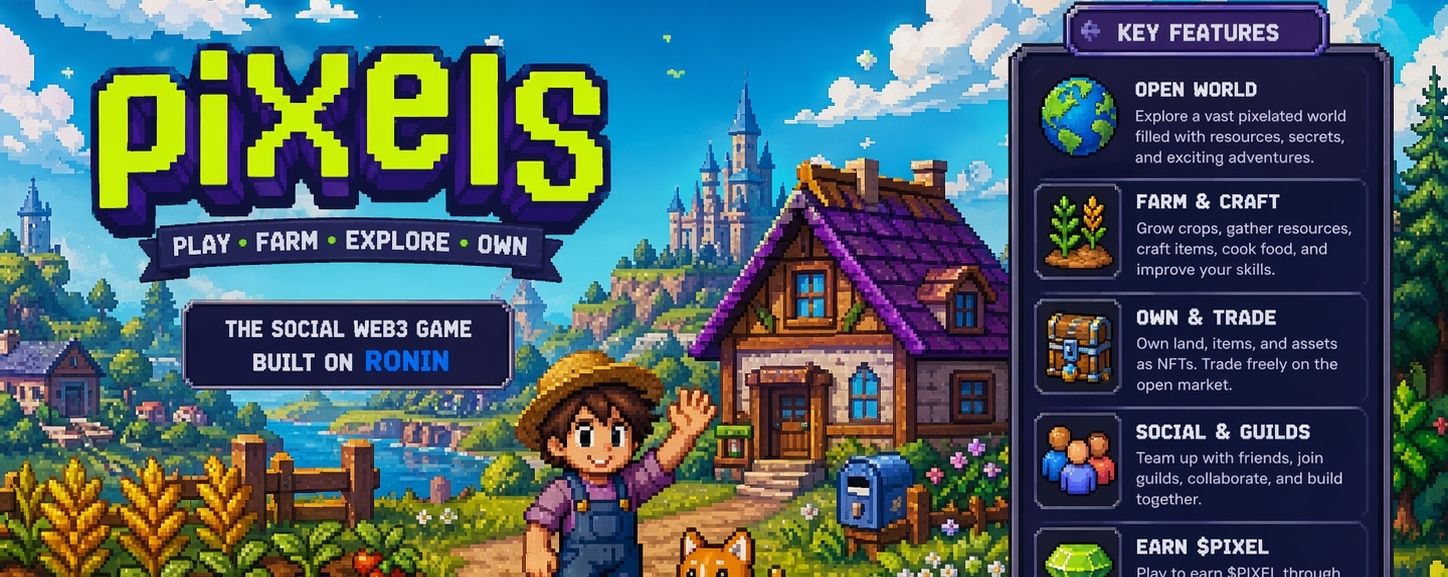
When I first looked into Pixels (PIXEL), what stood out to me wasn’t just that it’s another Web3 game—it’s how deliberately it tries to feel like a “real” game first and a crypto product second. That’s actually rare in this space. A lot of blockchain games I’ve seen lean heavily into earning mechanics, but Pixels seems to flip that. It pulls you in with simple, almost nostalgic gameplay, and only later do you start noticing the economic layer underneath.
As I explored it more, I realized the core loop is intentionally familiar. You farm, you gather resources, you craft items, and you slowly expand what you can do. It reminds me of classic farming simulators, but with a persistent online world where other players are always around. That social layer changes everything. I’m not just grinding crops in isolation—I’m part of a shared economy where other people’s actions actually affect what I do.
One thing I find interesting is how the game uses energy as a limiting system. At first, I thought it was just another typical mechanic to slow players down, but the more I paid attention, the more I saw how it shapes decision-making. I can’t just do everything at once. I have to think about whether I want to spend my energy farming, exploring, or crafting. That creates a subtle strategy layer that keeps the gameplay from feeling mindless.
The farming itself isn’t complicated, but it doesn’t need to be. I plant crops, wait, harvest them, and then decide what to do next—sell them, cook them, or use them for crafting. What makes it engaging isn’t the action itself, but how it connects to everything else. Crops feed into energy, energy feeds into productivity, and productivity feeds into the broader in-game economy. It’s a loop, but it’s a well-designed one.
As I dug deeper, I started paying attention to the economy, and that’s where things get more complex. Pixels uses multiple currencies, and at first, it can feel a bit confusing. There’s the main token, PIXEL, which has real-world value, and then there are in-game currencies that are more casual and easier to earn. I actually think this layered approach makes sense. It keeps the game accessible for new players while still giving more serious players something to aim for.
What I find especially notable is how ownership works. In traditional games, everything I earn or build is locked inside the game. Here, that’s not the case. Land, items, and certain assets can actually belong to me in a way that extends beyond the game itself. That sounds great in theory, but I’ve learned to look at it realistically. Ownership only matters if there’s demand. If no one wants what I have, then its “value” doesn’t mean much. So while the system is powerful, it still depends heavily on player activity and interest.
Land ownership is probably one of the most talked-about parts of Pixels, and I can see why. If I own land, I can benefit from what other players do on it. That creates a kind of passive income model, which is appealing. But at the same time, I don’t think it’s essential to enjoy the game. I’ve noticed that the developers seem aware of this balance—they want land to be valuable, but not so powerful that it locks out free-to-play players.
The social side of Pixels is where I think it really differentiates itself. I’m not just playing alongside others—I can interact with them, visit their land, trade, and even collaborate. When I see other players working in the same space, it makes the world feel alive. That’s something a lot of Web3 games struggle with. They often feel empty or transactional, but here there’s at least an attempt to build a community-driven environment.
Guilds add another layer to this. When players group together, it changes the dynamic from individual grinding to cooperative play. I’ve noticed that this is where the game starts to feel more like an MMO than a simple farming sim. Working together, sharing resources, and coordinating strategies—it all adds depth that wouldn’t exist otherwise.
Another thing I find worth mentioning is the visual design. The pixel art style might seem simple, but I think that’s intentional. It lowers the barrier to entry and makes the game run smoothly even on basic devices. More importantly, it creates a sense of familiarity. I don’t feel overwhelmed when I enter the game. Instead, it feels approachable, almost nostalgic.
From a technical perspective, the move to the Ronin Network seems like a smart decision. High fees and slow transactions can ruin the experience in blockchain games, and I’ve seen that happen before. By using a network designed specifically for gaming, Pixels avoids a lot of those issues. I don’t have to think about gas fees every time I interact with the system, which makes the whole experience smoother.
That said, I can’t ignore the economic risks. Because PIXEL is a tradable token, its value isn’t stable. If the market shifts, the rewards I earn in-game can change significantly. That’s something I always keep in mind. While it’s possible to earn, it’s not guaranteed, and it shouldn’t be the only reason to play. I think the game works best when I treat the economic side as a bonus rather than the main goal.
What I appreciate most is the “fun-first” approach. It’s clear to me that the developers are trying to avoid the mistakes of earlier play-to-earn games, where everything revolved around maximizing profits. In Pixels, the gameplay itself is the focus, and the earning potential is layered on top. That makes it more sustainable in the long run, at least in my view.
I’ve also noticed that the developers are quite active with the community. Updates, changes, and new features seem to come regularly, and they often respond to player feedback. That creates a sense that the game is evolving rather than being static. It feels more like a live experiment than a finished product, which can be both exciting and unpredictable.
Looking ahead, I think Pixels has potential to grow beyond just farming. The systems they’ve built—resource management, social interaction, and player-driven economy—could support a much larger ecosystem. If they expand carefully, they could turn it into a broader platform rather than just a single game.
At the same time, I remain cautious. Web3 gaming is still an emerging space, and not every project succeeds long-term. Player interest can shift, token values can fluctuate, and new competitors can appear quickly. Pixels has momentum right now, but maintaining it will require consistent updates and a strong community.
In the end, my overall impression is that Pixels is one of the more balanced attempts at combining gaming and blockchain. It doesn’t feel overly technical, and it doesn’t force me to think about crypto at every step. I can just play, explore, and interact, and the Web3 elements sit quietly in the background until I choose to engage with them.
That balance is what makes it stand out to me. It’s not perfect, and it still has challenges to overcome, but it shows a direction that actually makes sense. If Web3 games are going to become mainstream, I think they’ll need to look a lot more like this—simple on the surface, but with deeper systems underneath for those who want to explore them.