
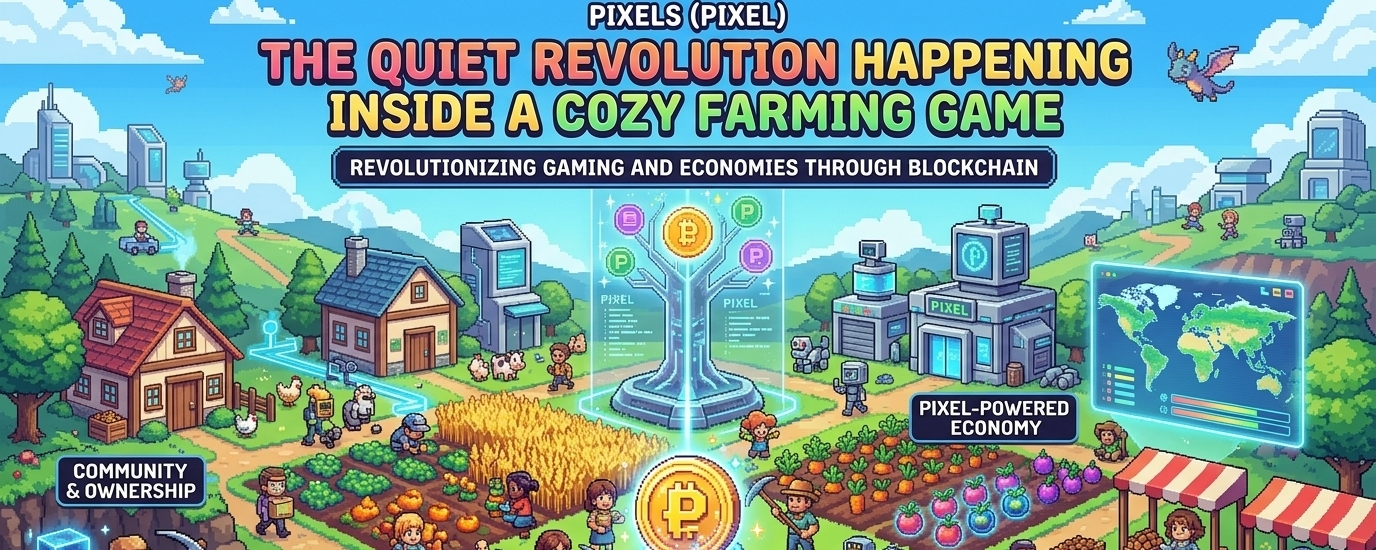
There’s something almost ironic about it. In a digital world obsessed with highoctane graphics, cinematic storytelling, and hypercompetitive gameplay, one of the most talked-about Web3 games looks… calm. Peaceful, even. You plant crops, chat with neighbors, wander through pixelated landscapes. At first glance, it feels closer to Stardew Valley than anything tied to blockchain
And yet, beneath that soft, nostalgic surface, Pixels (PIXEL) is quietly rewriting how people think about ownership, economies, and time spent in virtual worlds
Let’s dig into why this game mattersand why so many players aren’t just playing it, but living in it
A World That Doesn’t Rush You
Pixels drops you into an open world where nothing feels forced. There’s no dramatic opening battle, no urgent mission screaming for attention. Instead, you start small: a patch of land, some basic tools, and a gentle nudge toward farming
But here’s where it gets interesting
Unlike traditional games where progression is tightly scripted, Pixels gives you room to choose your rhythm. Some players become full-time farmers, optimizing crop cycles and trading goods. Others explore the map, hunting for rare resources or hidden interactions. A few lean into social play—forming communities, sharing land, and building reputations
It feels less like a game loop” and more like a digital lifestyle
Built on Ronin: Why That Actually Matters
Pixels runs on the Ronin Network, a blockchain purpose-built for games. That might sound like a technical footnote, but it shapes the entire experience
Ronin isn’t trying to be everything. It’s optimized for
Fast transactions
Low fees
Seamless in-game interactions
This matters because in Pixels, actions like trading items or earning tokens happen frequently. If every interaction felt like a financial transaction (slow, expensive, clunky), the illusion would break instantly
Instead, it feels smoothalmost invisible
That’s the sweet spot Web3 games have been chasing for years: blockchain functionality without blockchain friction
The PIXEL Token: More Than Just a Reward
Let’s talk about the economic layer, because this is where Pixels separates itself from earlier Web3 experiments
The PIXEL token isn’t just a shiny reward tossed at players to keep them engaged. It’s woven into the ecosystem in a way that actually makes sense
You earn PIXEL by
Completing tasks
Farming efficiently
Participating in events
Contributing to the ecosystem
But here’s the key difference: earning feels like a byproduct, not the goal
Earlier “play-to-earn” games often collapsed because players were there only for extraction. Once rewards dipped, so did the community
Pixels flips that dynamic. People stay because
The game itself is relaxing
Progression feels satisfying
Social interactions are meaningful
The token becomes a bonus layer, not the entire reason to exist
Digital Land That Actually Feels Valuable
Ownership in games isn’t new. We’ve had skins, cosmetics, and tradable items for years. But Pixels takes it further with land ownership
Players can own plots of land that
Generate resources
Host other players
Become hubs of activity
This creates something unusual: location matters
A well-placed or well-developed plot can turn into a mini economy. Players visit, trade, collaborate. Over time, certain areas develop reputationsalmost like neighborhoods in a real city
It’s one of the first times digital land feels less like speculation and more like participation
The Social Layer: Where the Game Comes Alive
If you spend enough time in Pixels, you start noticing something subtle
People talk. A lot
Not just quick chats or transactional exchanges, but actual conversations. Advice gets shared. Strategies evolve. Friendships form
That’s partly because the game design encourages
Cooperation over competition
Shared spaces instead of isolated gameplay
Slow progression instead of constant urgency
It’s closer to hanging out in an online community than grinding through a typical game
And in a strange way, that’s what keeps people coming back
Lessons Learned from Earlier Web3 Games
To understand Pixels, you have to look at what came before it
Take Axie Infinity, also built by Sky Mavis (the same team behind Ronin). At its peak, Axie was a global phenomenon. But it also exposed a major flaw in early Web3 gaming
When earning dominates fun, the system becomes fragile
Pixels feels like a direct response to that lesson
Instead of
High entry costs
Complex financial mechanics
Pressure to “ROI” your gameplay
You get
Easy onboarding
Free-to-play accessibility
Gradual, organic engagement
It’s less about “how much can I earn todayand more about what do I feel like doing today
That shift changes everything
Why Simplicity Is Its Biggest Strength
Visually, Pixels doesn’t try to compete with AAA titles. It leans into a retro, pixelart aesthetic that feels familiar and approachable
And that’s not a limitationit’s a strategy
Because the simplicity
Lowers the barrier to entry
Makes the game run smoothly on most devices
Keeps the focus on interaction, not spectacle
In a world where games often overwhelm players with complexity, Pixels feels like a deep breath
The Hidden Depth: Systems You Only Notice Later
At first, Pixels seems straightforward. Plant crops, harvest, repeat
But stick around, and you’ll notice layers
Resource optimization strategies
Economic fluctuations in player-driven markets
Land specialization and efficiency planning
Event-based opportunities
It’s the kind of game that rewards curiosity. The more you explore, the more it reveals
And importantly, it never forces you to engage with that depth. You can stay casualor dive deep
Real People, Real Stories
One of the most fascinating aspects of Pixels isn’t the tech or the economyit’s the people
You’ll find
Players in developing regions using it as supplemental income
Casual gamers who log in just to relax after work
Crypto enthusiasts experimenting with digital economies
Communities forming around shared land and goals
It becomes a strange mix of game, social platform, and economic experiment
And unlike many Web3 projects that feel speculative, Pixels feels… lived in
The Bigger Picture: What Pixels Represents
Pixels isn’t just another blockchain game trying to ride a trend. It’s part of a broader shift toward
Player ownership that feels natural
Economies that support, not dominate, gameplay
Communities that form organically
It suggests a future where games don’t just entertainthey sustain ecosystems
Not in a hype-driven, overnight-success way, but in a slow, steady, human way
Final Thoughts: A Game That Doesn’t Shout, But Stays
Pixels doesn’t try to impress you immediately. It doesn’t overwhelm you with features or promise life-changing earnings
Instead, it does something far more difficul
It earns your time
You log in for a few minutes, plant some crops, maybe chat with someone. Then you come back the next day. And the next
Before you realize it, you’re not just playingyou’re part of something that feels aliveIn an industry chasing the next big breakthrough, Pixels quietly proves that sometimes, the real innovation isn’t louder graphics or bigger rewards.It’s making people want to stay
