

I didn’t really notice it at first.
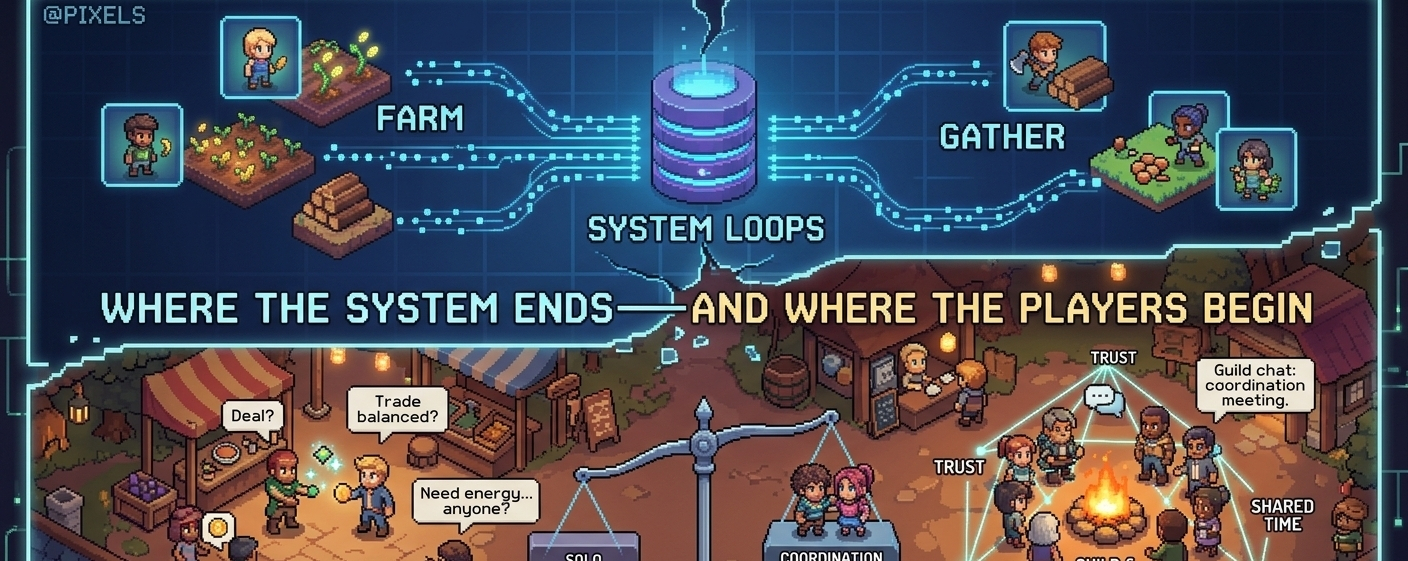
It wasn’t a feature, or a mechanic, or even a reward that stood out. It was something quieter. The way players lingered a little longer than necessary. The way trades kept happening even after tasks were done. The way conversations, deals, small collaborations… seemed to fill the gaps where the system itself went silent.
At a glance, @Pixels looks like a familiar loop. Farm, gather, trade, repeat. A structure we’ve seen before. Predictable, even. But after spending time inside it, something feels… less mechanical than expected.
You start to wonder where the system actually ends—and where the players begin.
Because the longer you observe, the harder it becomes to separate the two.
On the surface, community feels like an outcome. Players gather because the game exists. They interact because there are incentives. But look a bit deeper, and it starts to feel reversed.
What if the community isn’t forming around the system…
What if the system is quietly shaping itself around the community?
Take the economy, for example. Resources flow, coins circulate, items move between players. That’s expected. But the interesting part isn’t the existence of trade—it’s the dependency on it.
Why does the system allow inefficiencies to exist?
Why aren’t all loops perfectly optimized for solo play?
At first, it feels like a gap. But then you realize—it’s not a flaw. It’s pressure.
A player can do everything alone… but not efficiently. Not sustainably. There’s always a friction point. A moment where time, energy, or resources don’t quite align.
And in that gap, something emerges.
Interaction.
Trade becomes less about profit and more about balancing time. Guilds stop being optional and start becoming optimization layers. Conversations aren’t just social—they’re economic decisions.
Is that really community…
Or is it a coordination mechanism disguised as one?
That’s where things start to shift.
Because if players are solving inefficiencies together, then the community isn’t just participating in the system—it’s stabilizing it.
And suddenly, $PIXEL doesn’t just circulate through gameplay loops. It circulates through relationships.
Which raises another question: when value moves through people instead of systems, where is it actually being controlled?
There’s a subtle psychological layer here too.
Left alone, players tend to optimize. They chase efficiency, minimize waste, reduce time spent per reward. But introduce other players into that equation, and something changes.
Optimization becomes negotiation.
Time becomes shared.
Even “fun” becomes contextual—because now it depends on others.
So is the system encouraging social play…
Or quietly limiting solo optimization to make social behavior more valuable?
And if that’s true, then community isn’t just an added layer. It’s a constraint system. A way to guide behavior without explicitly forcing it.
But constraints come with trade-offs.
A strong community can stabilize an economy. It can slow down extraction, create organic demand, and extend player retention beyond pure rewards. People don’t just log in for tasks—they log in for people.
But what happens when that balance shifts?
If rewards drop, does the community hold?
If coordination becomes friction instead of advantage, does engagement weaken?
And more importantly… can a system rely on its community without eventually overburdening it?
Because the same mechanism that creates connection can also create pressure.
Dependence.
Expectations.
Unspoken obligations to stay active, to contribute, to not fall behind.
At some point, the line between playing a game and maintaining a role inside an ecosystem starts to blur.
And maybe that’s the real design question behind $PIXEL.
Not how strong the economy is.
Not how engaging the gameplay feels.
But how much weight the community is actually carrying.
There’s a moment—if you pay attention—where the perspective flips.
You stop seeing guilds, trades, and chats as social features.
And you start seeing them as infrastructure.
Invisible systems that hold everything together when the visible mechanics alone wouldn’t be enough.
And once you see that, it’s hard to unsee.
Because now the success of @Pixels #pixel doesn’t just depend on design choices.
It depends on people continuing to choose each other.
Not because they have to.
But because, somewhere along the way, the system made that the most natural thing to do.
The question is…
Is that kind of system more resilient…
Or more fragile than it appears?