
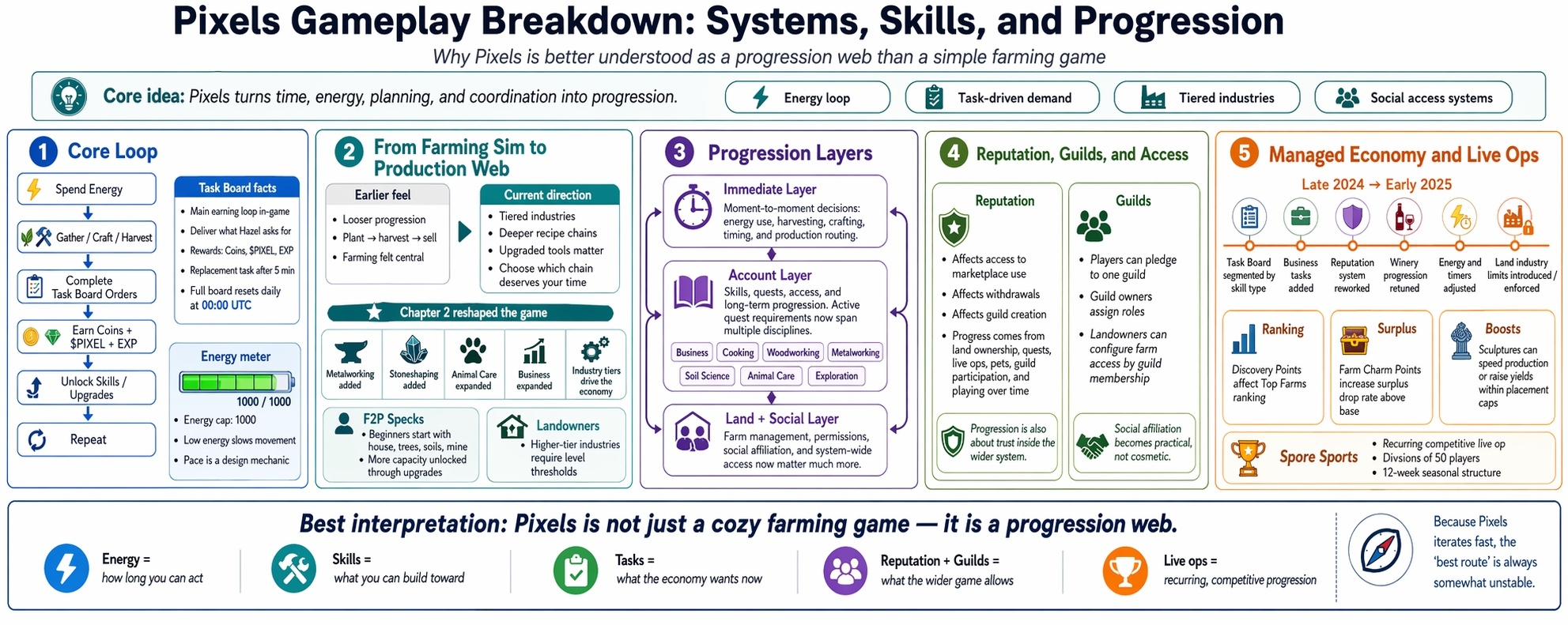
I used to think Pixels was basically a relaxed farming game with a crypto wrapper around it. The more I look at how it actually works the less that description holds up. What I see instead is a tight loop built around energy and item production and timed demand with a constant push to turn simple actions into longer chains of planning. The clearest example is the Task Board. The official guide treats it as the main way to earn Coins and PIXEL in game. You make or gather what Hazel asks for and turn it in for rewards and EXP and then wait five minutes for a replacement task before starting again. The full board resets daily at 00:00 UTC. That loop sits on top of energy management and energy matters more than people sometimes assume because Pixels gives each player a 1000 energy cap and even slows your movement as you run low. That means pace is part of the design rather than just a convenience setting.
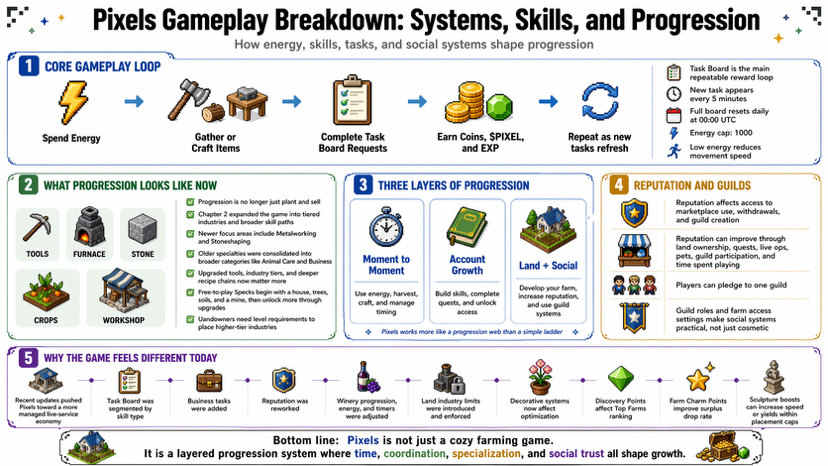
What makes that loop more interesting now is that progression no longer feels like a straight line from planting a crop to selling it. Chapter 2 reshaped the game around tiered industries and a broader skill structure. It added Metalworking and Stoneshaping and folded several older specialties into bigger categories such as Animal Care and Business while tying more of the economy to industry tiers and upgraded tools and deeper recipe chains. Free to play Specks were also reworked so beginners start with a house and trees and soils and a mine and then unlock more capacity through upgrades. At the same time landowners face level requirements for placing higher tier industries. When I compare that to the earlier and looser version of Pixels the shift is obvious. The game is trying to make progression feel less like passive accumulation and more like choosing which production chain deserves your time. Even the active quest list reinforces that idea because current quest requirements spread across Business and Cooking and Woodworking and Metalworking and Soil Science and Animal Care and Exploration rather than treating farming as the whole game.
I find it helpful to look at Pixels progression as a few connected layers instead of a simple ladder. There is the immediate layer where you spend energy and craft and harvest and think about timing. There is also the account layer which covers skills and quests and access. Then there is the land and social layer and that is where the game has become much more defined lately. Reputation now affects access to core features such as marketplace use and withdrawals and guild creation. Pixels says that score can improve through land ownership and quests and live ops and pets and guild participation and simply playing over time. That means progression is not only about building efficient routes through crops and benches. It is also about building trust inside the game’s broader system. Guilds push that idea further. A player can pledge to one guild and receive roles from the guild owner while landowners can configure farm access around guild membership. That turns social affiliation into a practical gameplay tool instead of a cosmetic extra.
That social layer is also part of why Pixels gets more attention now than it would have five years ago. From the official release notes I could verify late 2024 and early 2025 were full of adjustments that pushed the game toward a more managed live service economy. The Infinifunnel or Task Board was segmented by skill type. Business tasks were added. The reputation system was reworked. Winery progression was retuned. Energy and timers were adjusted. Land industry limits were introduced and then enforced. Even decorative and optimization systems now feed into progression more directly than they used to. Discovery Points affect Top Farms ranking. Farm Charm Points increase surplus drop rate above the base rate. Sculpture boosts can speed production or raise yields within placement caps. What surprises me is that none of this feels accidental. It reads like a game trying to control inflation and smooth player paths and make specialization meaningful while still keeping some of its casual surface.
So when I try to explain Pixels honestly I do not think the best starting point is calling it a farming game even though farming is still the easiest door into it. I think it makes more sense to call it a progression web. Energy tells you how long you can act. Skills tell you what you are allowed to build toward. The task system tells you what the economy wants right now. Reputation and guild systems decide how much of the wider game opens up around you. Live ops reinforce that structure rather than distracting from it. Spore Sports is a good example because it uses divisions of 50 players and a 12 week seasonal structure which shows how far Pixels has moved toward recurring competitive events layered on top of its resource loop. The uncertainty is part of the picture too. Pixels openly iterates fast and the official notes show balance changes arriving again and again so the exact best route through the game is always a little unstable. To me that is the real shape of Pixels now. It is not static. It is not purely cozy. It is not especially mysterious once you see that every system is there to turn time and coordination and judgment into progression.


