
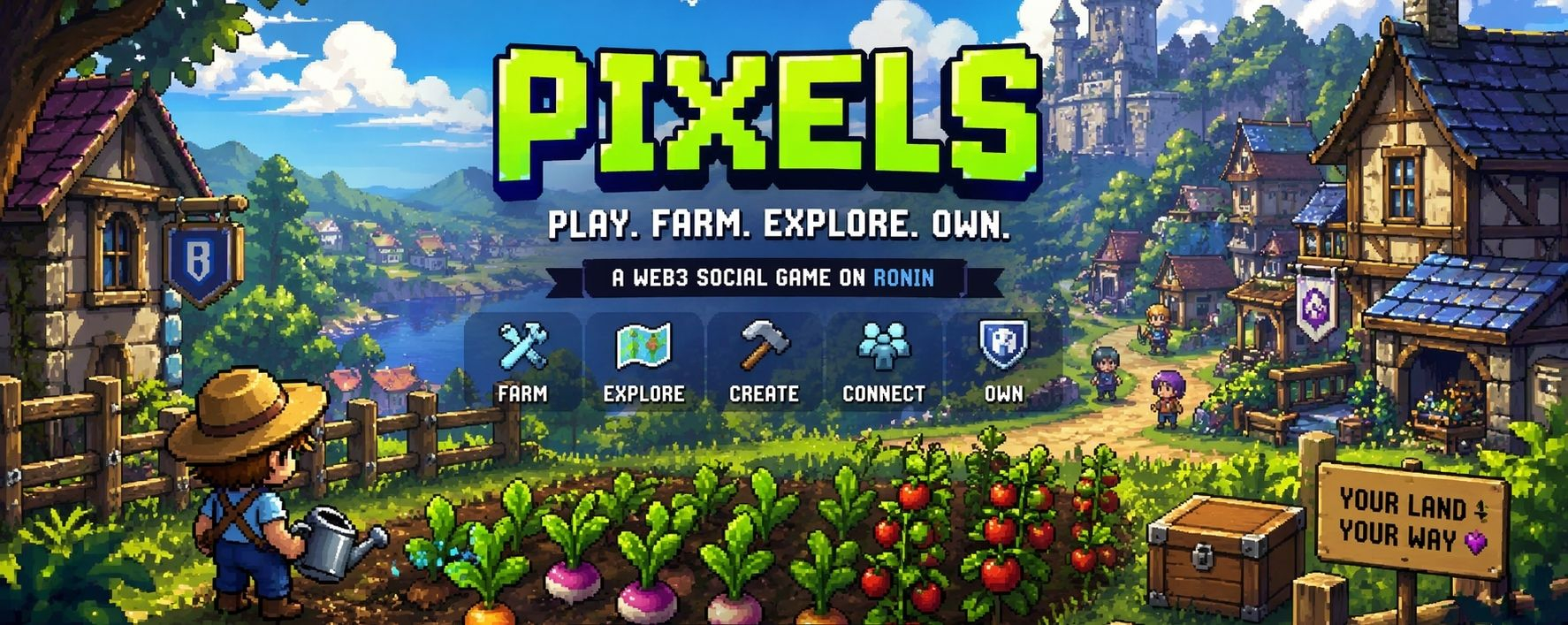
Pixels is the kind of project that looks straightforward until you spend enough time staring at it and start asking the annoying questions. On the surface, it is a social Web3 farming game on Ronin, which already puts it in familiar territory. We have all seen the pitch before: cozy visuals, player ownership, token utility, community, a bit of progression, a bit of speculation, and some promise that this time the game will actually matter. But Pixels is interesting precisely because it does not announce itself like a grand revolution. It feels smaller, quieter, almost suspiciously normal. And that is usually when I start paying closer attention.
The strange thing about being around this sector long enough is that you stop reacting to the words and start reacting to the structure. “Open world.” “Social economy.” “Player-owned assets.” “Meaningful utility.” You have seen these phrases in DeFi, GameFi, AI narratives, modular chains, restaking pitch decks, and a dozen other cycles that burned hot, then faded into dashboards no one opens anymore. So when a project like Pixels comes along, the real question is not whether it sounds good. The question is whether it actually has a system that can hold people once the novelty wears off. That is where things get more interesting.
Pixels does not try to win with complexity. It starts with farming, exploration, and creation, which in another context might sound almost too soft for a market that loves aggressive narratives. But that simplicity may be the point. Farming is legible. It gives players a loop they can understand immediately: plant, wait, harvest, improve. And because the loop is simple, the project has room to layer in other systems without making the whole thing collapse under its own design. That matters more than people think. A lot of Web3 games fail because they confuse added mechanics with actual depth. Pixels, at least in theory, seems to understand that depth comes from repetition, consequence, and social context, not from stuffing the screen with features.
What makes the game slightly more credible than the average whitepaper fantasy is that the mechanics are not trying to impersonate a financial product too aggressively. The game revolves around familiar, almost old-fashioned gameplay patterns. You manage land. You gather resources. You craft. You expand. You interact with others. That may not sound disruptive, but disruption is not what most games need. Most games need retention. Most projects in this sector die because they overestimate how long curiosity can substitute for habit. Pixels seems to be trying to build habit first.
The land system is one of the better examples of that thinking. Ownership exists, but it is not framed in the usual exclusionary way where the whole game is basically a gated asset farm. Players can still participate without owning land, which is important because otherwise the project slides too quickly into the usual trap: the people who arrive early get the upside, and everyone else is left staring at a spreadsheet with a mascot on it. Pixels at least appears to preserve access while still giving ownership some meaning. That balance is delicate. Too much accessibility and the assets become decorative. Too much exclusivity and the game starts to feel like a landlord simulation with extra steps.
The token side is where my skepticism usually wakes up. Most GameFi tokens are burdened by too many promises and too little actual demand. The token is supposed to do everything: govern, reward, accelerate, unlock, incentivize, and somehow hold price while also being distributed to people who want to sell it. That tension is not unique to Pixels, of course, but it is where these projects are usually exposed. A token has to be useful enough to justify its existence, but not so essential that it turns ordinary gameplay into a paywall. Pixels seems aware of that problem. The token is positioned as an enhancement layer rather than the whole game, which is healthier than the old “earn first, understand later” model that dominated earlier cycles.
Still, utility is only convincing if the game gives players a reason to care about the utility in the first place. That is where the broader world design matters. Pixels is not just farming in isolation; it is trying to create a social environment where players have reasons to return, collaborate, compete, and eventually identify with the world they are in. That is a better thesis than “play to earn” ever was. People rarely stay because they are optimizing yield. They stay because they build routines, relationships, and a sense of personal progress. The project seems to be aiming for that older, more durable kind of engagement.
Ronin is part of why this can work at all. Infrastructure is boring until it becomes the reason a project survives. A game like Pixels needs transactions to be cheap, fast, and almost invisible. If users have to think about friction every time they interact with the world, the world stops feeling like a game and starts feeling like a chore. Ronin’s gaming-first positioning is not a miracle, but it does solve one of the biggest unglamorous problems in Web3 gaming: the chain should disappear into the background. That is not a flashy argument, but it is probably the right one. The best blockchain experience is often the one where the user is only reminded of the blockchain when ownership actually matters.
What I find mildly encouraging is that Pixels does not seem to rely entirely on the idea that blockchain ownership itself is the product. That narrative used to be enough to attract capital and short-term attention. It is not enough anymore. People have seen too many launches, too many token charts, too many “ecosystem” decks that read like they were assembled in a hotel room after a conference dinner. The bar is higher now. A project has to justify its existence in actual user behavior, not just in a roadmap. Pixels at least appears to be trying to create a loop that can survive beyond the initial speculative window. Whether it succeeds is another matter, but the attempt is more mature than most.
The social layer is where the project may ultimately be judged. Games with blockchain elements usually become more interesting when they stop acting like isolated products and start behaving like places. Guilds, shared activity, reputation, collaborative systems, and community identity are not optional decorations. They are the things that make a game feel lived in. Pixels seems to understand this, at least conceptually. If the world remains socially active, the economy has a chance. If the social layer dies, the rest tends to follow it. That is true in crypto games, true in DeFi communities, and honestly true in most online systems that depend on repeated participation.
There is also a quiet realism in how Pixels handles progression. It does not look like it is trying to promise instant financial transformation, which is refreshing in a market that has spent years rewarding exaggerated narratives. The project seems more interested in making incremental progress feel meaningful. That is a much harder design problem than it sounds. Anyone can create a reward loop. The harder part is making a player feel that their time changed something. That feeling is what keeps people coming back after the first burst of curiosity fades. And in a space as crowded and overpromised as Web3 gaming, retention is the only story that matters in the end.
So does Pixels matter? Late at night, after reading too many whitepapers, the honest answer is: maybe, and more than most, but for reasons that are easy to miss if you are only looking for a headline. It is not trying to be the most ambitious game in the sector. It is trying to be a world people can actually inhabit. That is less exciting on a pitch deck, but probably more useful in practice. It has familiar mechanics, a more sensible relationship with its token, an infrastructure choice that fits the product, and a social structure that could give it a longer life than the average hype-cycle experiment.
That does not mean it is immune to the usual pressures. Token economies still warp. Communities still drift. Players still leave when the loop stops feeling rewarding. But Pixels at least seems to be asking the right question, which is rarer than it should be: not how do we make the token louder, but how do we make the world worth returning to? In this market, after enough cycles of DeFi excess, GameFi collapse, AI overreach, and chain modularity being sold like salvation, that kind of question starts to sound almost radical in its restraint.