
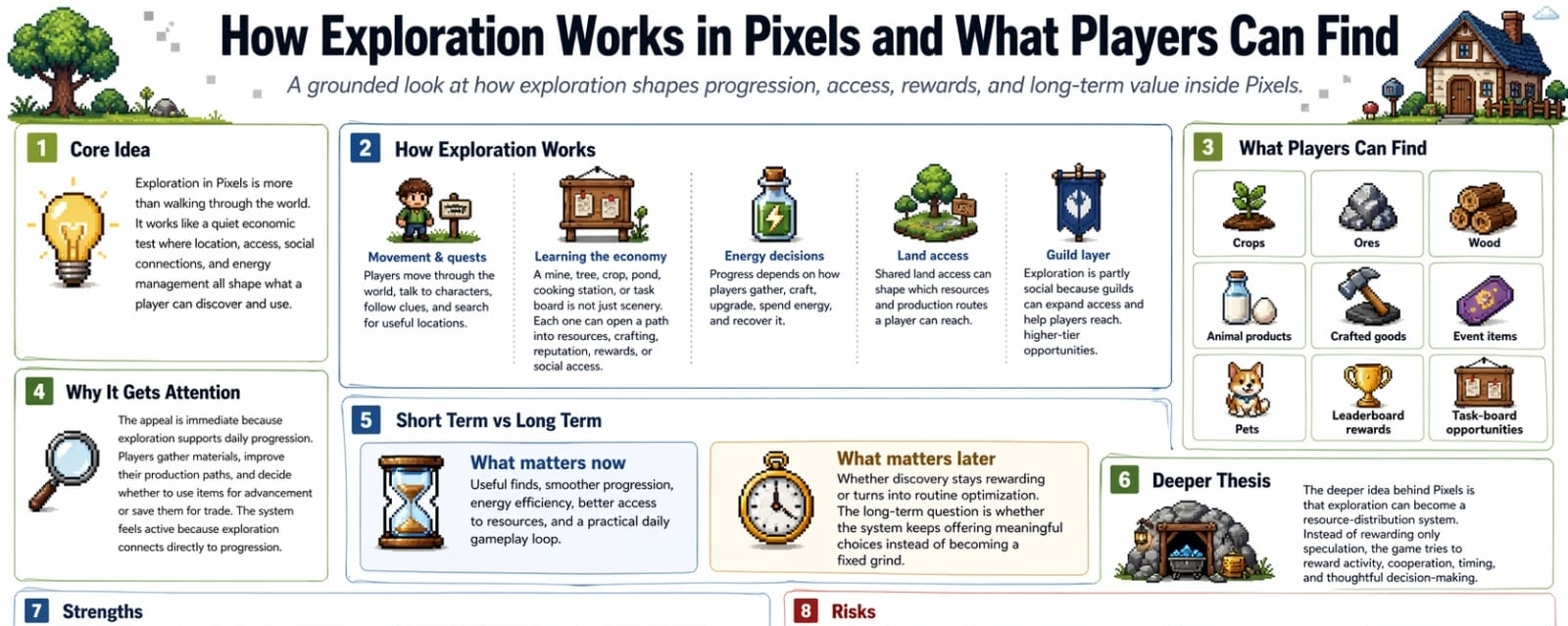
I used to think of exploration in Pixels as the simple act of walking around Terra Villa and seeing what was tucked behind the next building. My view has changed a bit because the game seems to treat exploration less like sightseeing and more like a quiet economic test. Where you go and what you can access and who you play with and how carefully you spend energy all shape what you are able to find. Pixels describes itself as an open-ended world built around farming and exploration and resources and skills and relationships and quests and blockchain-linked ownership. That is a broad promise but the interesting part is how ordinary that promise feels once it becomes a daily loop.
At the surface exploration means moving through the world and talking to characters and following quest hints while discovering which places or activities produce useful items. Early quests teach the basics while later ones can feel less automatic since players may need to approach NPCs and follow clues and search around locations such as Terra Villa rather than being guided through every step. That matters because Pixels is not only asking players to “find” things in the visual sense. It is asking them to learn the shape of the economy. A mine or tree or crop or pond or cooking station or task board is not just scenery. Each one can become a path into resources and crafting and reputation and coins and PIXEL rewards and social access.
What surprises me is that the strongest exploration layer may be land access. Free players are not locked out of Chapter 2’s basic resource path since Pixels has said upgraded Specks and beginner-tier resources remain available while guilds can give free-to-play players access to higher-tier resources through shared lands. That makes exploration partly social. You are not only looking for a rare item. You may be looking for the right guild or farm or permission system or production route. The official help material also says landowners can connect NFT Farm Land with guilds and set access for guild members. That turns land into something closer to a shared map of opportunity than a private decoration board.
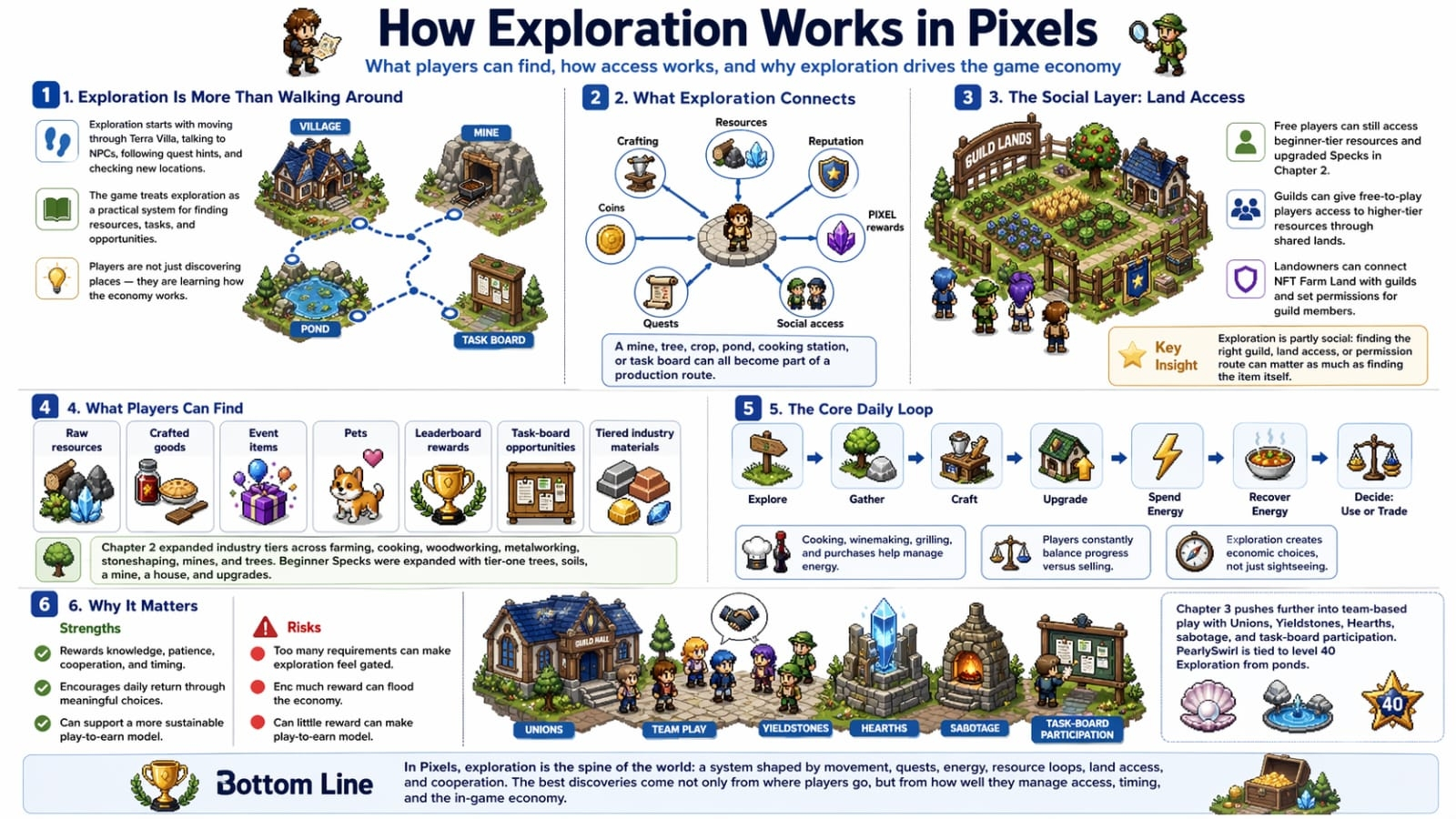

The short-term appeal is easy to understand because players can find resources and crafted goods and event items and pets and leaderboard rewards and task-board opportunities. Chapter 2 added industry tiers across the main production paths such as farming and cooking and woodworking and metalworking and stoneshaping as well as mines and trees. Beginner Specks were also expanded with tier-one trees and soils and a mine and a house and several upgrades. That gives exploration a practical rhythm where players gather and craft and upgrade and spend energy and recover energy while deciding whether an item is more useful for progress or better saved for trade. Pixels itself says that cooking and winemaking and grilling and purchasing energy are part of finding the balance between using energy and selling.
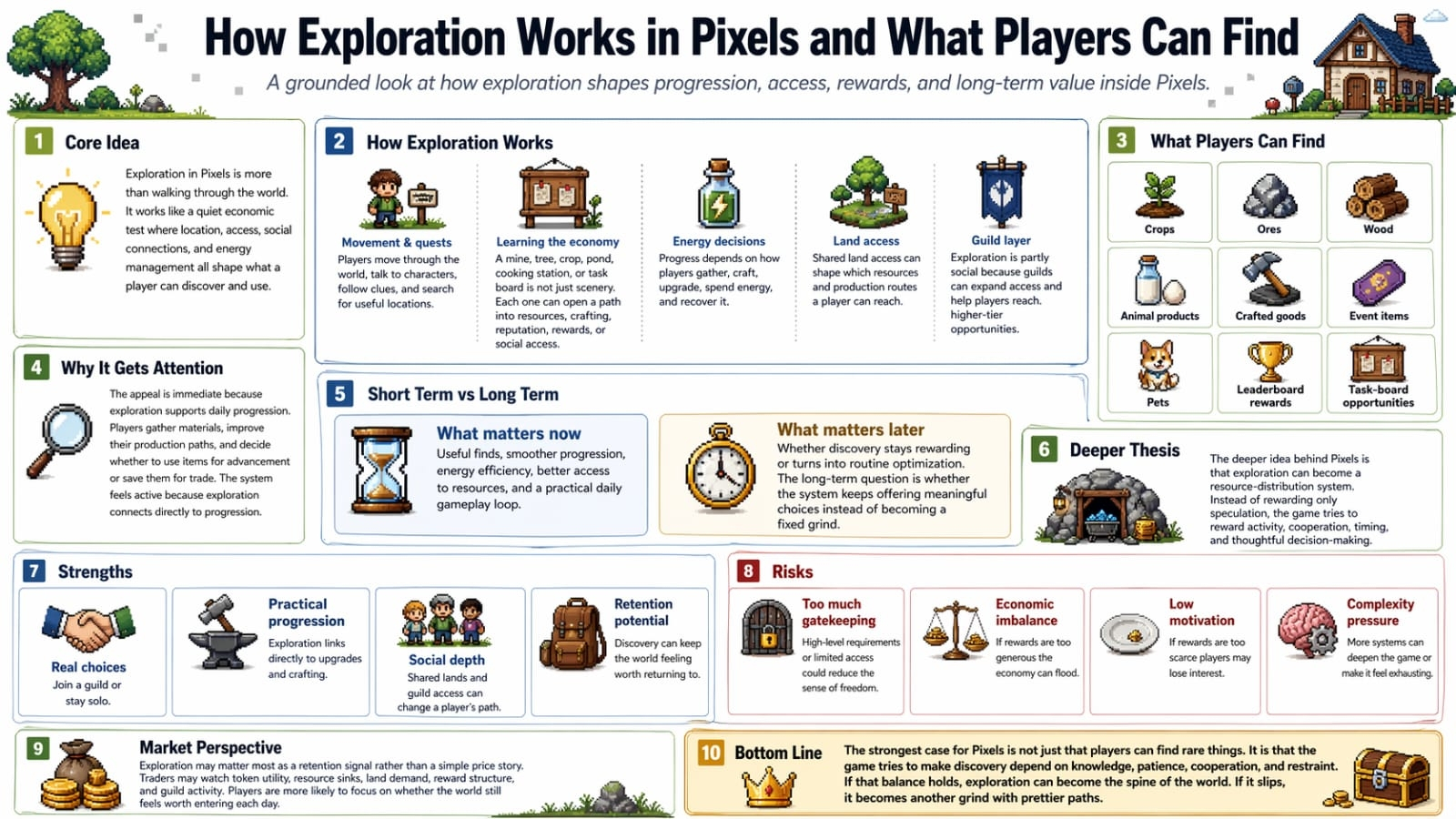
The longer-term question is whether this keeps feeling like discovery or turns into routine optimization. That is where I think the project’s deeper thesis sits. Pixels is trying to make exploration into a resource-distribution system that rewards activity and cooperation and timing instead of only raw speculation. Its broader ambition is to move beyond a single farming game toward a more sustainable play-to-earn model with better incentive alignment. I find that logic strongest when the game uses exploration to create real choices. A player has to decide whether to join a guild or stay solo and whether to chase higher-tier resources or stay casual and whether to spend energy now or preserve it and whether to craft for progression or respond to market demand.
The risk is that these systems can become too tight. If the best discoveries sit behind high-level requirements and land access and VIP perks and social coordination then exploration may feel less like freedom and more like gatekeeping. If rewards become too generous then the economy gets flooded. If they become too scarce then players may stop caring. Recent Chapter 3 material shows Pixels pushing further into team-based competition through Unions and Yieldstones and Hearths and sabotage and task-board participation while also tying one new crafting input called PearlySwirl to level 40 Exploration from ponds. That is more complex and complexity can deepen a game or exhaust it.
My market view is that Pixels’ exploration matters most as a retention signal rather than as a simple price story. Traders may watch token utility and reward pools and land demand and guild activity and whether new systems create real sinks for resources. Players may care more about whether the world still feels worth entering each day. For me the strongest case is not that Pixels lets people find rare things. It is that the game is trying to make finding things depend on knowledge and patience and cooperation and restraint. If that balance holds then exploration can become the spine of the world. If it slips then it becomes another grind with prettier paths.