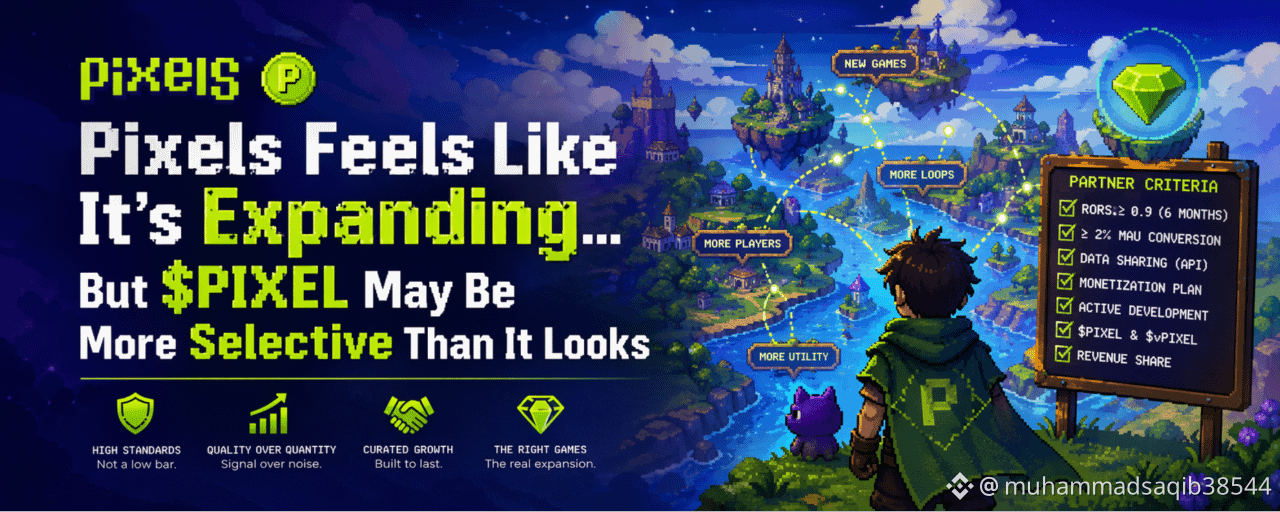
#pixel Every announcement about a new game joining the @Pixels ecosystem arrives wrapped in the language of growth.... More titles. More loops. More surfaces for PIXEL to touch. And for a moment, each announcement feels like evidence of momentum.
Then I started reading the actual requirements for joining. And something about the whole picture shifted.
Not in a negative direction. Just in a more precise one.
Because the gap between what "expansion" sounds like and what the Pixels partner criteria actually demand is wider than the announcements suggest. And that gap is worth sitting with before drawing any conclusions about what $PIXEL's trajectory actually depends on.
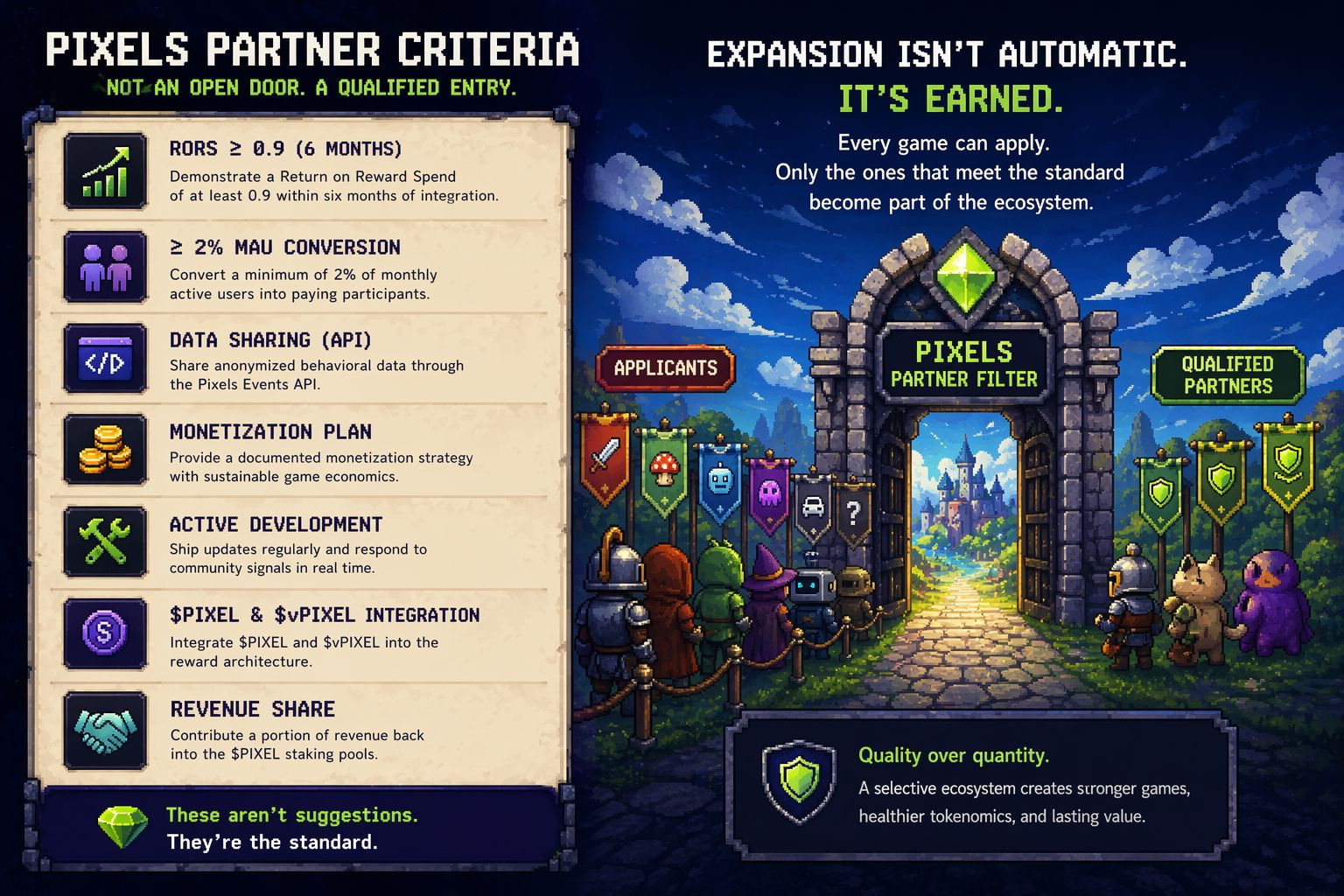
The whitepaper lays out what a game needs to demonstrate before it qualifies for ecosystem participation. A Return on Reward Spend of at least 0.9 within six months of integration. Converting a minimum of two percent of monthly active users into paying participants. A genuine commitment to sharing anonymized behavioral data through the Pixels Events API. Documented monetization strategies. Development teams capable of shipping updates with regularity and responding to community signals in real time. A willingness to integrate PIXEL and $vPIXEL into their reward architecture and contribute revenue share back into the staking pools.
Read through those requirements slowly. None of them describe a low bar.
A RORS of 0.9 within half a year means the game needs to demonstrate near-sustainable reward economics almost immediately after plugging into an unfamiliar infrastructure. A two percent MAU conversion rate sounds modest until you consider what percentage of mobile game audiences ever spend anything at all. Open data sharing requires a level of institutional trust that many studios guard carefully. And revenue share back into staking pools asks studios to redistribute a portion of income they could simply retain.
These aren't welcoming terms. They're qualifying terms. The kind of framework you build when you're more interested in who passes than in how many apply.
I kept thinking about professional certification bodies. Not the ceremonial kind that issue credentials after a weekend seminar. The rigorous ones. Where the application process is technically open to anyone with an internet connection but the standards are calibrated so that only practitioners who've already reached a certain level of competence can realistically clear them.
Nobody walking through those doors for the first time passes on their first attempt. And that's entirely deliberate. The certification doesn't derive value from its accessibility. It derives value from the difficulty of obtaining it. The more candidates it screens out, the more the credential means to those who hold it.
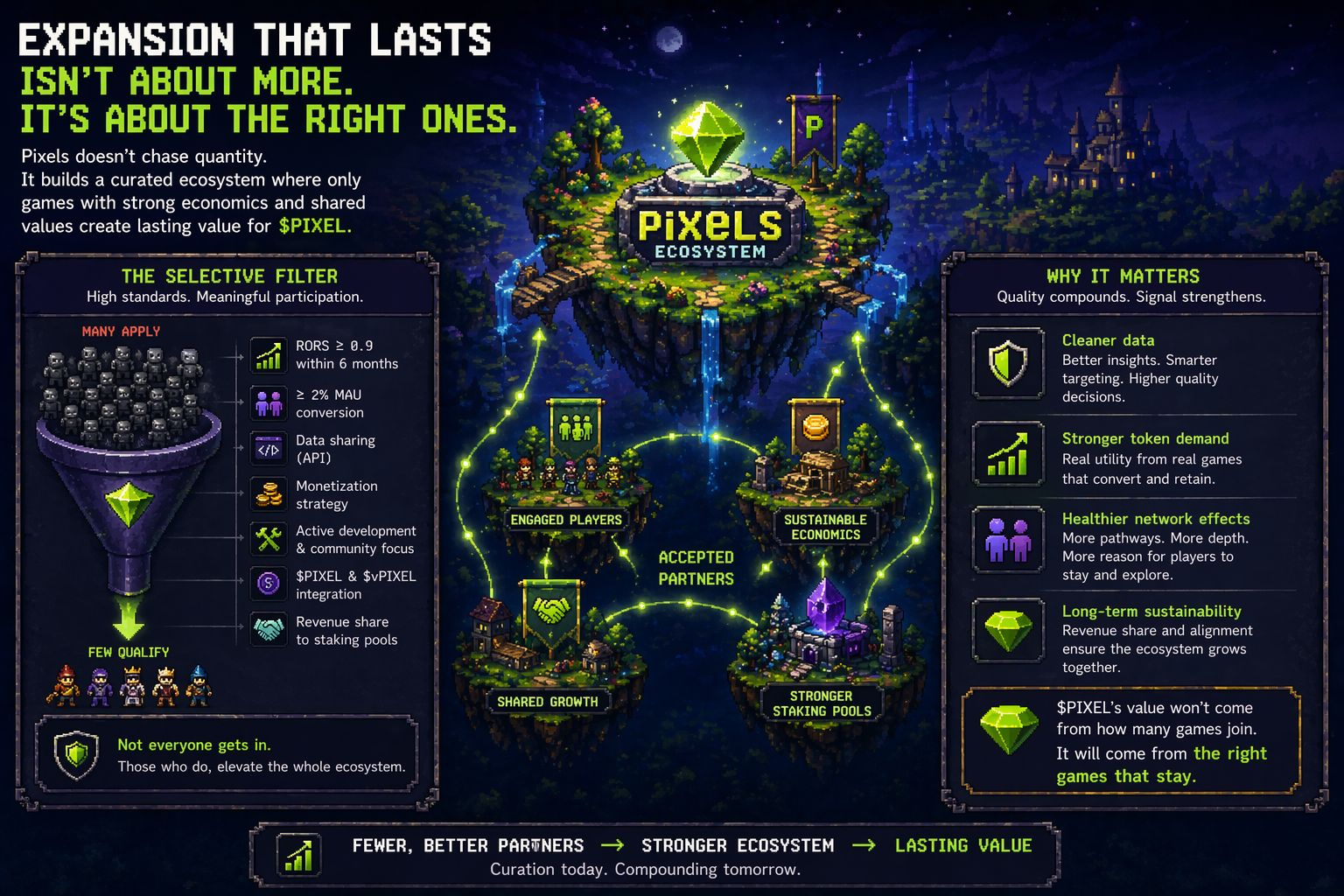
Pixels seems to be constructing something structurally similar with its partner ecosystem. The pitch is openness. The mechanism is curation. And the value of whatever gets built will depend far more on who the filter removes than on the total number of applicants it processes.
This reframes what PIXEL's expansion actually tracks.
Most analysis of gaming token ecosystems follows a straightforward assumption. More games equal more demand. More players across more titles equal more token circulation. More integrations equal more utility. The logic is simple and it isn't wrong exactly. But it's incomplete when the integration process itself is selective.
If two studios apply and only one meets the RORS threshold at six months, the token demand generated by the second application is zero. The ecosystem didn't grow. It auditioned and declined. And that distinction matters for how you model what's actually happening when Pixels announces new partnerships.
The real question isn't how many games are interested in joining. It's how many games have the underlying economics to survive the filter. Those are very different populations.
There's something genuinely right about this approach. Ecosystems that let anything in tend to dilute their signal over time. When every game qualifies regardless of performance, the staking data stops meaning much. Community capital flows toward whatever is loudest rather than whatever is healthiest. The RORS metric loses precision because it's averaging across studios with wildly different economic profiles.
Maintaining a threshold protects the quality of the data, which protects the quality of the targeting, which protects the sustainability of the whole reward model. The selectivity isn't arbitrary. It's load-bearing.
But there's a real tension hiding inside this design that I haven't fully resolved.
Network effects require density. A platform that connects studios and players becomes more valuable as more participants join, but only if those participants are genuinely interacting with each other. Too few studios means too few player pathways through the ecosystem. Too few pathways means players don't develop the cross-game behavioral patterns that make PIXEL useful as a cross-ecosystem currency rather than just a single-game token.
Getting the calibration right between quality thresholds and network density is genuinely difficult. Set the bar too high and the ecosystem stays clean but thin. Drop it too low and you gain breadth while sacrificing the signal integrity that makes the whole system worth building.
Whether the current partner criteria land in the right place is something Phase 3 data will eventually clarify. Right now it's still a hypothesis dressed in the vocabulary of standards.
What I do feel fairly confident about is this: if $PIXEL value ends up being meaningful, it won't be because many games joined. It'll be because the right games joined and stayed long enough to prove their economics.
That's a different kind of growth. Slower to show up on a chart. Harder to celebrate in an announcement. But possibly the only kind that actually holds.