
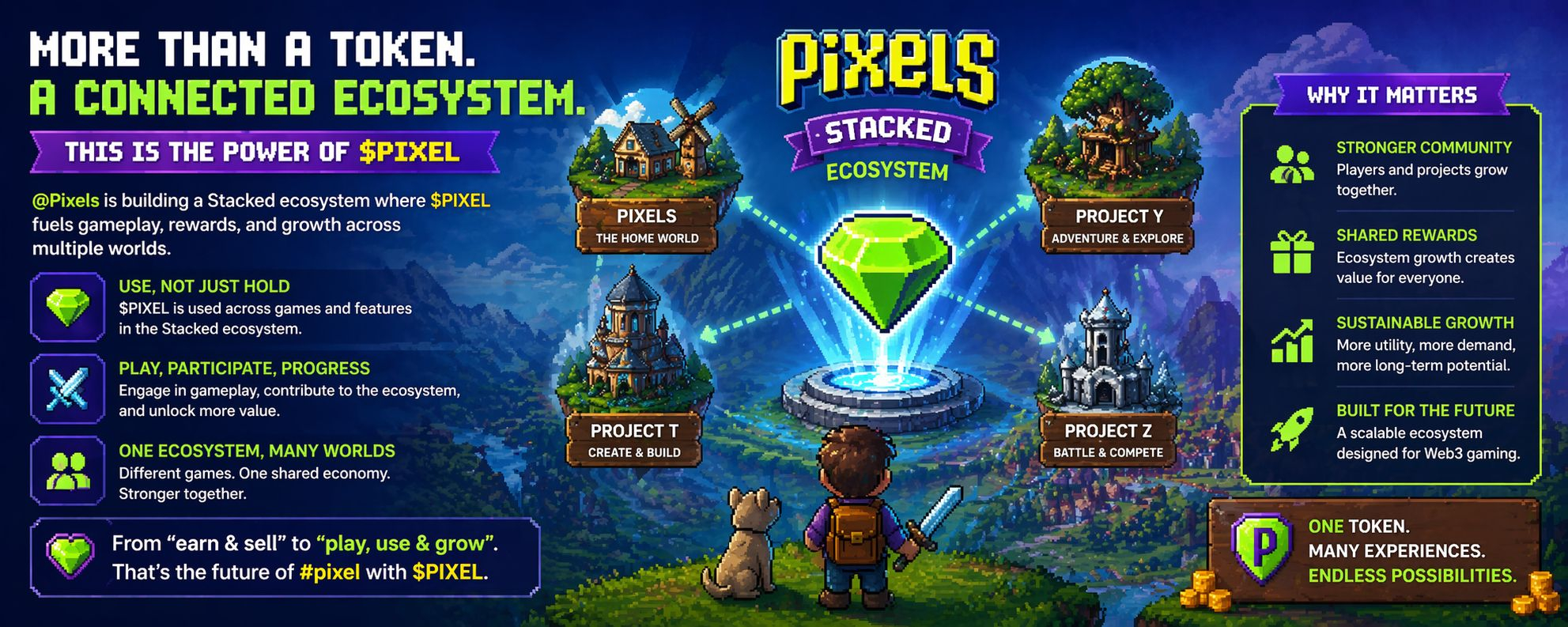
In the early days of blockchain gaming, most tokens followed a simple pattern: players earned them, then quickly sold them. While this created short-term excitement, it often failed to build long-term value. @Pixels is addressing this challenge by designing $PIXEL with deeper utility through its Stacked ecosystem.
Instead of focusing on a single game, the Stacked ecosystem connects multiple experiences under one shared economic layer. This means pixel is not limited to one use case—it can evolve as new games and features are added. As a result, players are not just participants in a game, but contributors to a growing digital economy.
One key idea behind this system is utility through interaction. Players can engage with different parts of the ecosystem, and $PIXEL becomes a tool for progression, participation, and potential rewards. This reduces the reliance on constant new players and shifts the focus toward sustainable engagement.
Another important aspect is scalability. As more projects join the ecosystem, the value of being part of it can increase. This creates a network effect where both players and developers benefit from shared growth rather than isolated success.
In simple terms, @Pixels is trying to solve one of GameFi’s biggest problems: sustainability. By giving $PIXEL real use across an expanding ecosystem, it moves closer to becoming a meaningful in-game asset rather than just a tradable token.
For anyone interested in the future of Web3 gaming, understanding how #pixel evolves through pixel and the Stacked ecosystem is definitely worth watching.