
Why do so many blockchain games feel like something you try once, rather than something you return to every day? It is not a technical problem as much as a human one. People don’t stay because something is new or innovative. They stay because it feels natural, familiar, and worth their time even when nothing is being earned.
This is where Web3 gaming has struggled from the beginning. The early idea was simple: if players truly own their in-game assets, they will feel more connected and engaged. On paper, that makes sense. But in practice, ownership alone did not create attachment. Many players found themselves learning wallets, tokens, and marketplaces before they even understood the game itself. Instead of feeling empowered, the experience often felt layered and heavy.
Different projects tried to fix this in different ways. Some leaned heavily on rewards, hoping that earning would keep people involved. And for a while, it worked. But once those rewards slowed down, so did the interest. Others tried to copy familiar game styles, but kept the blockchain part separate enough that it felt optional rather than meaningful. The result was often the same: either the game felt like work, or the ownership felt unnecessary.
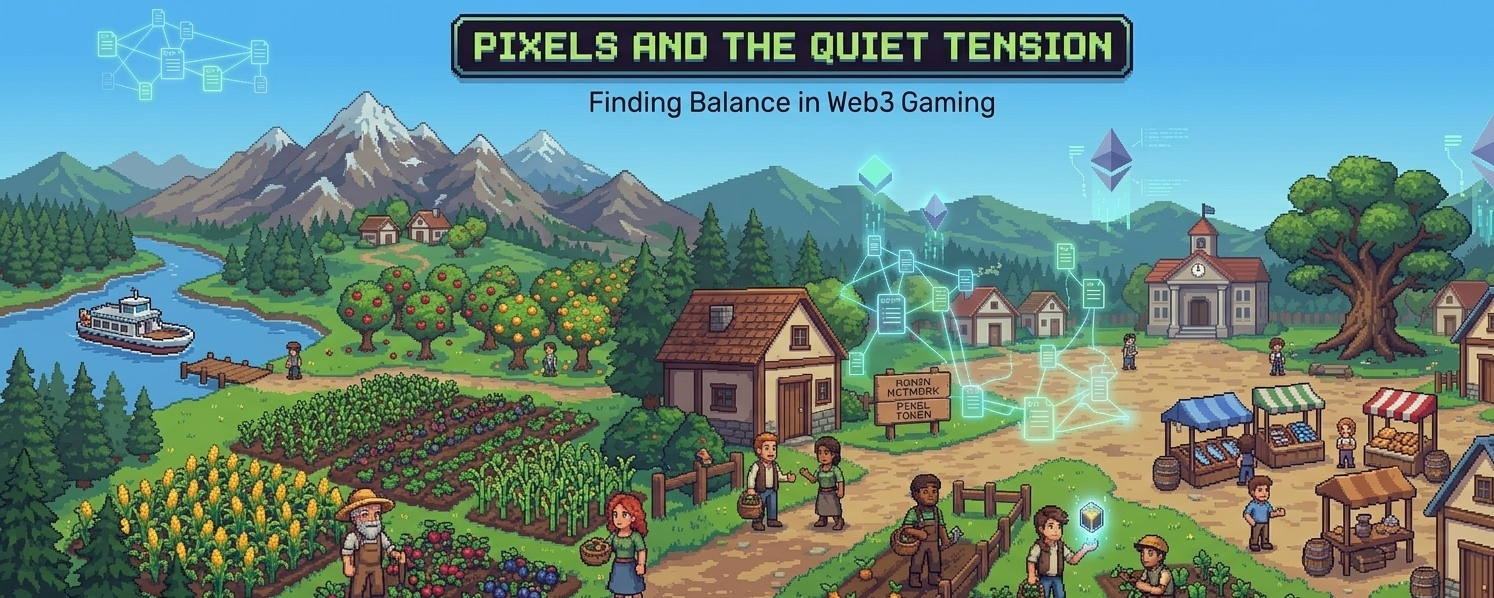
Pixels sits somewhere in the middle of this ongoing experiment. At first glance, it feels simple. You farm, explore, collect resources, and slowly build your progress. There is no pressure to understand everything immediately. In fact, part of its design seems to rely on routine—doing small, repeated actions that gradually add up over time. That kind of loop is not new, but it is something many players already understand.
A big part of this experience is shaped by the Ronin Network. Ronin focuses on making interactions smooth and low-cost, which matters for a game built around constant small actions. If every step felt slow or expensive, the entire experience would break down. By reducing that friction, Pixels allows players to focus more on what they are doing rather than how the system works behind the scenes.
But that leads to an interesting trade-off. The smoother the experience becomes, the less noticeable the blockchain is. And when players stop noticing it, a question naturally comes up: does it still add something meaningful, or is it just quietly sitting in the background? In Pixels, ownership exists through land, items, and progression, but much of the gameplay can feel similar to traditional simulation games. For some players, that is a strength. For others, it may blur the purpose of having a blockchain at all.
The game’s evolving use of the PIXEL token also shows that things are still being figured out. Like many Web3 projects, it has to balance rewards with long-term stability. If rewards are too strong, the system can become unsustainable. If they are too weak, players may lose interest. There is no perfect balance, only constant adjustment.
Who gets the most out of a game like this depends a lot on the player. Someone who enjoys slow, steady progress and social interaction may find Pixels relaxing and engaging. Players already familiar with Web3 may appreciate the ownership layer and flexibility. But more casual players—especially those who just want a simple, distraction-free game—might still feel that the extra systems are not really needed.
What Pixels shows is not a final answer, but a shift in direction. It is trying to make Web3 gaming feel less like a system you have to learn and more like a place you can settle into. That is a meaningful step, even if it does not solve everything.
And maybe that brings us back to the original question. If a game becomes enjoyable enough on its own, does the blockchain quietly support it—or does it eventually become something players stop thinking about altogether?