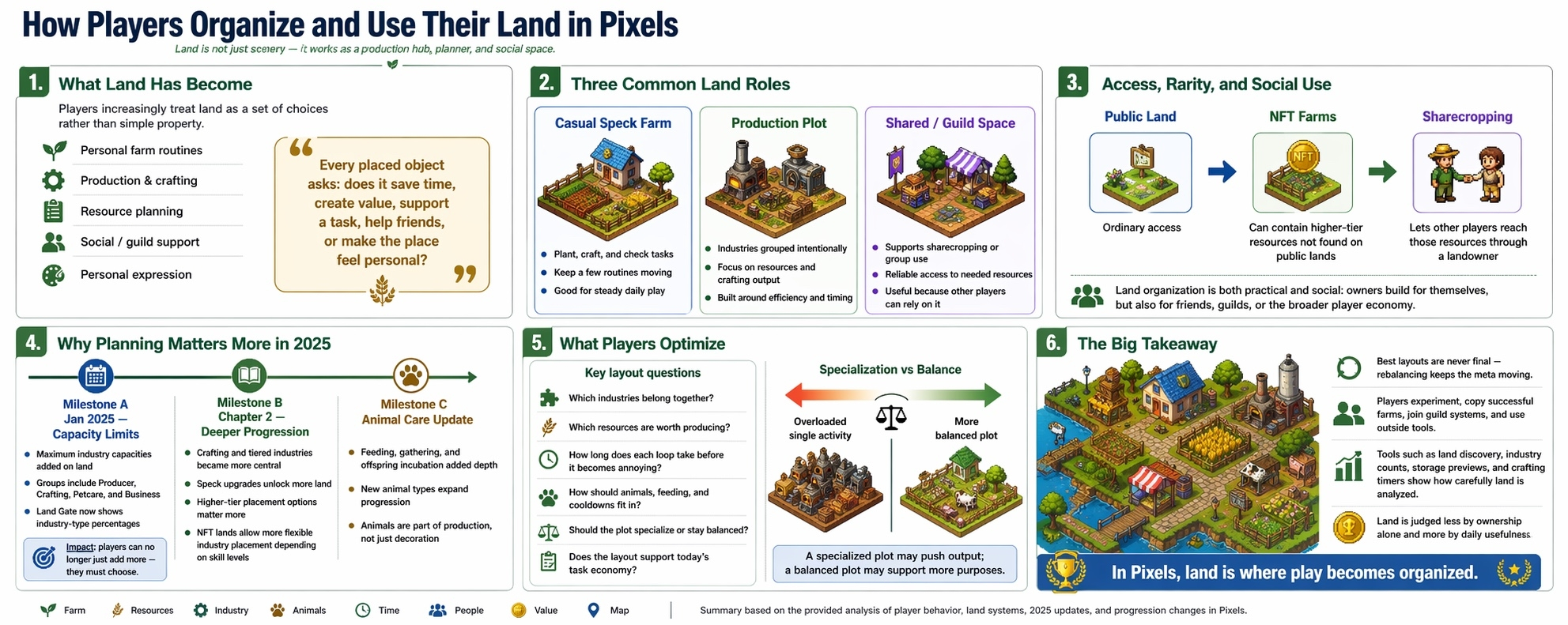
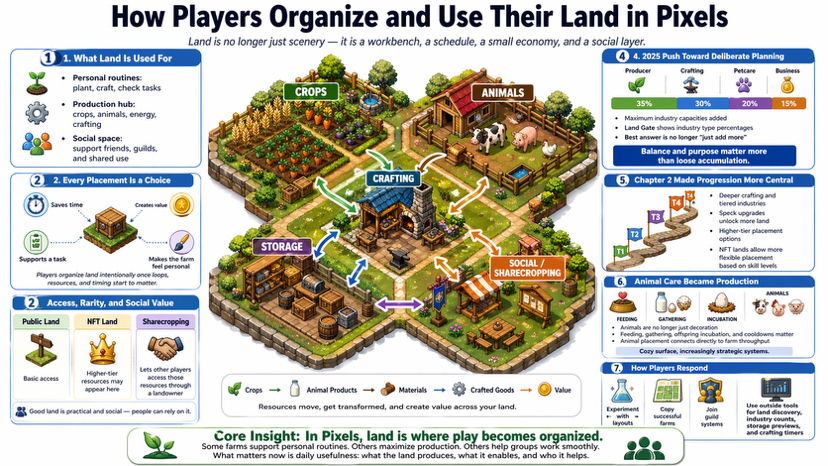
I used to think of land in Pixels as mostly a backdrop where the farming happened while the real game lived somewhere else. The more I look at how players actually use it now though the more my view changes. Land is not just scenery or storage space. It is closer to a workbench and a schedule and a small economy with a social layer built into the same map. Pixels itself describes the basic fantasy simply as players managing crops and raising animals and harvesting energy while using that activity to build out their part of the world. In practice the interesting part is how players decide what their land is for.
A casual player may treat a Speck as a personal farm where they can plant and craft and check tasks while keeping a few routines moving. That is still a real way to play. Players who stay longer often organize land with more intention because they begin to think about which industries belong together and which resources are worth producing and how much time a loop takes before it becomes annoying. I find it helpful to look at land less like property and more like a set of choices. Every object placed on it asks a quiet question about whether it saves time or creates value or supports a task or helps friends or simply makes the place feel personal.
The distinction between ordinary access and owned land matters because some resources are tied to land type and rarity. Pixels’ own land documentation says NFT farms can contain higher tier resources that are not found on public lands while sharecropping gives other players one route to reach those resources through a landowner. That makes organization partly practical and partly social. A landowner may arrange a plot to support their own production while also opening parts of it to other players through guild activity or sharecropping. The land becomes useful because people can rely on it. A good farm is not only full because it also has to make sense to the people who use it.
What has changed recently is that the game has been pushing players away from loose accumulation and toward more deliberate planning. In January 2025 Pixels added maximum capacities for industries on land with groups such as producer and crafting and petcare and business while also showing industry type percentages at the Land Gate. That kind of limit changes the feel of land management because the best answer can no longer be to simply add more. Players have to choose. A plot overloaded with one kind of activity may stop being efficient while a more balanced plot can serve more purposes even if it becomes harder to optimize. I like that tension because it makes land feel less like a spreadsheet and more like a small farm with real constraints.
Chapter 2 also made land progression and crafting more central. Reports on the update described deeper crafting and tiered industries and Speck upgrades that unlock more land along with higher tier placement options while NFT lands allow more flexible industry placement depending on skill levels. That helps explain why people are paying closer attention now than they might have five years ago. In older web3 game discussions land often sounded like a promise about future value. In Pixels today land is judged more by daily usefulness. The important questions are what it produces and what it lets you craft and who can use it and whether its layout supports the current task economy.
The Animal Care update pushed this even further. Animals are no longer just charming things sitting around the farm because recent coverage describes feeding and gathering and offspring incubation and new animal types as part of a broader progression loop. That means a player organizing land has to think about animals as part of production rather than decoration. Placement and feeding needs and cooldowns and related crafting all start to matter. What surprises me is how quickly a cozy looking farm game can become a game about timing and throughput without losing its gentle surface.
There is uncertainty here and it is worth saying plainly. When a game keeps rebalancing land and industries and recipes and energy costs and animal systems the best layout is never final. Players respond by experimenting or copying successful farms or joining guild systems or using outside tools. Pixels Guru for example advertises resource finding and land discovery and industry counts and storage previews along with crafting timers which tells me players are already treating land as something worth searching and analyzing carefully. That does not mean every player needs to optimize everything. It means land has become dense enough that organization has real consequences.
So when I think about how players use land in Pixels I do not see one pattern. I see farms that serve personal routines and plots that support production and shared spaces that help groups work more smoothly. Some players will chase efficiency while others will decorate or sharecrop or visit the plots that make their current goal easier. The point is that land gives all of those behaviors a place to happen. That is why it keeps getting attention. Not because land ownership is a magic idea on its own but because in Pixels land is where play becomes organized.