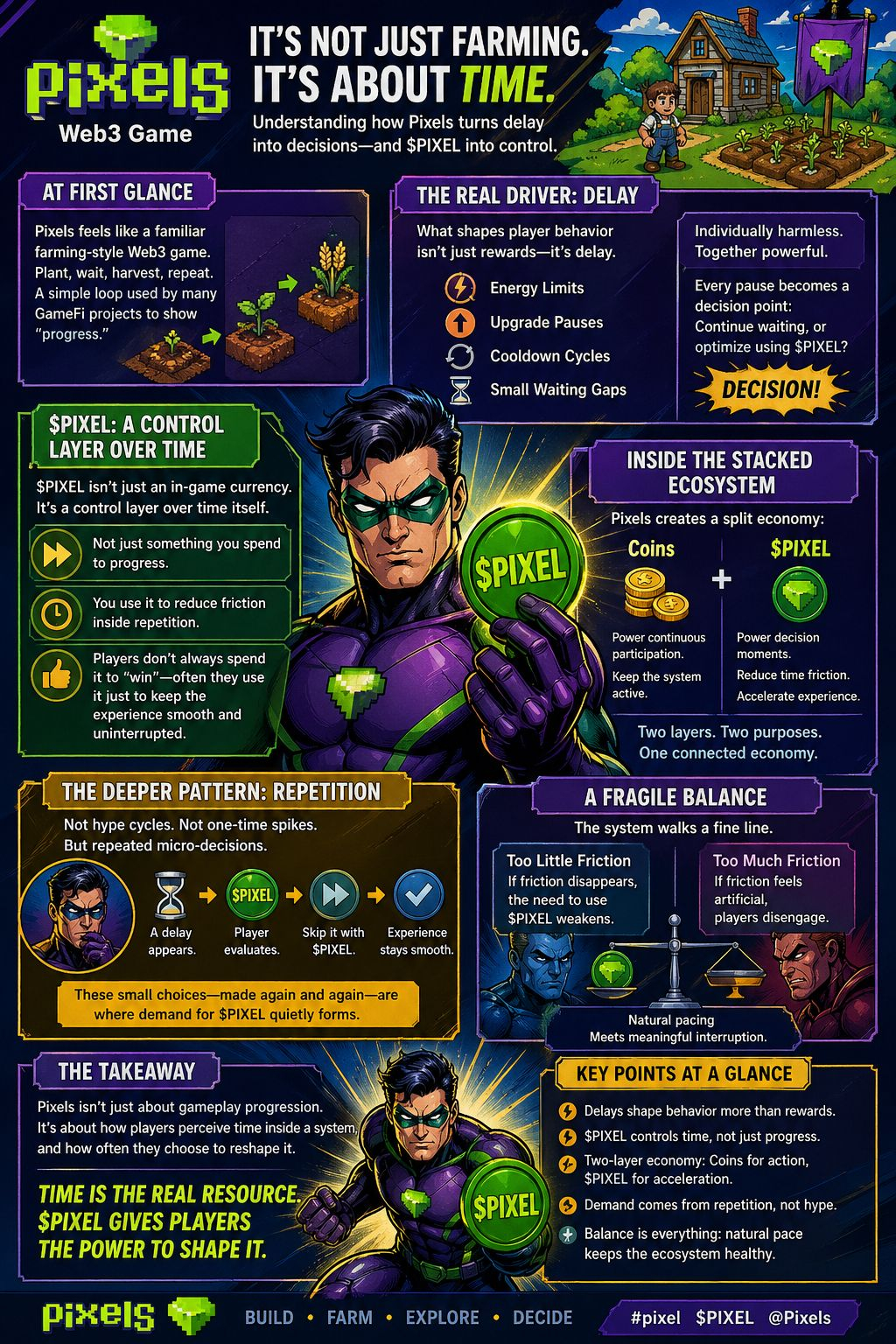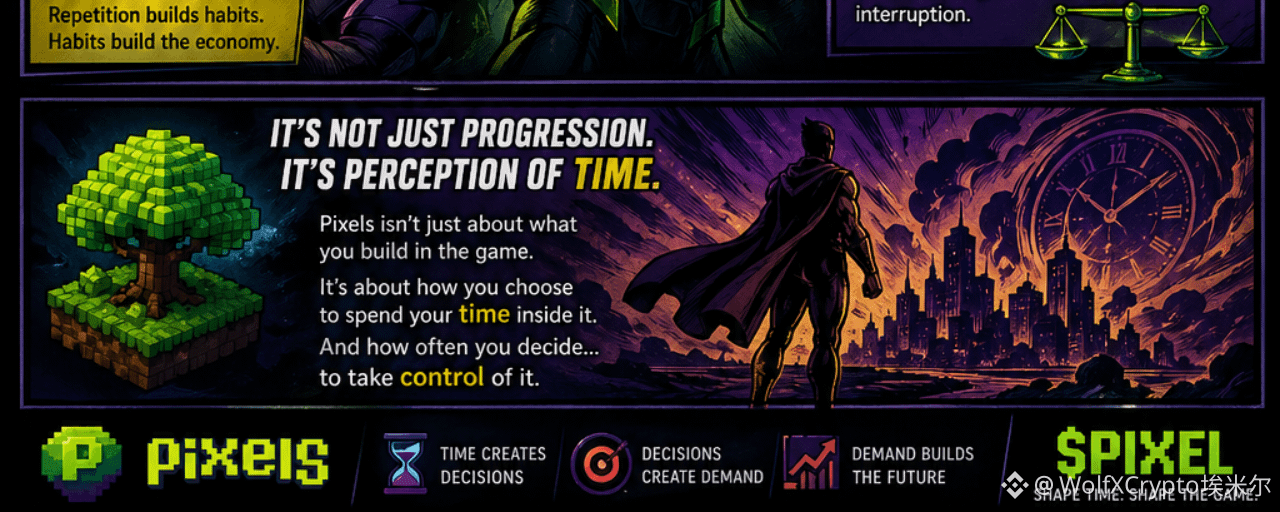
I didn’t really notice it at first. @Pixels Pixels felt like another familiar Web3 farming loop sitting on top of a token system. Plant, wait, harvest, repeat. I’ve seen enough Gamefic models to assume I already understood the pattern. But after observing how players actually interact with the system, something subtle starts to stand out. It’s not just about farming or exploration. It’s about how time itself is structured inside the experience.
What players react to isn’t only reward size or token output. It’s the delay between actions. The waiting. The pauses. The small interruptions that sit between intention and outcome. Energy limits, upgrade locks, cooldown cycles—individually they look harmless. But together they form a layered system of friction. And friction changes behaviour more than rewards ever do. That’s where $PIXEL XEL becomes interesting.
It doesn’t behave like a traditional in-game currency. It feels more like a control mechanism for time inside the ecosystem. You’re not just spending it to acquire items—you’re using it to remove waiting, reduce friction, or bypass repetition. In many cases, players aren’t spending $PIXEL to “win more.” They’re spending it to wait less.
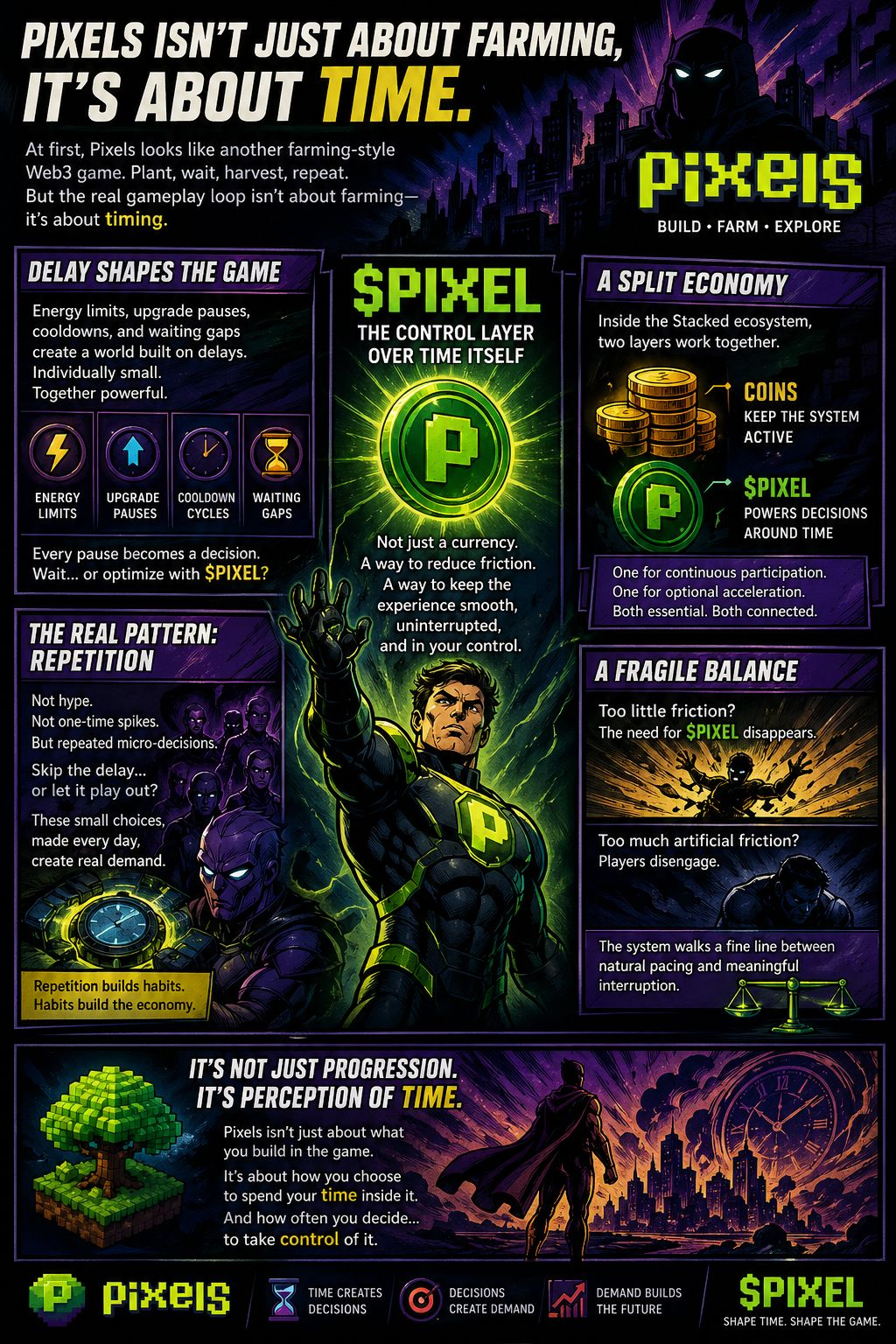
That is a very different kind of demand. Not hype-driven. Not event-driven. But behaviour-driven. Inside @Pixels Pixels, there’s also a quiet split in how the system operates. One layer is built around continuity—coins, farming loops, routine progression. That layer keeps the world active and stable. You can stay there indefinitely without ever touching premium mechanics. But another layer exists underneath it. A layer of control.
When players want to shape their experience rather than just participate in it, they naturally drift toward $PIXEL. Not because the system forces it aggressively, but because control always becomes valuable when repetition increases.
Over time, players start making micro-decisions:
Skip this wait.
Speed up that process.
Avoid repeating that cycle again.
Individually, these choices feel small. But repeated across thousands of players, they form a consistent behavioural pattern. That’s where the Stacked ecosystem concept becomes important. It isn’t just about stacking rewards or upgrades. It’s about stacking decisions over time—each one tied to friction, patience, and optional acceleration. What makes this structure interesting is that it doesn’t rely purely on growth metrics or external hype cycles. Instead, it relies on repetition of experience. The more often players encounter friction, the more often they face the same decision point. Wait… or use $PIXEL.
However, this system is not without risk. If the experience becomes too efficient, friction disappears—and so does the motivation to spend. On the other hand, if friction feels artificial or forced, players adapt by disengaging entirely instead of participating in the solution.
So the design has to remain balanced. Friction must feel natural. Almost invisible. Like part of the world, not a monetization layer sitting on top of it. That balance is extremely difficult to maintain at scale. From a broader perspective, most market discussions around Game Fi still focus on supply schedules, token unlocks, and user growth. Those are visible and easy to measure. But the real dynamic inside systems like @Pixels is behavioural, not structural.
It exists in the repeated, almost unconscious choices players make:
Pause or proceed.
Wait or accelerate.
Repeat or optimize.
That’s where pixels tally lives—not just in wallets or charts, but in decision loops. And this is why simple adoption metrics don’t fully capture what’s happening. A system like this can have stable user numbers but still evolve in internal demand patterns depending on how often those friction points appear. Still, nothing here is guaranteed.
Players always have alternatives. Sometimes they adapt and tolerate the wait. Sometimes they optimize around it. And sometimes they leave entirely instead of paying to remove friction. That exit option always exists, regardless of design.
So the long-term strength of $PIX$PIXEL end less on expansion alone and more on how consistently the system can maintain meaningful, natural friction without breaking immersion.
Because once players stop feeling the weight of waiting, the decision layer disappears. And when decisions disappear, demand becomes harder to sustain. For now, @Pixels sits in an interesting position—between gameplay and control, between participation and acceleration, between routine and choice. And $PIXLS exactly at that boundary. Not as just a token. But as a mechanism for shaping time inside the system.