
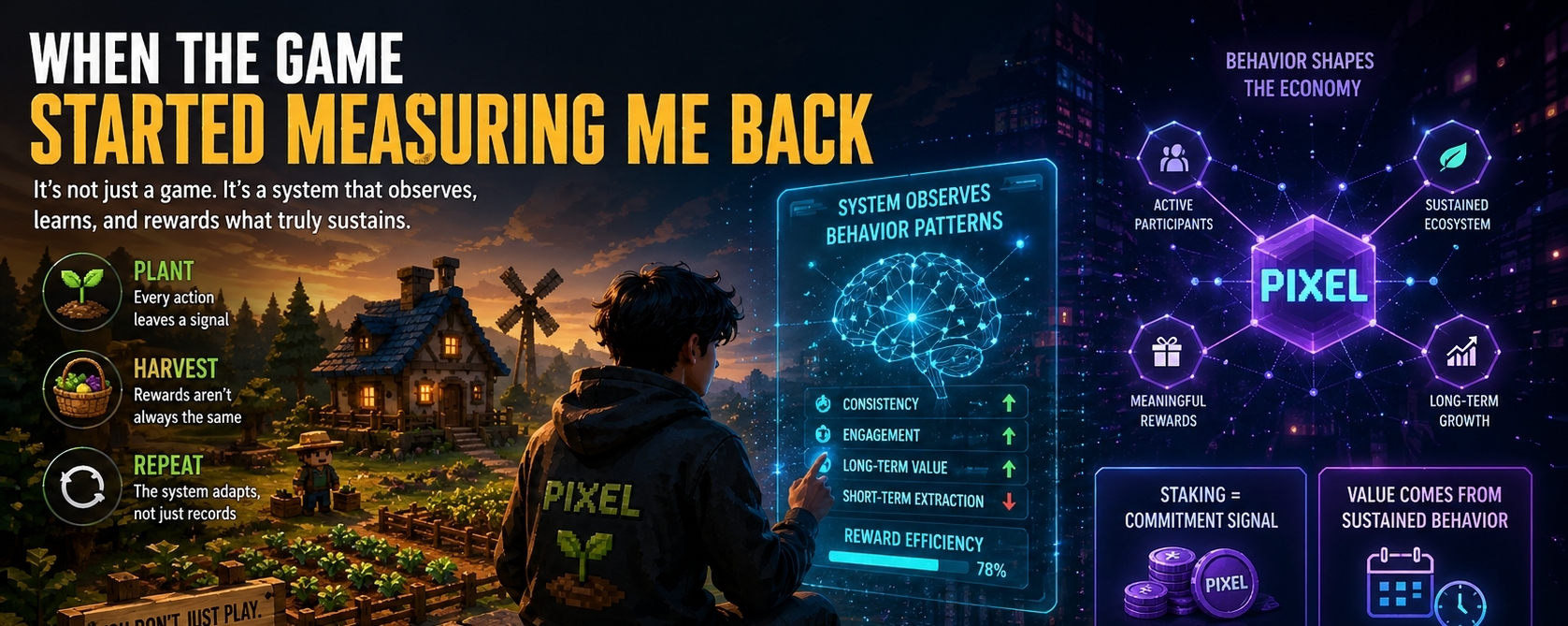
@Pixels At the beginning, it never felt like anything more than a simple routine. You log in, plant a few crops, harvest what’s ready, and move on without thinking too much about it. It’s the kind of loop that feels familiar, almost automatic, like something your hands learn before your mind even gets involved. There’s no pressure to question it, no reason to look deeper. It just works the way you expect it to, and that’s enough.
But somewhere along the way, that feeling starts to shift, not in a sudden or obvious way, but slowly, almost quietly. You begin to notice small inconsistencies, moments where the outcome doesn’t fully match the effort you put in. At first, it’s easy to brush off as randomness, the kind of variation every system has. Yet the more you repeat the same actions, the harder it becomes to ignore that something else might be happening beneath the surface. It doesn’t feel broken or chaotic, just slightly… aware, like the system isn’t only processing what you do, but somehow weighing it.
That’s where the experience begins to change. The loop stops feeling like a fixed structure and starts feeling more fluid, almost responsive. Actions don’t always lead to identical results anymore, even when everything seems the same on your end. And instead of clear patterns, there’s this subtle sense that the system is adjusting itself over time, not randomly, but with intention that isn’t fully visible. It creates this quiet tension where you’re no longer just repeating tasks, you’re trying to understand something that doesn’t openly explain itself.
Going in, the expectation is always the same—optimize early, move fast, extract value, and eventually slow down when it no longer makes sense. That’s the rhythm most systems follow, especially in environments built around tokens and rewards. But here, that rhythm doesn’t quite settle the way you expect it to. The outputs don’t stabilize, and the efficiency you try to build doesn’t always hold its shape. Instead, it feels like the system is constantly adjusting how much it gives back, almost like it’s asking whether certain behaviors are worth continuing to reward.
That idea changes everything. It shifts the mindset from simple cause and effect into something more gradual and layered. It’s no longer about doing something once and getting a result, but about whether that same action continues to hold value over time. Rewards don’t disappear, but they don’t stay fixed either. They move, they adapt, they respond in ways that feel connected to how consistently you engage rather than how efficiently you execute.
Over time, this creates a feedback loop that’s easy to miss if you’re not paying attention. You act, the system responds, and without realizing it, you adjust your next move based on that response. It’s not forced, it just happens naturally. And the more you stay inside that loop, the more it starts to shape how you play. You’re no longer just following a strategy, you’re evolving alongside the system, even if you can’t fully explain how or why.
What makes it even more interesting is how this behavior ties into the broader economy around it. On the surface, everything still looks familiar—price movements, sentiment shifts, the usual volatility that comes with any token-based system. But underneath that, there’s a slower layer that feels like it’s trying to connect rewards with something more stable than short-term activity. It’s less about quick gains and more about sustained presence, about who keeps showing up and reinforcing the cycle over time.
Even things like staking start to feel different in that context. Instead of being purely passive, it carries a sense of commitment, like you’re choosing to remain part of the system rather than just passing through it. And that subtle shift changes how value feels. It’s no longer just about what you can take out quickly, but about how your behavior fits into something that’s trying to last longer than a typical cycle.
At the same time, there’s a tradeoff that becomes harder to ignore the longer you stay. As the system starts favoring certain patterns, it naturally begins to filter players. Some approaches seem to gain strength over time, while others slowly lose their impact without ever being directly discouraged. It doesn’t remove freedom, but it reshapes it. You can still play however you want, but the outcomes don’t treat every approach equally anymore.
And maybe that’s necessary. Systems that don’t filter at all tend to collapse under pure extraction, where everyone takes as much as they can without giving anything back. So it makes sense that value would gradually shift toward behaviors that keep the loop alive instead of draining it. Still, that balance between freedom and structure creates a kind of tension that’s always present, even if it’s not always visible.
What stands out the most is how the focus slowly moves away from the token itself and toward behavior. It becomes less about how much you earn in a moment and more about how consistently you engage over time. Who comes back, who stays active, who becomes part of the system rather than just a visitor. That’s where the real weight seems to sit.
And once you start seeing it that way, it’s hard to go back to looking at it as just another game. It begins to feel more like something evolving, something that keeps adjusting how value flows based on what actually holds up over time. Not perfectly, not transparently, but enough to make you notice.
In the end, the question that lingers isn’t about what gets rewarded once. It’s about what continues to be rewarded without breaking everything around it. And the more time you spend inside that loop, the more that question starts to matter.