Honestly... I didn't expect to feel this specific kind of attention reading through how Pixels structures the relationship between the players who own land, the players who work it, and the yield that flows between them.
Not skepticism. not alarm. something closer to the feeling you get when a game mechanic that reads like a simple farming loop turns out to encode one of the most sophisticated economic relationship structures in the Web3 gaming space.
because there's a pattern in how blockchain games describe their player economies that this space accepts without examining what is actually being exchanged. the standard framing separates players into two categories. owners who hold assets and earn passively. non-owners who play for free and earn less. the economy is a hierarchy and the rungs are defined by capital.
but Pixels built something structurally different. the economy has three distinct layers that are interdependent rather than hierarchical, and understanding how those layers interact is what separates players who are optimizing their position from players who are participating without a map.
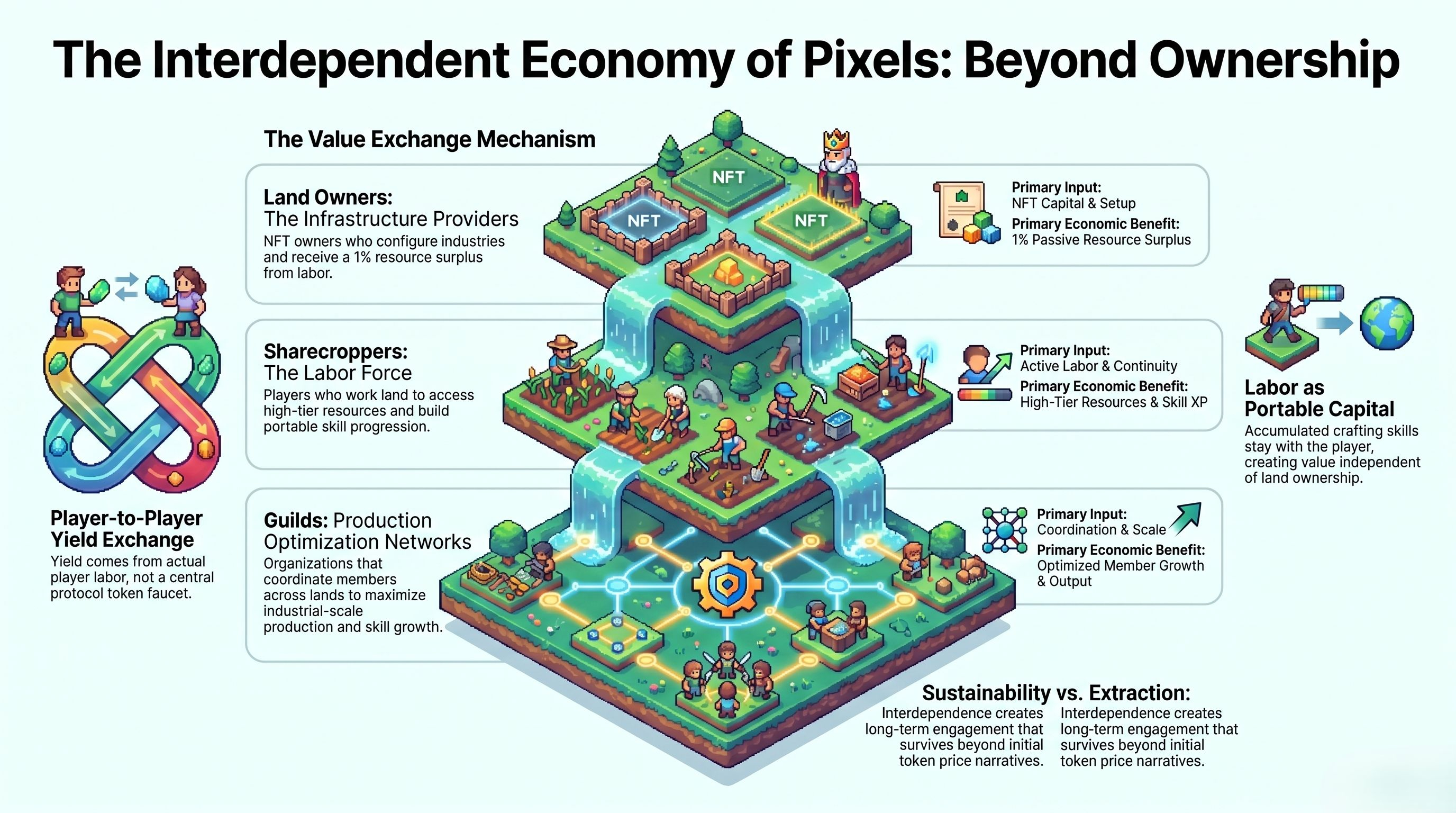
because the product they are describing is real. the whitepaper defines three primary relationships to land. land owners who hold NFT plots, configure industries, and receive a 1% resource surplus from every harvest on their land. sharecroppers who work those industries, access resource tiers unavailable on free plots, and build skill progression through continuity of production. and the broader ecosystem of crafters, traders, and builders who consume the outputs that both layers generate. each role is real. each has distinct incentives. and the yield that each produces is a function of how well they understand the roles above and below them in the chain.
so yeah... the three layers are real.
but a layered economy has never been hard to describe. the hard part is understanding where value is actually created.
and this is where Pixels is doing something that deserves to be examined much more carefully than the typical ownership-versus-free-play conversation allows.
because here's what I keep coming back to. in most Web3 games, value flows in one direction. the protocol emits tokens, players capture them, the exit is to an external market. value enters through emissions and leaves through withdrawal. the player in the middle is a conduit, not a participant in a genuine economy.
Pixels built the yield relationship differently. the 1% surplus that land owners receive from sharecropper activity is not a token emission from a protocol faucet. it is a resource transfer generated by actual labor performed by another player inside the game. the land owner's yield is not a reward for holding an NFT. it is a return on the infrastructure investment they made by configuring industries that other players found worth working. the sharecropper's access to high-tier resources is not a subsidy from the protocol. it is compensation for providing the productive labor that activates the land owner's passive yield.
that is a genuine economic exchange between players, not a distribution from a central faucet. and the distinction matters enormously for long-term sustainability.
then comes the skill layer. because of course.
and here's where it gets genuinely compelling. sharecroppers build skill progression through continuity of production on specific industries. the longer a sharecropper maintains a relationship with a specific land and its industries, the deeper their skill development in those production categories. that accumulated skill is portable. a sharecropper who has spent months developing crafting skills on a well-equipped land owner's plot carries that progression into every subsequent role they play in the ecosystem. the labor they performed for someone else's yield compounded into their own long-term capital.
that dynamic completely reframes what sharecropping means in Pixels. it is not just a temporary arrangement while a player saves toward land ownership. it is a skill investment strategy that generates real returns independent of whether the player ever buys an NFT plot.
there's also a dimension nobody talks about enough.
guilds in Pixels created a third organizational layer on top of the ownership and sharecropping structure. a guild that actively manages its members across multiple land relationships, coordinating which sharecroppers work which industries on which lands, is not just a social community. it is a production optimization network. MetaGaming Guild deployed 1,500 scholars into Pixels at a single point. that is not casual participation. that is industrial-scale production coordination operating on top of the ownership and labor structure Pixels built underneath it. the guild master who matches members to the industries that advance their skills fastest is creating economic value the entire guild that no individual member could create alone.
still... I'll say this.
the decision to build yield as a function of player-to-player exchange rather than protocol-to-player emission reflects a genuine understanding of what makes a virtual economy sustainable over the long term. an economy where players generate value for each other through their interactions is more resilient than one where all value originates from a central faucet and all behavior is oriented toward capturing it before it runs out. the three-layer structure creates genuine interdependence, and genuine interdependence is what keeps players engaged beyond the initial token price narrative.
the question is not whether the ownership, labor, and yield structure creates real economic relationships. it clearly does. the question is how many players currently inside the Pixels ecosystem have mapped all three layers clearly enough to understand which role they are actually playing, which roles they are creating value for, and what they are building toward beyond the next harvest.
and in this space, the players who can answer all three questions are operating with a fundamentally different understanding of what Pixels actually is.
@Pixels #pixel $PIXEL $BSB $AXS