
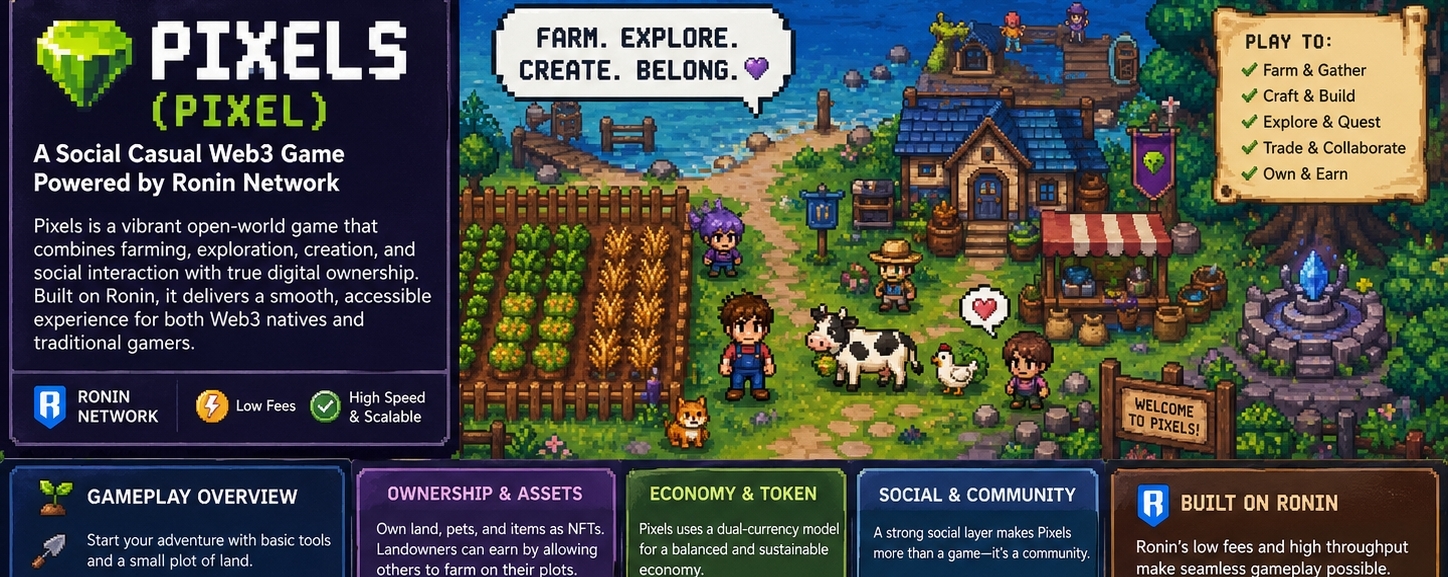
Pixels (PIXEL) feels like one of those rare Web3 games where I can actually see the developers trying to fix what earlier blockchain games got wrong. It isn’t just about tokens or NFTs—it’s about creating a world people actually want to spend time in. Built on the Ronin Network, it blends familiar farming gameplay with blockchain ownership, but in a way that doesn’t constantly remind me I’m using crypto. That’s probably its biggest strength—it lets the gameplay breathe first, and the Web3 layer comes in naturally.
When I look at the core gameplay, it reminds me of classic farming sims, but with a social twist that feels more alive. I’m not just planting crops or chopping wood in isolation; I’m part of a shared world where other players are doing the same thing. There’s something engaging about walking through the map and seeing activity everywhere—people farming, trading, exploring. It makes the environment feel less like a game and more like a small digital society. I think that’s where Pixels really stands out compared to older Web3 titles that often felt empty or overly mechanical.
The progression system is simple on the surface, but it gradually opens up. I start with basic tools and limited energy, and over time I unlock better crafting recipes, more efficient production methods, and new areas to explore. It doesn’t overwhelm me early on, which is important, but it still gives enough depth that I feel like I’m building toward something. Energy management, in particular, adds a subtle layer of strategy. I have to decide what’s worth spending my time on instead of just grinding endlessly, and that keeps the gameplay from becoming repetitive too quickly.
What I find interesting is how Pixels handles ownership. A lot of Web3 games push NFTs aggressively, but here it feels optional rather than forced. I can play for free and still enjoy most of the experience, which lowers the barrier to entry significantly. At the same time, if I choose to invest, owning land or assets gives me additional opportunities. Landowners can benefit from other players using their space, which creates a kind of player-driven economy. It’s not perfect, but it’s a step toward making ownership feel useful instead of purely speculative.
The economy itself tries to strike a balance, and I can see the intention behind it. There’s a soft in-game currency for regular activities and the PIXEL token for more premium interactions. This separation helps prevent everything from turning into a paywall. I don’t feel like I need to spend money to enjoy the game, but I can see how spending enhances the experience. That balance is crucial, especially in a space where “play-to-earn” models have often collapsed because they focused too much on extraction instead of sustainability.
Another thing that stands out to me is how social the game feels. It’s not just about mechanics—it’s about interaction. I can visit other players’ lands, collaborate indirectly through the economy, and feel like my actions exist in a shared ecosystem. That’s something traditional farming games don’t fully capture. Here, the presence of other players adds unpredictability and a sense of community. It’s still early in terms of what this social layer could become, but the foundation is clearly there.
From a technical perspective, building on the Ronin Network makes a noticeable difference. Transactions are fast and cheap, which is essential for a game where small actions happen frequently. If every action felt like a costly blockchain transaction, the experience would fall apart quickly. Instead, it feels smooth enough that I don’t constantly think about what’s happening behind the scenes. That’s exactly how Web3 integration should work—it should support the game, not interrupt it.
I also notice how Pixels leans into interoperability. The ability to use external NFT avatars or assets adds a layer of personalization that goes beyond typical games. It hints at a bigger vision where Pixels isn’t just a standalone game but part of a wider ecosystem. If they expand this idea further, it could turn into a platform where different communities and projects connect, which is something Web3 has promised for a long time but rarely delivered in practice.
Visually, the pixel-art style works in its favor. It’s simple, but it’s also charming and accessible. I don’t need high-end hardware to run it, and that makes it easier for more players to join. At the same time, the style gives it a nostalgic feel that many players are already comfortable with. It doesn’t try to compete with AAA graphics—instead, it focuses on clarity and usability, which fits the overall design philosophy.
That said, I don’t think everything is solved yet. The biggest challenge I see is long-term engagement. Farming and crafting loops can become repetitive if new content doesn’t arrive consistently. The social layer helps, but it needs to evolve further to keep players invested over time. Also, like any token-based ecosystem, there’s always the risk of economic imbalance. If too many players focus on earning rather than playing, it could affect the overall experience.
Still, I think Pixels is moving in the right direction. It shifts the narrative from “play-to-earn” to something closer to “play-and-own,” where enjoyment comes first and rewards are secondary. That mindset alone sets it apart from many earlier projects. I can see why it’s gaining traction—it feels approachable, social, and relatively polished compared to most Web3 games.
Looking ahead, I’m curious about how far they’ll push the idea of user-generated content and expansion. If players eventually get more control over creating experiences within the game, it could transform Pixels into something much bigger than a farming simulator. It could become a kind of sandbox platform where creativity drives the ecosystem. That’s an ambitious goal, but the current structure suggests they’re at least thinking in that direction.
In my view, Pixels isn’t just another blockchain game—it’s more like an experiment in making Web3 gaming actually work for everyday players. It doesn’t ignore the economic side, but it doesn’t let it dominate the experience either. I can play it casually, interact with others, and gradually progress without feeling pressured. That balance is hard to achieve, and while it’s not perfect yet, it shows that Web3 games can evolve beyond their early limitations.