I keep coming back to this question: why do so many digital worlds feel active, but not actually alive? You log in and everything looks like it’s working players moving around, tasks being completed, tokens flowing through the system but after a while, it starts to feel mechanical. Like you’re watching activity, not participating in something that actually matters. That gap between movement and meaning is where most games quietly lose people.
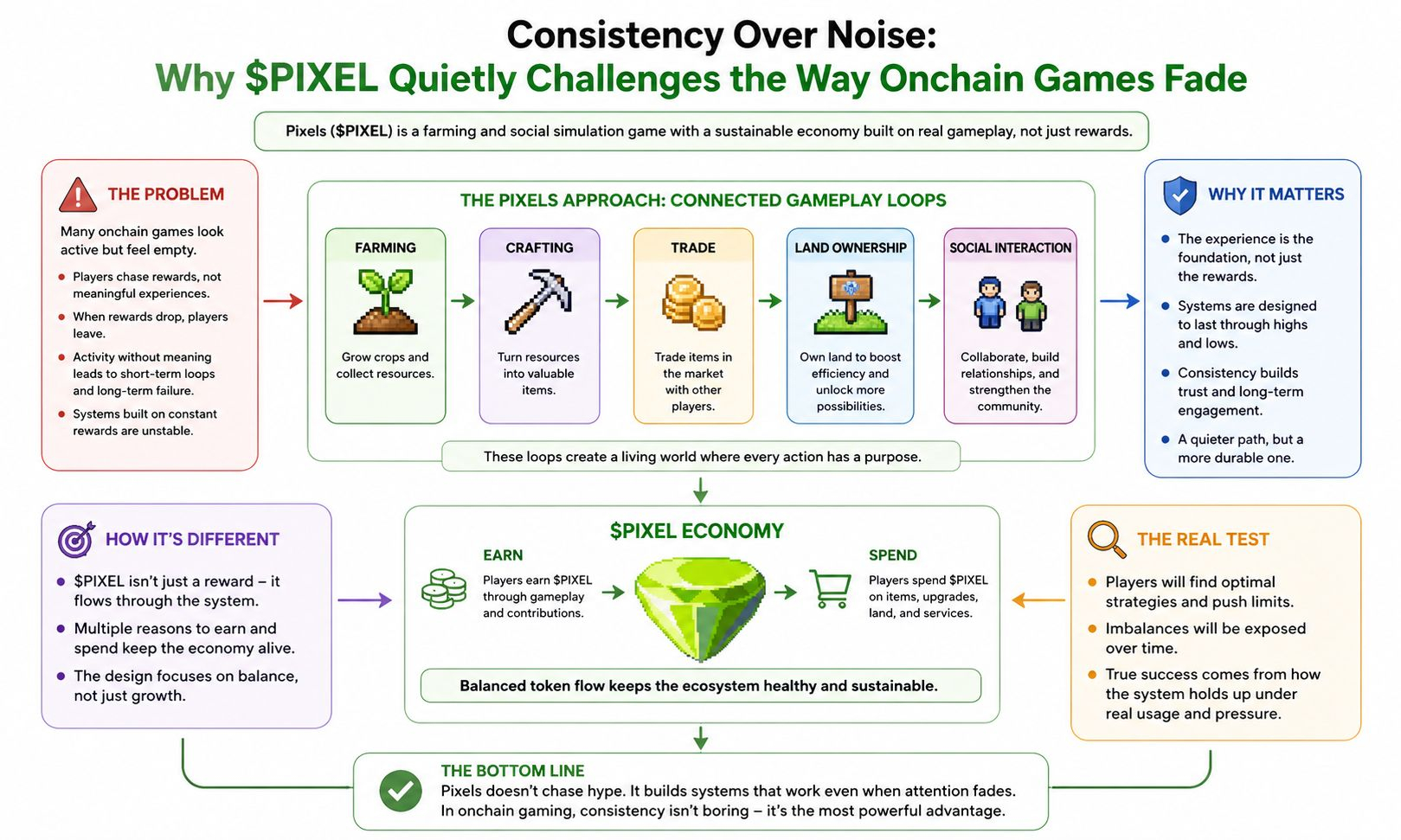
A lot of blockchain based games struggle with this because they lean too heavily on incentives that don’t last. Early on, rewards are attractive enough to pull people in, and for a while, that works. But it also trains players to think in a very specific way. You stop exploring and start calculating. You stop engaging with the world and start optimizing it. And when the rewards begin to shrink or lose value, the entire structure underneath starts to feel fragile. What looked like a living economy turns out to be a temporary loop.
That’s not just a design flaw it’s a pattern. The moment a system depends too much on constant reward pressure, it becomes unstable. Developers try to adjust emissions, rebalance rewards, or introduce new mechanics, but those changes often come too late or feel reactive. The underlying issue isn’t the numbers. It’s that the experience itself wasn’t strong enough to carry people through the quieter phases.
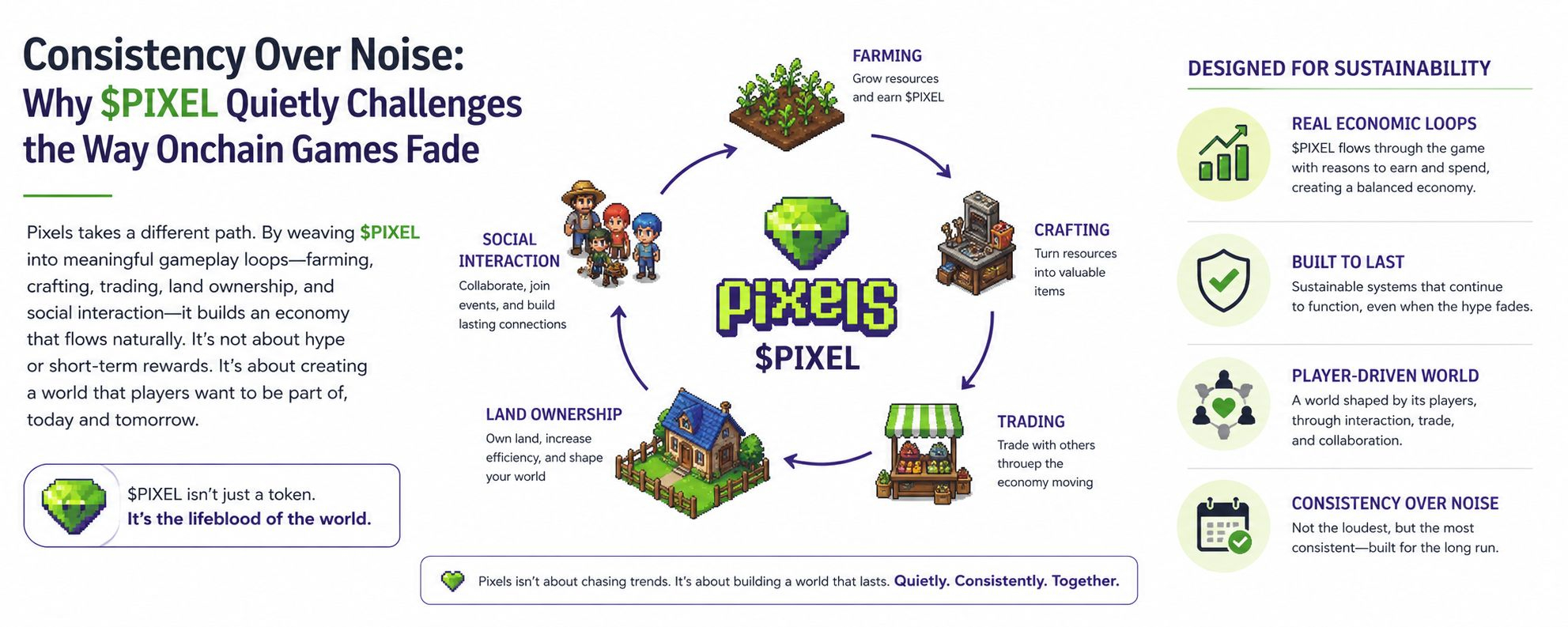
Pixels (PIXEL) doesn’t try to overwhelm this problem with complexity or hype. If anything, it takes a slower and more deliberate approach. On the surface, it’s a farming and social simulation game, which doesn’t sound particularly ambitious. But the way its systems are arranged suggests something more careful. The loops are simple, but they’re connected. Farming leads to crafting, crafting feeds into trade, land ownership shapes how efficiently you can operate, and social interaction adds another layer that isn’t purely transactional.
What makes this interesting is how the economy sits inside those loops instead of floating above them. PIXEL isn’t just something you receive it’s something that moves through the system. There are reasons to earn, but also reasons to spend, and that balance is where things either hold together or fall apart. The design seems aware that if tokens only flow in one direction, the system eventually collapses under its own weight.
Still, none of this guarantees success. Players are unpredictable, and they tend to push systems to their limits. If there’s an optimal strategy, it will spread quickly. If there’s an imbalance, it won’t stay hidden for long. The real test isn’t how the system looks at launch it’s how it behaves after months of real usage, when patterns emerge and pressure builds.
What Pixels seems to understand is that sustainability doesn’t come from constant excitement. It comes from systems that continue to function even when attention drops. It’s not loud, and it doesn’t try to be. But consistency, if it holds, might be the more difficult path and possibly the more durabple one.