
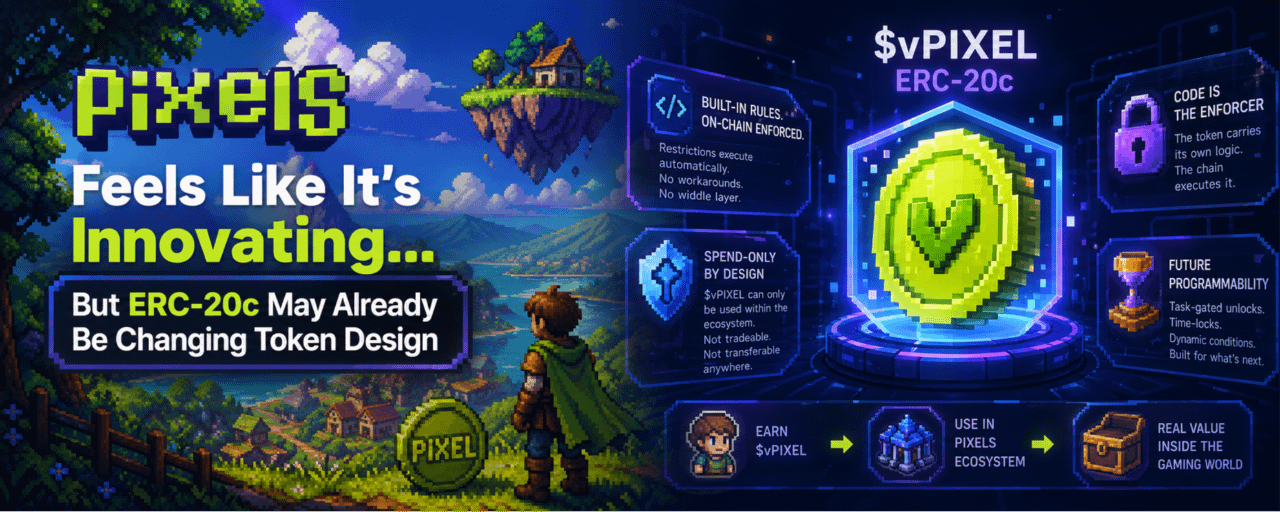
@Pixels didn't expect a technical specification to be the most interesting thing in the whitepaper. I skimmed past it the first time. A paragraph about token transfer logic. Something about programmable restrictions. I mentally filed it under implementation detail and kept reading.
Then I came back to it. And I've been thinking about it differently ever since.
The detail is this. $vPIXEL, the spend-only token inside the Pixels ecosystem, runs on ERC-20c. Not a standard ERC-20. Something with an added layer that most tokens don't have. And once I understood what that layer actually does, the whole $vPIXEL design stopped looking like a tokenomics decision and started looking like something closer to an architectural statement.
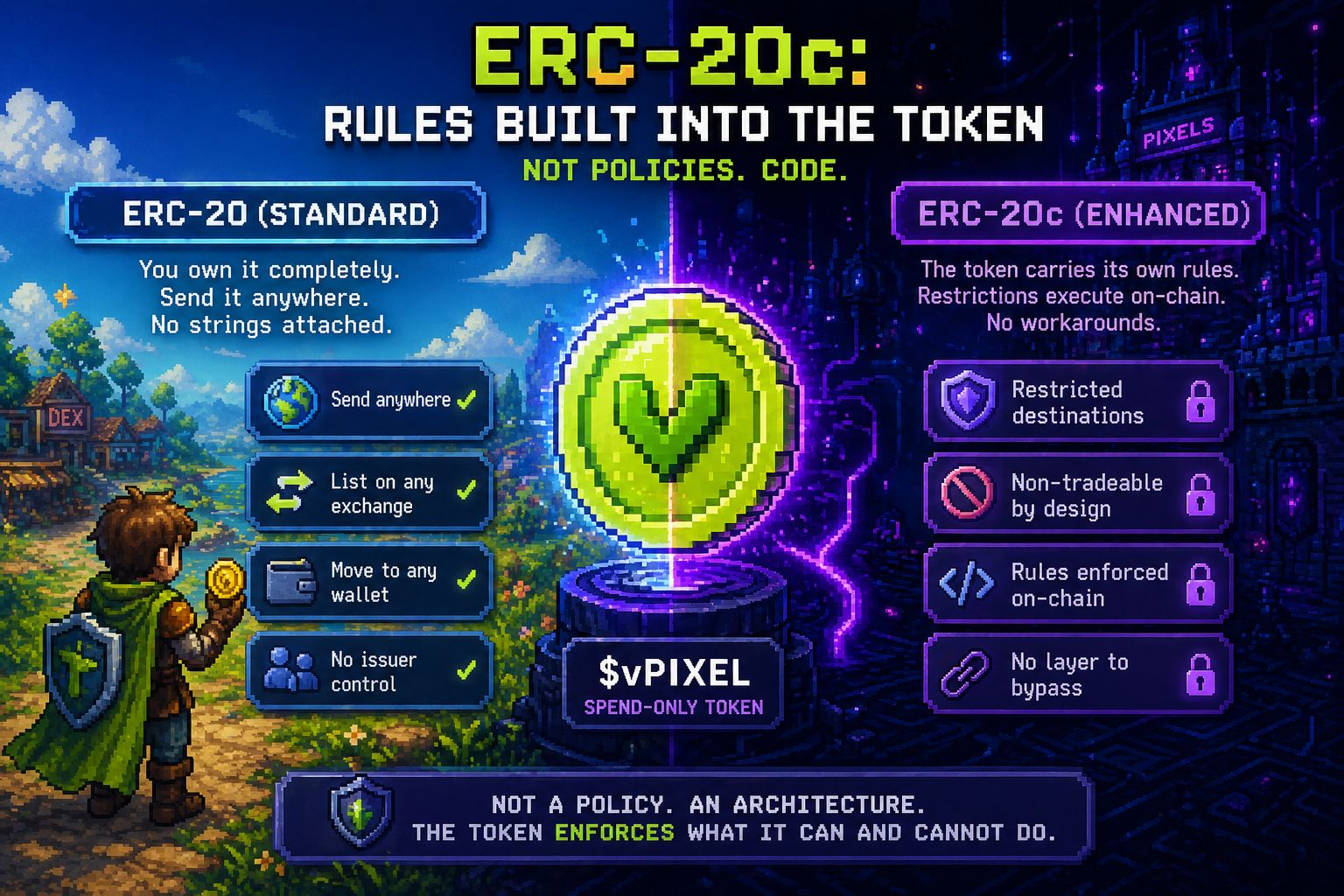
Standard fungible tokens work on a simple principle. You receive one, you own it completely. You can send it anywhere, list it on any exchange, move it to any wallet in the world. The issuer has no continued relationship with the token once it leaves the original contract. That's by design. Fungibility requires freedom of transfer.
ERC-20c changes that assumption at the technical layer, not at the policy layer. The distinction matters more than it sounds.
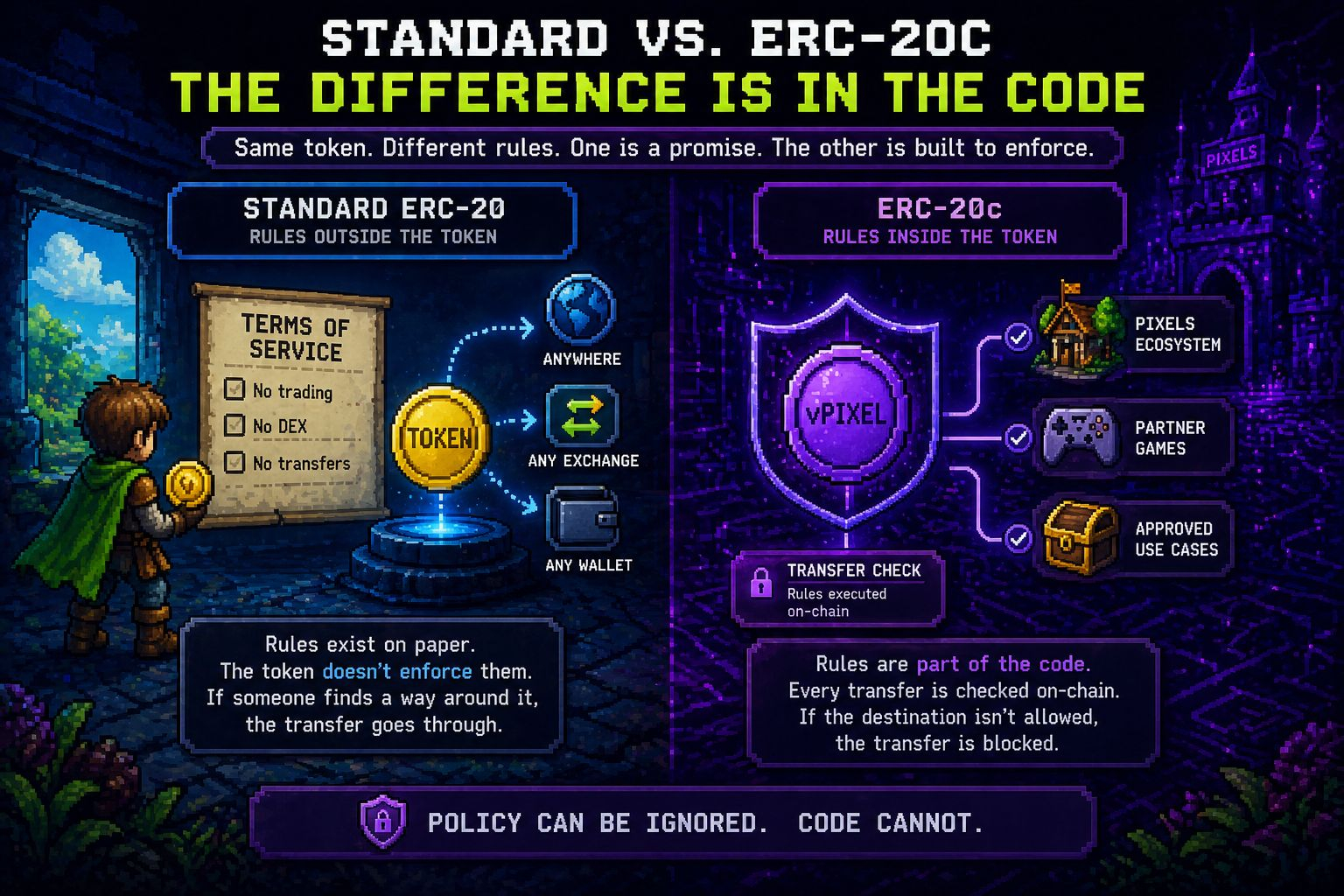
Most attempts to restrict token behavior work through terms of service. The issuer says you can't do certain things with the token. But the token itself doesn't enforce that. If someone figures out how to route around the restriction, the token moves regardless. The rule exists on paper. The chain doesn't know about it.
ERC-20c bakes the restriction into the transfer logic itself. The token carries its own rules about where it can go and what it can do. Those rules execute on-chain every time a transfer is attempted. You can't route around them because there's no layer between the rule and the execution. The code is the enforcement.
For $vPIXEL specifically, this means the non-tradeable restriction isn't a policy Pixels could theoretically reverse under pressure. It's built into how the token moves. A player who earns $vPIXEL and wants to list it on a DEX isn't stopped by Pixels enforcing a rule. They're stopped by the token itself not being capable of that transfer.
I remember watching how certain airline loyalty programs shifted from generic miles that could be transferred freely to program-specific points that couldn't. The shift wasn't just about stopping people from selling miles. It was about making the value of the points inseparable from the relationship with the airline. A point that can only be spent within the program isn't just restricted. It's fundamentally different in nature from a point that can become cash.
$vPIXEL works on the same logic. But where the airline enforced this through contract terms and account monitoring, Pixels is enforcing it through the token's own architecture. The restriction isn't maintained by Pixels watching for violations. It's maintained by the chain itself executing the transfer rules every single time.
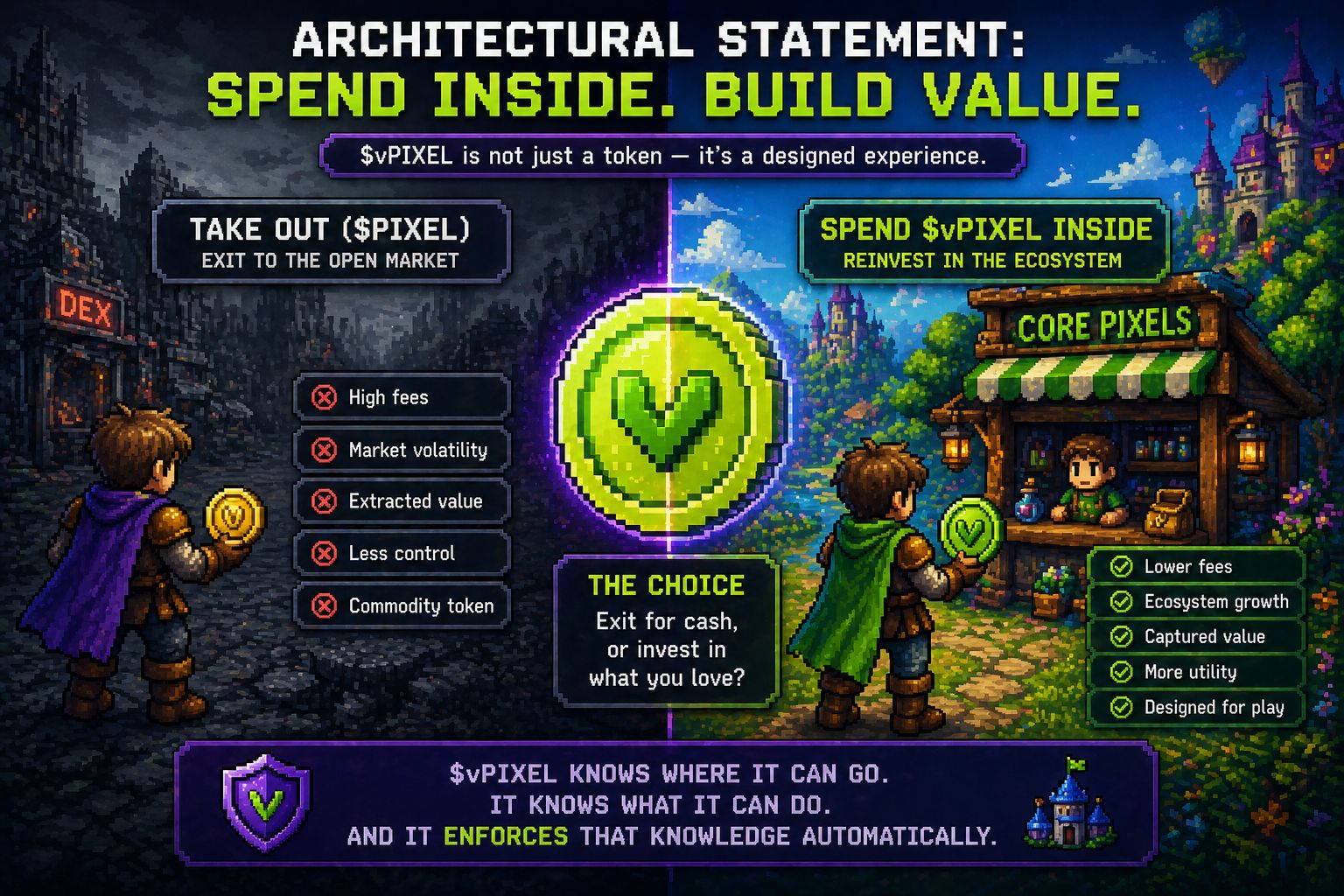
This has a specific implication I haven't seen discussed much. When a player earns $vPIXEL and decides to spend it inside Core Pixels or a partner game rather than taking the PIXEL withdrawal route, they're not just making an economic decision about fees. They're operating inside a token that is architecturally different from everything else in their wallet. It knows where it can go. It knows what it can do. And it enforces that knowledge automatically.
I noticed that the whitepaper mentions that ERC-20c allows for future programmability. Task-gated unlocks. Time-locks. Additional conditions that could be layered on top of the base restriction. That sentence is easy to read past. But it's pointing at something genuinely significant about where token design might be heading more broadly.
Most tokens today are either fully free or restricted through external enforcement. ERC-20c suggests a middle category. Tokens that carry their own behavioral logic. That can be programmed to unlock under specific conditions. That can change their own capabilities based on what happens inside the ecosystem they were created for.
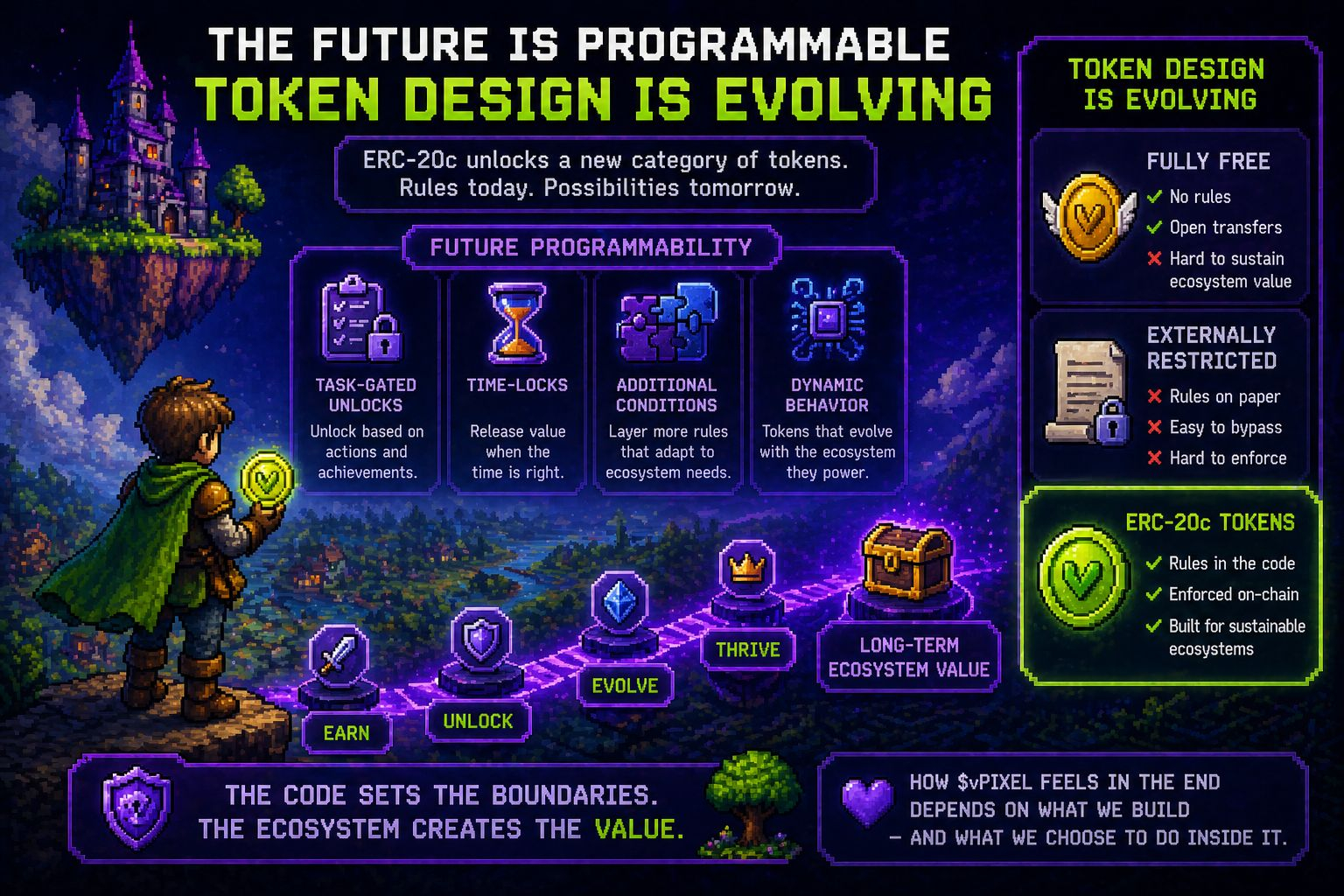
I'm genuinely uncertain whether this serves players as much as it serves the ecosystem design. A token that can only do what its creator's architecture allows is powerful when that architecture aligns with what players actually want. It's constraining when it doesn't. The ERC-20c design assumes those two things stay in alignment. Whether that assumption holds as the ecosystem evolves and player preferences shift is the tension the whitepaper doesn't fully address.
What I can say clearly is that the technical choice isn't incidental. A team that builds spend-only token architecture at the code layer rather than the policy layer is making a deliberate statement about what kind of system they think they're building.
Whether $vPIXEL ends up feeling like freedom or constraint depends on whether there's enough worth doing inside the ecosystem to make the restriction feel like context rather than limitation.
That answer isn't in the whitepaper. It's in what happens next. #pixel $PIXEL #PİXEL