
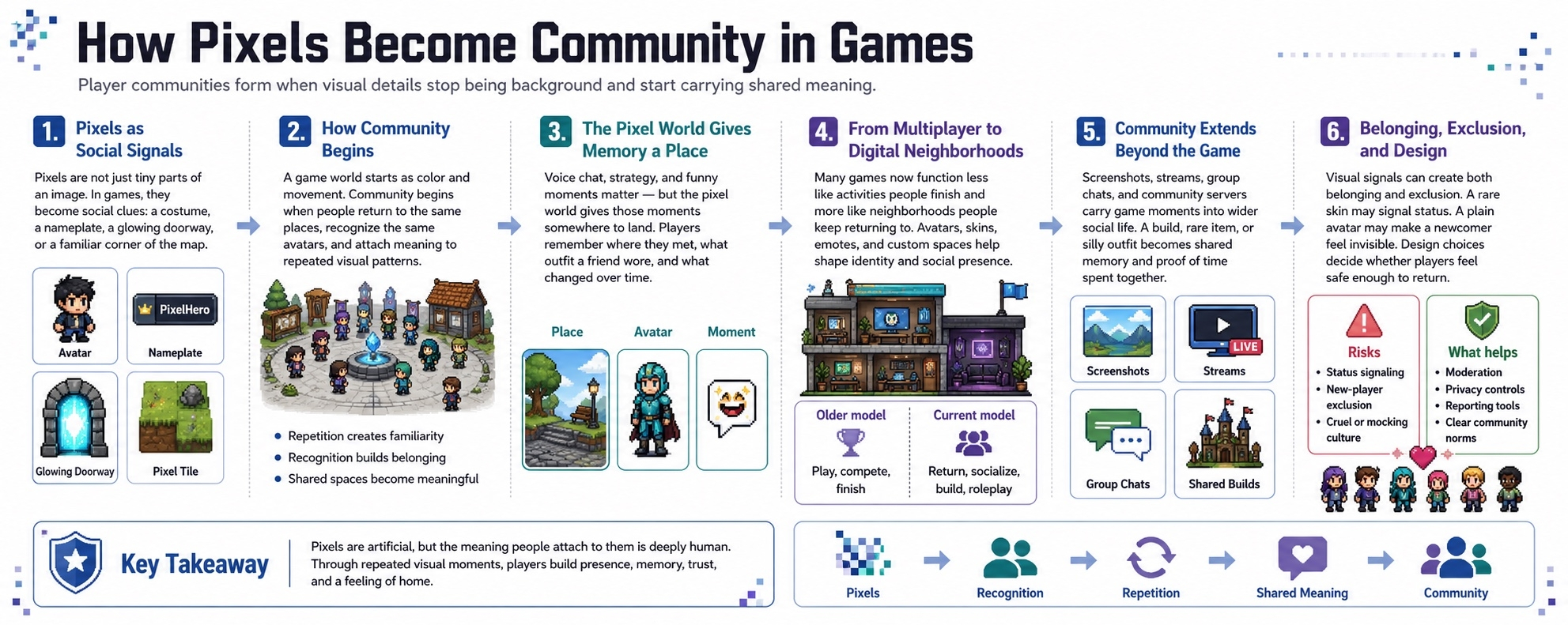
I used to think of pixels as the smallest and quietest part of a game and something too tiny to matter on its own. My view has changed because the more I look at how player communities form the more I see pixels not just as pieces of an image but as the little signals people gather around. A costume can become familiar. A nameplate can become recognizable. A glowing doorway or a shared corner of a map can slowly turn into a place that feels like ours.
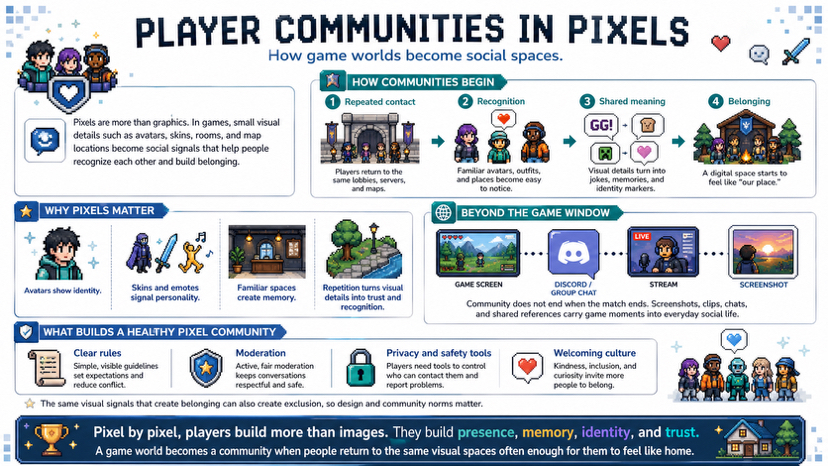
A player community begins when pixels stop being background and start carrying meaning. At first a game world is only a screen filled with shape and color and movement and sound. Then people return to it. They stand in the same plaza or queue for the same mode or decorate the same room until the place begins to feel less random. They recognize the same avatar from yesterday. A few pixels arranged one way become a badge while another arrangement becomes a joke or a warning or a memory or a sign that someone belongs. I find that easy to overlook because pixels can seem mechanical. Still communities often begin with small recognitions and in games those recognitions are visual before they are personal.
A familiar voice in chat matters and so does a shared strategy or a funny moment after a bad round. But the pixel world gives those moments a place to land. Someone remembers where the group first met. Someone knows the outfit a friend always wears. Someone changes their avatar and everyone notices because this is how people mark presence in a world where bodies are replaced by designed images. The pixel becomes a social clue that can say I was here or I am part of this or I want to be seen differently today.
That is why the current attention around gaming communities feels different from the older idea of online multiplayer. Years ago it was easier to describe games as things people played and finished. Now many digital spaces behave more like neighborhoods that keep changing while people live inside them. Avatars and skins and emotes and custom spaces give people ways to shape how they appear to others. The pixels are not decoration after the community forms. They help form it.
I notice this especially in spaces where players do not only arrive to win. They arrive to spend time with others and to build and roleplay and watch what changes around them. A lobby can become a meeting spot while a blocky house can become a clubhouse. A simple avatar can become someone’s public face. What looks minor from outside the game can feel personal from inside it because the meaning is not stored in the image alone. It is stored in repetition. The same pixels seen again and again with the same people become familiar.
Outside the game window that pattern continues. Discord servers and group chats and streams and shared screenshots carry those pixels into wider social life. A moment that happened in a match becomes an image people pass around. A silly outfit becomes an inside joke. A base or build or rare item becomes proof of time spent together. The community stretches beyond the screen but it still often starts with something visible. A scene or a character or a symbol or a place gives memory something to hold onto.
None of this means pixel communities are automatically kind or healthy. The same visual signals that create belonging can also create exclusion. A rare skin can become status. A plain avatar can make a new player feel like an outsider. A server can turn cruel if its rules are weak or if its culture rewards mockery. I think that is why design choices matter so much now. Moderation and privacy and reporting tools and community norms are not separate from the pixel world. They decide whether the space behind those pixels feels safe enough for people to return.
What interests me most is that pixels are both artificial and deeply human. They are made of code but people fill them with attachment. A doorway is only a doorway until friends keep meeting there. An avatar is only a model until others recognize it. A map is only terrain until players give it stories. Pixel by pixel people build more than images. They build a sense of presence and shared memory and trust. That is how a game world becomes a community not all at once and not by graphics alone but through countless small visual moments that people return to until the pixels begin to feel like home.


