
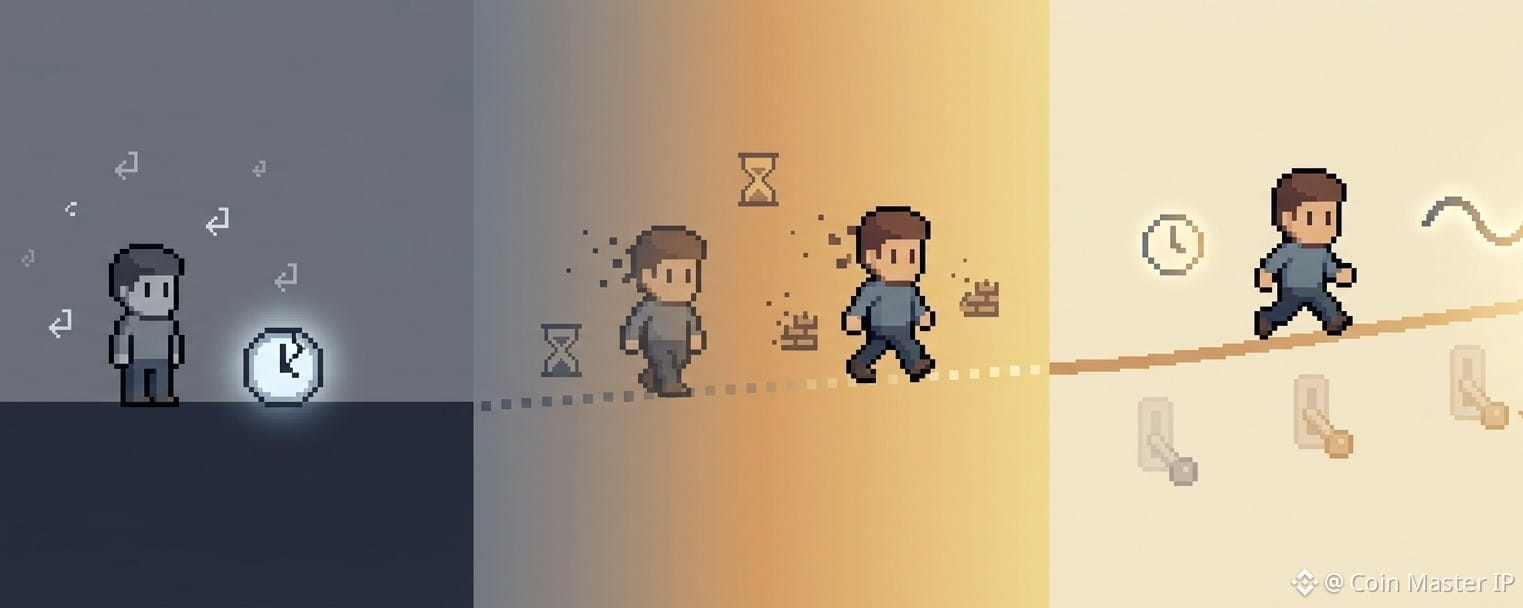
There’s a habit people fall into when they first enter a system like Pixel. They assume openness means neutrality.
Nothing blocks them. Everything feels accessible. The loops are clear, the actions are simple, and the pacing seems fair. At the surface level, $PIXEL l doesn’t restrict participation. It lets you move freely through its economy. But systems are rarely defined by what they allow. They’re defined by what quietly compounds over time.
And compounding… rarely feels visible in the moment.
What often gets labeled as “friction” in Pixel is usually treated as background structure—delays between actions, waiting cycles, small interruptions in flow. These don’t stop progress, so they don’t feel important at first. But fricton doesn’t need to restrict access to shape outcomes. It only needs to make experiences slightly diffrent between players.
That small difference, repeated enough times, stops being cosmetic.
It becomes directional.
In Pixel, time monetization is not always explicit. It doesn’t constantly present itself as a paywall or forced upgrade. Instead, it appears as optional smoothing—ways to reduce waiting, shorten cycles, or remove interruptions. This is familiar design in many systems, but familiarity is what makes it powerful. When something feels standard, players stop questioning its structure.
They simply adapt to it.
And adaptation is where Pixel’s deeper behavio r loop begins to show.
It’s easy to assume that differences in progression come down to skill—better planning, better timing, better decision-making. And that is partly true. Players absolutely shape their outcomes. But systems like Pixel also define what “better” even means in practice. If smoother flow consistently depends on reducing friction, then efficiency becomes a blend of skill and system alignment.

Not just mastery of the game—but mastery of its rhythm.
From a distance, Pixel still looks fully open. Everyone can play. Everyone can progress. The tools for faster movement exist in the same environment for all players. But availability doesn’t guarantee equivalence. Two players can operate under identical rules while experiencing completely different levels of continuity, depending on how often they engage with fricton-reduction paths.
No one is excluded. But not everyone is experincing the same version of time.
This is where “optional acceleration” becomes a misleading simplification. Optional suggests that the baseline experience remains unchanged regardless of choice. But in Pixel, choices repeat. And repetition matters more than single decisions. Skipping a delay once is nothing. Skipping it again and again becomes structure.
Not because the system forces it—but because patterns accumlate.
And accumulation reshapes expectation.
Friction itself isn’t inherently negative. In Pixel, it plays an important role in pacing. It prevents the system from collapsing into instant optmization. It creates rhythm, spacing, small breaths between actions. Without it, progression would lose meaning. But not all fricton behaves the same way. Some is design pacing. Some is adjustable.
And when friction becomes adjustable, it stops being just design texture.
It becomes a lever.
A lever players can pull again… and again… to move closer to smoother flow. Over time, those small adjustments start to define how different players move through the same system.
Not through hard separation. Not through visible tiers. But through gradients.
Some players experience Pixel as almost continuous flow—minimal interruption, clean cycling, low resistance. Others experience it as stop-start rhythm, where small pauses break immersion again and again. The difference is not dramatic in any single moment.
But Pixel is not built on single moments.
It is built on repetition.
And repetition turns small differences into stable patterns.
This is why calling Pixel “just another GameFi loop with convenience features” doesn’t fully capture it. The mechanics are familiar, yes. But the way they shape perception is more subtle. When optmization becomes smooth enough, it stops feeling like a transaction and starts feeling like self-adjustment inside the system.
Players don’t feel like they are buying advantage.
They feel like they are removing inefficienc y.
And inefficiency is something people naturally learn to avoid.
Over time, players begin spotting delays on their own. They notice where time is leaking. They start adjusting behavior not because they are told to, but because friction becomes visible at a deeper level. Slight interruptions start to feel heavier once smoother paths are seen.
This is how preference forms.
And preference… once stable… becomes expectation.
At that point, Pixel no longer needs to push anything directly. The system becomes partially self-guiding. Players shape their own efficiency routes based on what feels smoother, not what is required.
This is where agency gets complicated.
Yes, players choose how they engage with Pixel. They choose how much fricton they tolerate. But those choices are shaped by repetition, comparison, and exposure. Agency still exists—but it operates inside a system that gently steers what feels “better.”
And most people follow what feels better… not what is equal.
So Pixel remains open. It remains accessible. It does not lock participation behind hard barriers or explicit tiers. But it also doesn’t need to. By making friction adjustable, it creates layers of experience instead of layers of access.
Some players operate close to optimal flow. Others stay in default rhythm.
Both are valid. Neither is excluded.
But they are not the same experience.
And that is the key distinction.
The real structure of $PIXEL Pixel is not visible in rewards or tasks or outputs. It shows up in how time behaves differently depending on friction. Not what the system gives—but what it slowly teaches players to avoid.