
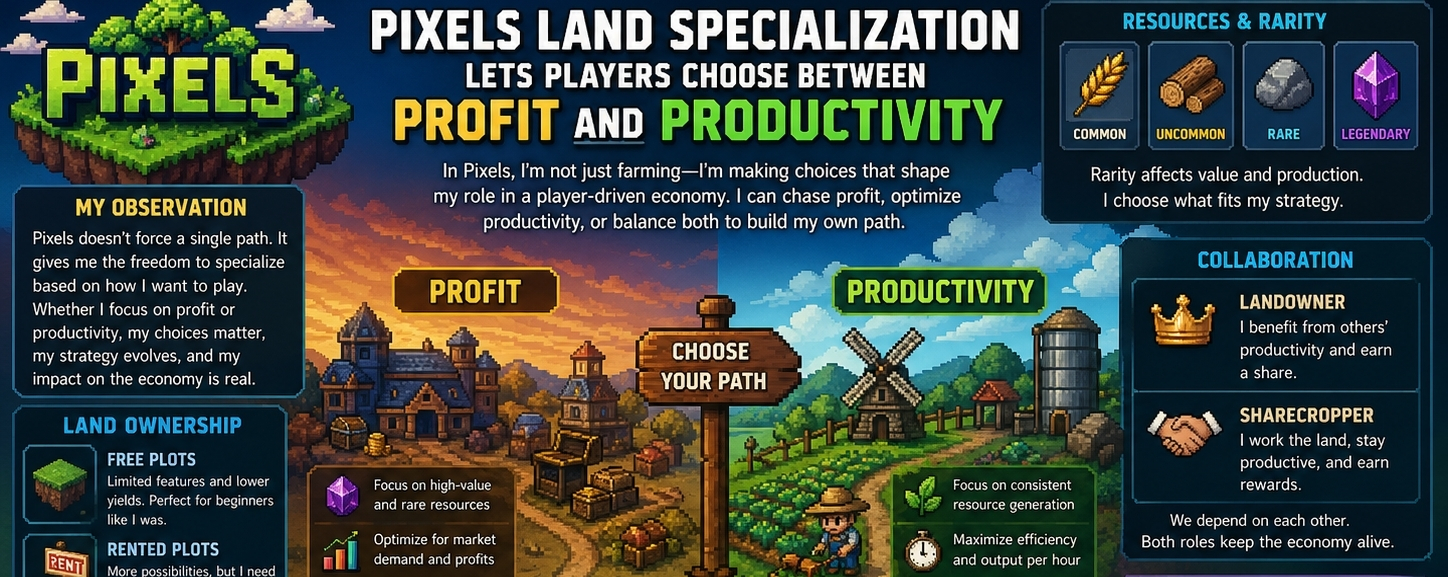
When I look closely at how Pixels Land specialization works, I don’t see it as a simple game mechanic—I see it as a deliberate economic philosophy. It’s not just about farming crops or owning land; it’s about choosing how I want to exist inside a digital economy. The moment I step into the system, I’m pushed—subtly but clearly—to decide whether I care more about profit or productivity. And what makes it interesting is that the game doesn’t tell me which one is better. It lets me figure that out through experience.
I’ve noticed that land ownership sits right at the center of everything. If I own land, I’m not just playing—I’m controlling a piece of the economy. I can decide what gets produced, who works on my land, and how rewards are distributed. That naturally pulls me toward a profit mindset. I start thinking like an investor instead of just a player. I’m not asking “what should I grow?”—I’m asking “what will give me the best return?” That shift in thinking is powerful, because it changes how I interact with every part of the game.
At the same time, I’ve realized that not owning land doesn’t make me weak—it just pushes me in a different direction. When I’m working on someone else’s farm or using limited resources, I start focusing on efficiency. I care about how fast I can harvest, how well I can manage my time, and how consistently I can produce output. That’s where productivity becomes my strength. I’m not trying to maximize profit per asset—I’m trying to maximize output per minute. And honestly, that feels just as rewarding in its own way.
What stands out to me is how the game quietly encourages specialization without forcing it. I’m not locked into a role, but my choices start shaping my path. If I invest heavily in land and upgrades, I naturally drift toward profit optimization. If I stay active, grinding resources and completing tasks, I lean toward productivity. Over time, those small decisions stack up, and I end up building a playstyle that feels uniquely mine.
I’ve also observed that resources play a huge role in defining this balance. Not all resources are equal, and that’s intentional. Some are common and easy to produce, while others are rare and require better land or more planning. If I’m chasing profit, I’ll probably target those rare resources because they carry higher value in the market. But that path isn’t always stable—it depends on demand, timing, and sometimes even luck. On the other hand, if I focus on productivity, I might stick with more consistent resources that I can generate reliably. It’s less risky, but also less explosive in terms of earnings.
Another thing I find interesting is how collaboration fits into this system. When I interact with other players—whether I’m sharing land, working as a sharecropper, or managing others—I start to see the economy as something bigger than myself. If I’m a landowner, I benefit from other players’ productivity. If I’m a worker, I benefit from access to better land and opportunities. It creates this loop where profit-driven players and productivity-driven players depend on each other. I don’t think the system would work as well if everyone chose the same path.
Upgrades and land traits add another layer that I think is easy to underestimate. When I improve my land with structures or bonuses, I’m not just increasing output—I’m defining my specialization more clearly. If I build in a way that boosts production speed or capacity, I’m leaning into productivity. If I optimize for rare outputs or high-value chains, I’m leaning into profit. These decisions feel small at first, but over time they shape the entire direction of my gameplay.
I’ve also noticed how the token economy reinforces these choices. Earning tokens isn’t just about playing—it’s about how I play. If I’m focused on profit, I might think about trading, timing the market, or scaling my operations. If I’m focused on productivity, I’ll earn through consistent activity and contribution. The system seems designed to reward both, but in different ways. That balance is important, because it keeps the economy from becoming one-dimensional.
What really stands out to me is that Pixels doesn’t treat players as identical units. It recognizes that people enjoy different things. Some players like strategy, investment, and long-term planning. Others enjoy active gameplay, routine, and steady progress. Instead of forcing everyone into the same loop, the game creates space for both. I think that’s why the specialization system feels natural—it aligns with how people already think and play.
At times, I’ve found myself switching between these mindsets. There are moments when I want to step back and think like a strategist, focusing on profit and expansion. Other times, I just want to play actively, harvest resources, and enjoy the rhythm of productivity. The fact that I can move between these roles without breaking the system makes the experience feel flexible and alive.
I also think there’s a deeper implication here. The way Pixels structures its land and economy mirrors real-world dynamics more than most games do. Ownership, labor, efficiency, and investment all exist in a simplified but recognizable form. When I choose between profit and productivity, I’m essentially choosing how I want to participate in that system. It’s not just gameplay—it’s a reflection of economic behavior.
Over time, I’ve come to see that neither path is strictly better. Profit-focused gameplay can be powerful, but it often requires more resources, planning, and sometimes patience. Productivity-focused gameplay is more immediate and consistent, but it might not scale as dramatically. The real strength of the system is that it allows both to coexist and support each other.
In the end, what I find most compelling is how personal the experience becomes. My farm, my land, and my strategy all reflect the choices I’ve made. Whether I’m chasing profit or maximizing productivity, I’m building something that feels like my own version of the game’s economy. And that sense of ownership—both literal and strategic—is what makes the specialization system stand out to me.