
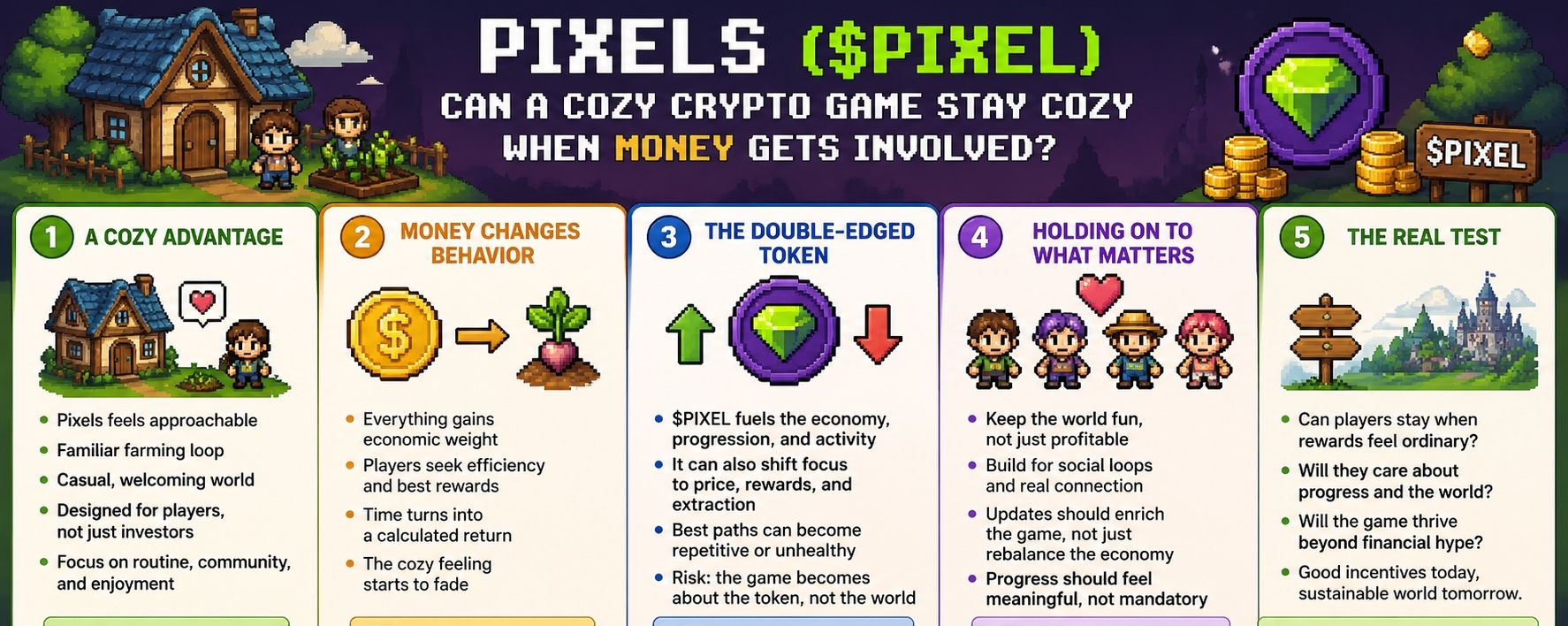
Pixels has one clear advantage over many Web3 games.
It does not feel hostile to normal players.
That sounds basic, but in crypto gaming, it is a big deal. A lot of earlier play-to-earn projects felt like they were built for people who already understood wallets, tokens, emissions, asset prices, and farming strategies. The game was there, but the financial system was louder.
Pixels takes a softer route.
It looks approachable. The farming loop is familiar. The world feels casual. The experience does not immediately demand that players think like investors before they can enjoy anything.
That gives it a better chance.
Because if Web3 gaming is ever going to work, it cannot only serve speculators. It needs players who care about the world, the routine, the community, and the feeling of progress. It needs people who come back because they like being there, not only because the rewards are worth harvesting.
Pixels seems to understand that.
But understanding the problem does not remove it.
The moment real financial value enters a game, behavior starts to change. Players become more aware of efficiency. They compare rewards. They calculate what is worth doing. They start treating time as something that should produce a return.
That is where a cozy game can lose its innocence.
A crop stops being just a crop. A quest stops being just a quest. An item stops being just part of the world. Everything starts carrying economic weight.
And once that happens, the game has to fight its own incentives.
This is the uncomfortable part of Pixels.
The same token layer that makes the economy more interesting can also make the game more fragile. $PIXEL can support spending, progression, and ecosystem activity. But it can also turn attention away from the actual experience and toward price, rewards, and extraction.
That is not a small risk.
Crypto players are very good at finding the most profitable path through a system. If the best path is fun, that is great. If the best path is repetitive farming, multi-account behavior, or constant optimization, then the game slowly becomes something else.
It becomes work.
Pixels is trying not to let that happen. Its strength is that it has more game texture than the usual reward-first model. It has social energy, routine, accessibility, and a world that feels easier to inhabit. That gives it a better foundation than projects that only relied on token incentives.
Still, the foundation has to hold under pressure.
The real question is not whether Pixels can attract users when crypto gaming is exciting. It can probably do that. The harder question is whether it can keep people when the reward layer feels ordinary.
Will players still care about their progress?
Will they still log in for the social loop?
Will the world still feel alive without constant financial motivation?
Will updates make the game better, or just rebalance the economy?
That is where Pixels will prove itself.
Because the old play-to-earn trap was never just about bad games. It was about bad incentives. It was about systems that paid users to behave in ways that eventually weakened the world they were supposed to support.
Pixels looks more careful than that.
But careful is not the same as immune.
A crypto game can be better designed, friendlier, and more polished while still drifting toward extraction if the economy becomes the main reason people stay. That is the line Pixels has to keep defending.
For now, it is one of the more credible Web3 gaming attempts.
Not because it has escaped the problem completely.
Because it seems to know the problem is real.
And in crypto gaming, that is already more than most.
