
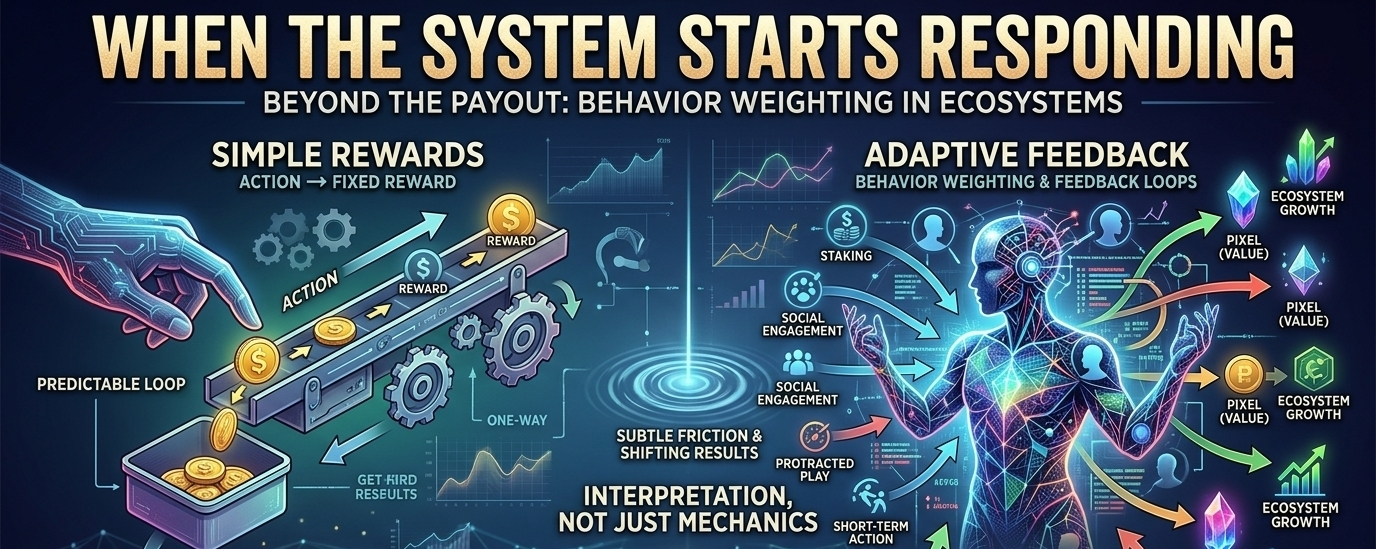
@Pixels It doesn’t really feel like a clean transition, and that’s what makes it interesting. The shift isn’t loud or obvious—it builds slowly, almost in a way that you can ignore at first. You repeat the same actions expecting the same outcomes, because that’s how most systems train you to think. But then something subtle breaks that expectation. The output starts to feel slightly inconsistent, not in a chaotic or broken way, but just enough to disrupt the comfort of predictability. That small friction is what changes everything, because it forces you to stop seeing the loop as something fixed and start questioning what’s actually being measured underneath.
In most GameFi environments, the relationship is simple—you perform an action, you get a reward, and over time you optimize that loop until it becomes second nature. But when the system begins to respond differently to the same behavior, it stops feeling like a machine and starts feeling like something that is interpreting you. Not in an intelligent or conscious sense, but in a way where outcomes seem tied to patterns rather than isolated actions. That’s where the idea of behavior weighting starts to emerge—not as something clearly defined, but as something you experience indirectly through shifting results.
The deeper you stay inside that loop, the harder it becomes to ignore that not all consistency is equal. Some actions seem to carry relevance for longer periods, while others fade quietly even when you haven’t changed anything. That creates a different kind of awareness, where you’re no longer just repeating actions for rewards, but observing which patterns the system continues to support. It becomes less about grinding efficiently and more about understanding what kind of participation still “fits” within the current state of the ecosystem.
That shift also changes how something like PIXEL is perceived. On the surface, it still behaves like any other GameFi token, moving with sentiment, speculation, and external attention. But internally, its real function feels more tied to behavior than to simple economic exchange. Mechanisms like staking or longer engagement loops start to feel less like pure yield strategies and more like filters—ways to distinguish between short-term interaction and sustained presence. And once that distinction becomes visible, value itself starts to feel less static and more conditional.
What makes it even more layered is how the system handles what it produces. Instead of rewards simply flowing outward, part of that value seems to cycle back into the ecosystem—into progression systems, social layers, and structures designed to keep players engaged beyond immediate payouts. That creates a kind of feedback loop where output is constantly being tested, absorbed, and redistributed based on how well it supports retention. It stops being a one-directional economy and starts resembling something more circular, where participation feeds the system as much as the system feeds the player.
At the same time, there’s an underlying tension that becomes harder to ignore the more you notice it. When a system starts adapting to behavior, it inevitably starts shaping it as well. Certain playstyles begin to feel more supported, not because alternatives are removed, but because they gradually lose reinforcement. The system doesn’t need to tell you what works—it shows you through outcomes. And over time, that quiet reinforcement can influence how people choose to engage, even if they’re not consciously aware of it.
But the alternative isn’t necessarily better. A completely open system with no filtering tends to collapse under its own incentives, where extraction overtakes sustainability. So it makes sense that there’s a shift toward rewarding behaviors that contribute to longer-term stability rather than short bursts of activity. That naturally moves the focus away from how much you do and toward how well your participation aligns with what keeps the ecosystem functioning.
Right now, it doesn’t feel like something fully formed or finalized. It feels like a system still experimenting, still adjusting, still trying to figure out what kind of engagement actually sustains it over time. And maybe that’s the most honest way to look at it—not as something to fully understand yet, but as something to observe. Because once the noise of incentives fades, what remains is usually the clearest reflection of how the system truly works.