
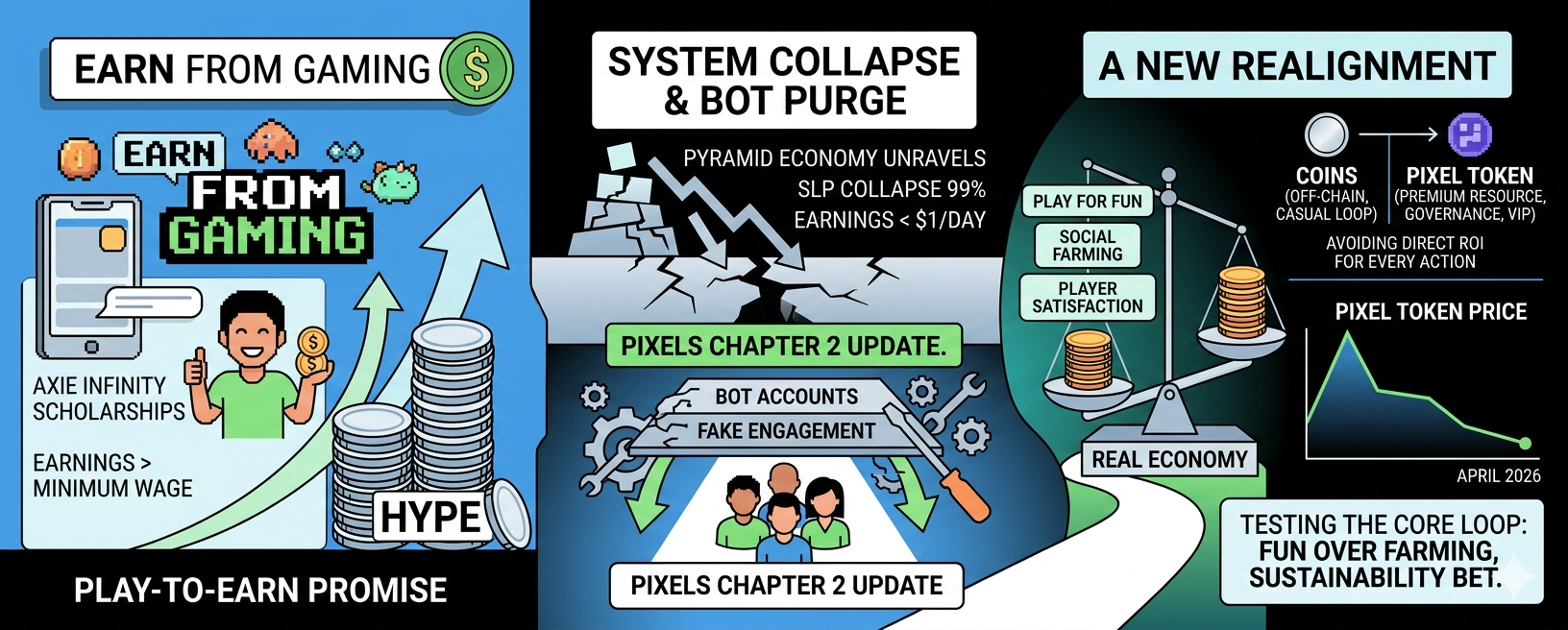
The play‑to‑earn pitch was simple, and for a while it sounded brilliant. You wouldn’t just play games anymore—you’d get paid to play them. Your time grinding inside a digital world would turn into actual money. Axie Infinity became the shining example. During the wild run of 2021, scholarship players in the Philippines were earning several times the local minimum wage, and that story spread everywhere. It felt like a door had opened to something new: a place where the line between working and playing just didn’t matter.
The problem was that the whole thing was built on a foundation that couldn’t hold. These economies worked exactly like pyramids. New money coming in paid out the people who arrived earlier. As soon as user growth slowed down, the entire mechanism started spinning in reverse. Axie’s SLP token collapsed ninety‑nine percent. Average daily earnings across the top play‑to‑earn games fell below a dollar. The scholarships vanished. What had been marketed as a sustainable economic model was, underneath all the hype, just yield farming dressed up in game mechanics.
Still, the dream didn’t completely fade. Some people kept looking for something that would actually stick. That’s where Pixels entered the picture—a 2‑D social farming game that, at first glance, seemed like another candidate for the same old graveyard. Launched in 2021, it let people farm virtual land, hang out, and earn token rewards in a pixel‑art world. After moving to the Ronin network, though, something shifted. By May 2024, Pixels was recording over a million daily active users and briefly held the top spot as the most popular Web3 game by that measure. For a moment, it looked like the whole narrative might get a second chance.
Then reality hit, and it hit fast. In June 2024, the team pushed out Chapter 2—a major update designed to reward players who were actually engaged, not just anyone clicking through. Within a little over a week, daily active users fell from roughly 976,000 to 251,600. A seventy‑four percent drop. On paper, that looks like a disaster. But the team offered a different explanation: a huge portion of the disappearing accounts were bots. Scripts that had been quietly draining the economy all along.
That explanation gets straight to the core of why play‑to‑earn broke in the first place. For years, Web3 games propped up their user numbers with bot accounts that farmed tokens, distorted economic signals, and created a fake impression of thriving communities. When Pixels tightened the rewards—task‑board payouts dropped to as little as 0.2 or 0.25 tokens per job—the bots vanished. What remained was a much smaller base of actual humans. The game hadn’t lost its real audience; it had peeled away a layer of engagement that was never genuine to begin with.
What makes Pixels so awkward for the Web3 gaming space is that it refuses to fit neatly into any category. It’s not a pure speculative gamble, but it’s not a fully sustainable game either. The project uses a two‑currency setup that tries to keep casual free‑to‑play activity separate from on‑chain speculation. Off‑chain “Coins” run the everyday loops—planting, crafting, talking to other players—while the PIXEL token acts as a premium resource for minting NFTs, forming Guilds, buying VIP passes, and voting on governance. That design intentionally avoids the trap of turning every single action into a math problem about return on investment.
But the tension hasn’t gone anywhere. Look at PIXEL’s price chart and you’ll see the familiar GameFi pattern. A Binance Launchpool listing in February 2024, a spike to an all‑time high of $1.02, and then a slow grind downward of over 99%, landing around $0.0075 by April 2026. Even with a capped supply of five billion tokens and a thoughtful vesting schedule, the token couldn’t escape the weight of a sector‑wide downturn and the constant mismatch between utility and unlock periods. Players who showed up for the rewards realized the math no longer worked. The ones who stayed found reasons that had nothing to do with token price.
This is where Pixels becomes a genuine test case. The team keeps saying that player satisfaction matters more than inflated user numbers propped up by bots. The Chapter 2 overhaul—messy though it was, with plenty of complaints about lower payouts and clunky design changes—was a deliberate step away from extraction and toward real retention. In theory, that’s exactly what the industry needs: a game willing to bet on fun over farming, on sustainability over flashy metrics.
History, however, doesn’t offer much comfort. Other Web3 games that went through similar bot purges—Splinterlands losing sixty‑eight percent of its daily users in mid‑2022, Alien Worlds shedding forty‑three percent in late 2023—never saw a wave of organic players come rushing in to fill the gap. Cleaning out bots is necessary for a healthy economy, but it doesn’t automatically create genuine growth. Pixels now has to prove that its core loop—social farming in a retro pixel world—can hold the attention of enough real people to support both the community and the token without leaning on fake metrics.
The bigger lesson goes well beyond a single project. Pixels is dragging into the open something the play‑to‑earn industry has dodged for years: the original vision was never a working business model. It was a marketing slogan. Real economies don’t run on endless extraction. They need genuine value creation, sinks that make sense, and participants who stick around for reasons deeper than a quick profit. Pixels might figure this out, or it might not. But its uncomfortable position—still needing rewards to pull people in while trying to become something more than just a reward machine—captures the unresolved tension sitting at the center of Web3 gaming. Until that knot gets untangled, the tired old promise will keep breaking, one token crash after another.
