I keep circling back to the same uncomfortable thought: why do so many digital worlds look busy but feel empty the moment you actually sit inside them? Everything is technically “working” players are grinding, tokens are moving, tasks keep refreshing but none of it feels like it depends on you. You could disappear for a week, a month, forever, and the system wouldn’t even flinch. It would just keep going, unchanged.
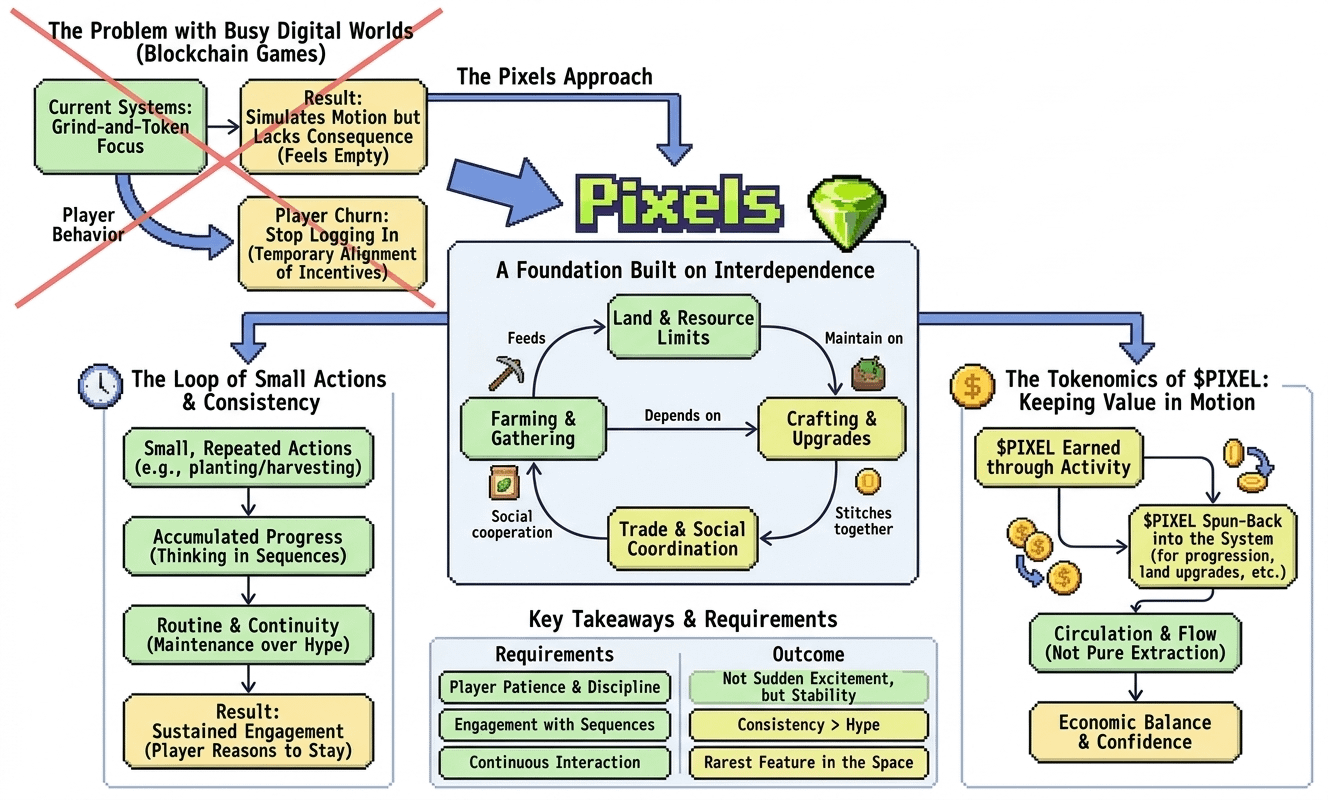
That’s the part that sticks with me. Not the activity, but the lack of consequence. A lot of blockchain games have figured out how to simulate motion. Very few have figured out how to make that motion matter.
By now, the cycle is predictable. Incentives come in hot at the start rewards are generous, participation spikes, and for a brief window everything looks alive. Charts go up, communities get loud, and there’s a sense that something is “working.” But it rarely lasts. Because underneath that initial burst, most systems aren’t actually built to hold weight. They’re built to distribute rewards, not to sustain meaning.
And players feel that, even if they don’t say it outright. You can sense it in how quietly things fall apart. There’s no dramatic exit. No mass rebellion. People just… stop logging in. One missed session turns into a few, and eventually the habit dissolves. What looked like a living economy reveals itself as something closer to a temporary alignment of incentives people showing up as long as it pays, and leaving the moment it doesn’t.
After watching that happen enough times, it’s hard not to become skeptical of anything that claims to break the pattern. The real challenge isn’t launching a system that attracts attention. It’s building one that can survive after attention fades. Something that gives players a reason to stay that isn’t purely transactional.
That’s where Pixels starts to feel different not in a loud, “this changes everything” way, but in a quieter, more deliberate shift in priorities. It doesn’t seem obsessed with speed. If anything, it leans in the opposite direction. Slower loops. Repetition. Systems that take time to unfold.
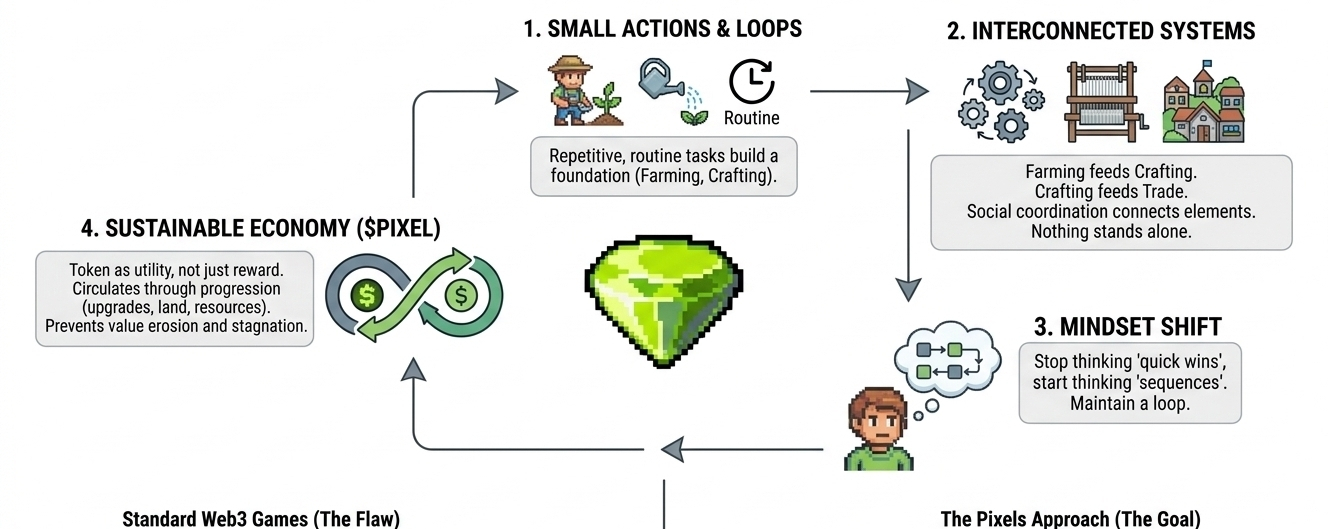
On the surface, it’s simple: farming, crafting, land, trade, social coordination. None of these ideas are new. What’s interesting is how tightly they’re connected. Nothing really stands alone. Farming feeds crafting. Crafting feeds trade. Land introduces limitations. Social interaction stitches it all together. It’s less about any individual mechanic and more about how they depend on each other.
And then there’s the way it treats small actions. That’s probably the part I keep thinking about the most.
In most games, small tasks are just filler. You do them to get past them. They’re a means to an end the “real” game exists somewhere further ahead. But here, those small actions feel like the actual foundation. Planting something, harvesting it later, managing resources it doesn’t look impressive in the moment. But over time, it adds up. Quietly. Almost in a way that’s easy to overlook if you’re expecting instant feedback.
It shifts your mindset without announcing it. You stop thinking in terms of quick wins and start thinking in sequences. What you do now connects to what you’ll be able to do later. Logging in isn’t about claiming a reward it’s about maintaining a loop. And once that loop becomes familiar, something changes. It stops feeling like a transaction and starts feeling more like a routine.
Of course, none of that exists in isolation from the economy. And that’s where things usually get complicated.
Introducing a token changes the psychology of everything. Suddenly, it’s not just a game system it’s a system with perceived financial weight. Expectations creep in. People start calculating. And that’s often where balance breaks down. Too much supply, and value erodes. Too little, and participation slows to a crawl.
From what I can tell, Pixels is trying to position PIXEL less as a reward you extract and more as something that moves something that circulates through the system. You earn it through activity, but you’re also expected to spend it to keep progressing. It ties into land, crafting, upgrades basically anything that pushes you forward.
That idea keeping value in motion instead of letting it sit is simple on paper. But it’s one of the hardest things to sustain in practice. Because players will always look for efficiency. They’ll always try to take more out than they put back in. And if the system leans too far in either direction, it shows up quickly.
If progression drags, people lose patience. If rewards become predictable, people optimize the fun out of it. If the economy slips even slightly out of balance, confidence disappears faster than it was built.
So no, none of this guarantees success. If anything, it just highlights how difficult the problem really is. Good intentions don’t protect a system from real behavior. Eventually, players test every edge.
Still, there’s something about this approach that feels more grounded than what I’ve seen elsewhere. It’s not chasing constant excitement. It’s not trying to manufacture urgency. It leans on something less flashy but arguably more durable: continuity. The idea that small, repeated actions if they’re meaningfully connected can build into something stable over time.
Whether that holds up depends on the players as much as the design. It requires a different kind of engagement. Less about chasing spikes, more about settling into a rhythm.
I have a feeling Pixels won’t appeal to everyone. It’s not built for people looking for quick returns or immediate gratification. It asks for patience, maybe even a bit of discipline. But for the ones willing to engage with it on those terms, there’s a chance it offers something most systems don’t.
Not excitement. Not hype. Just consistency.
And honestly, in this space, that might be the rarest thing of all.