
I’m watching the surface first.
Crops growing.
Avatars moving.
Resources cycling.
Everything looks calm.
Almost too calm.
I keep noticing games that feel frictionless usually hide their real pressure somewhere deeper.
Not in what players do.
In what players repeat.
And Pixels keeps pulling me back there.
Plant.
Harvest.
Craft.
That loop looks simple.
But I’m looking at what sits behind repetition.
Because repetition in GameFi is rarely neutral.
It often routes value.
Measures behavior.
Extracts patience.
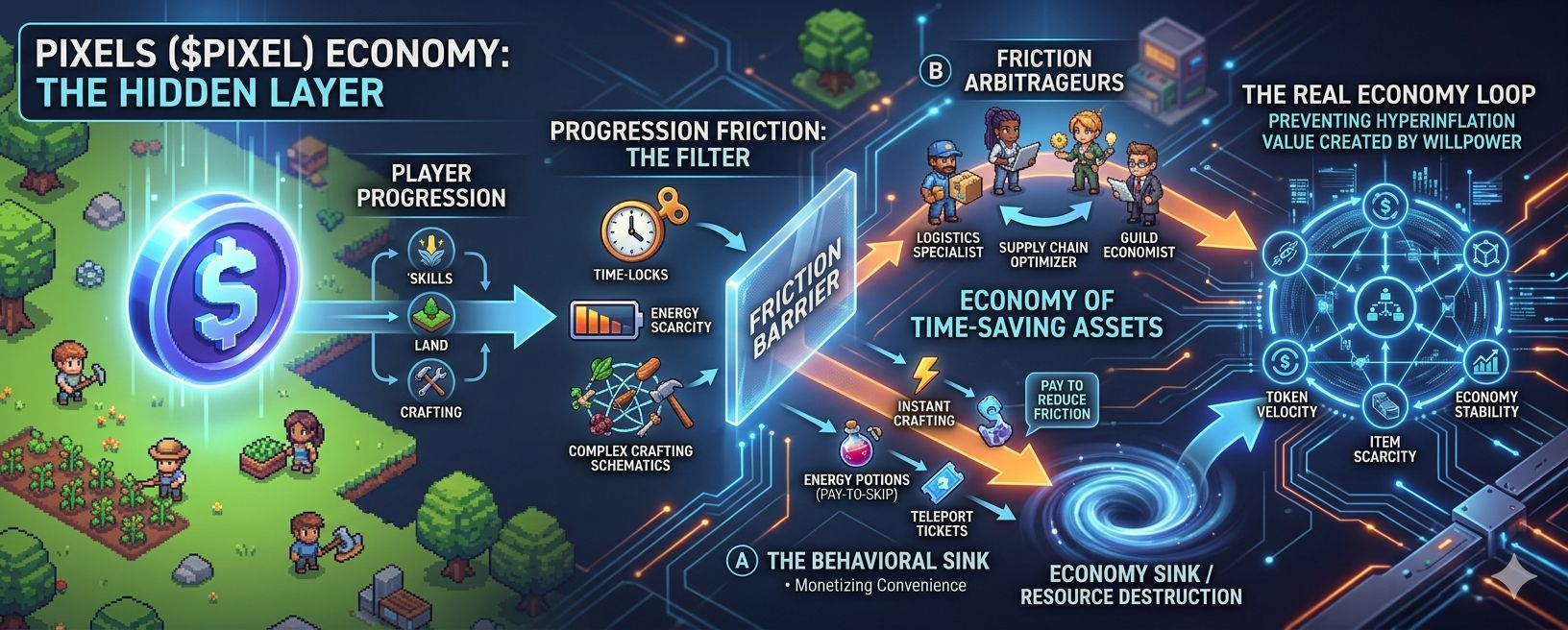
I keep focusing on where the system quietly slows you down.
Energy.
Time locks.
Land access.
Resource bottlenecks.
Progression ceilings.
Not obvious walls.
Soft pressure.
The kind that doesn’t stop you.
Just nudges decisions.
And that’s where $PIXEL starts looking less like a reward token.
More like a friction token.
Not something floating above gameplay.
Something embedded exactly where gameplay resists.
That changes how I look at incentives.
Because if the token appears where discomfort appears…
Then demand may not come from speculation.
It may come from pressure.
And those are different systems.
I’ve been noticing that in a lot of Web3 economies, value doesn’t flow toward activity.
It flows toward acceleration.
Toward whoever bypasses waiting.
Who compounds small advantages.
Who converts tokens into speed.
Pixels might be doing some of that.
Maybe quietly.
Maybe intentionally.
I’m not convinced farming is the economic center at all.
It may just be the behavioral wrapper.
The visible layer.
Underneath, maybe the system is studying who tolerates grind.
Who optimizes.
Who pays to reduce friction.
Who exits when returns flatten.
That starts looking less like a casual game loop.
More like incentive mapping.
And I keep wondering what breaks when pressure increases.
Because systems look elegant while growing.
Stress reveals structure.
What happens when resource scarcity rises?
When more players compete for the same productive land?
When rewards compress?
When token value falls but effort doesn’t?
That’s where simple loops stop looking simple.
That’s where hidden dependencies show up.
I keep looking at whether $PIXEL holds utility under pressure.
Or whether it mainly works while expansion hides weaknesses.
That matters.
Because many token economies feel sustainable only while new participation covers old inefficiencies.
Growth can disguise imbalance.
Until it can’t.
And behavior changes fast.
Farmers become extractors.
Players become sellers.
Communities become liquidity events.
I’m watching for that possibility.
Not saying it happens.
Just noticing the conditions.
There’s also something strange about how relaxed the game feels.
Relaxed games usually lower urgency.
But if progression still depends on scarce inputs…
Urgency may just be disguised.
Not absent.
That interests me.
Because hidden urgency often drives stronger monetization than visible pressure.
Players resist force.
They often accept friction.
Especially when it feels optional.
“Pay if you want.”
“Optimize if you want.”
“Speed up if you want.”
That sounds soft.
But it can structure behavior hard.
And I keep coming back to whether Pixels is rewarding creativity…
Or rewarding those who read the economic seams fastest.
Not the same thing.
One builds worlds.
The other arbitrages systems.
Maybe both happen.
Maybe that tension is the point.
I’m also watching where value leaves.
People focus on earning.
Less on leakage.
Upgrade sinks.
Crafting sinks.
Token sinks.
Maintenance costs.
Invisible drains.
Sometimes economies survive not because rewards are strong.
Because losses are well-designed.
That’s a different lens.
And maybe a more honest one.
I keep noticing the most interesting part of Pixels may not be farming mechanics at all.
It may be whether social behavior itself becomes productive infrastructure.
Guilds.
Coordination.
Shared land logic.
Collective optimization.
If players create efficiency for the system…
Who captures that value?
Players?
Or protocol?
That question feels unfinished.
And maybe it should.
Because the deeper I look, the less I see a casual farming game.
And the less I see a simple token.
More like a behavioral economy pretending to be peaceful.
Or maybe a peaceful game accidentally creating an economy it can’t fully control.
Not sure which.
Still watching that.