
I didn't think much about Phase 3 at first.
It was a row in a roadmap table.
Open Pools...
Q4 2025 target...
Any game surpassing the RORS threshold or certain DAU thresholds becomes eligible. Competitive emission allocation via staking competition.
I noted it, understood the broad shape of it, and kept reading. It looked like the natural next step after Phase 2 dynamic pools.
Expansion. More games. A bigger ecosystem.
Then I started thinking about what the RORS threshold actually means as a gate.
And the expansion framing started feeling slightly incomplete.
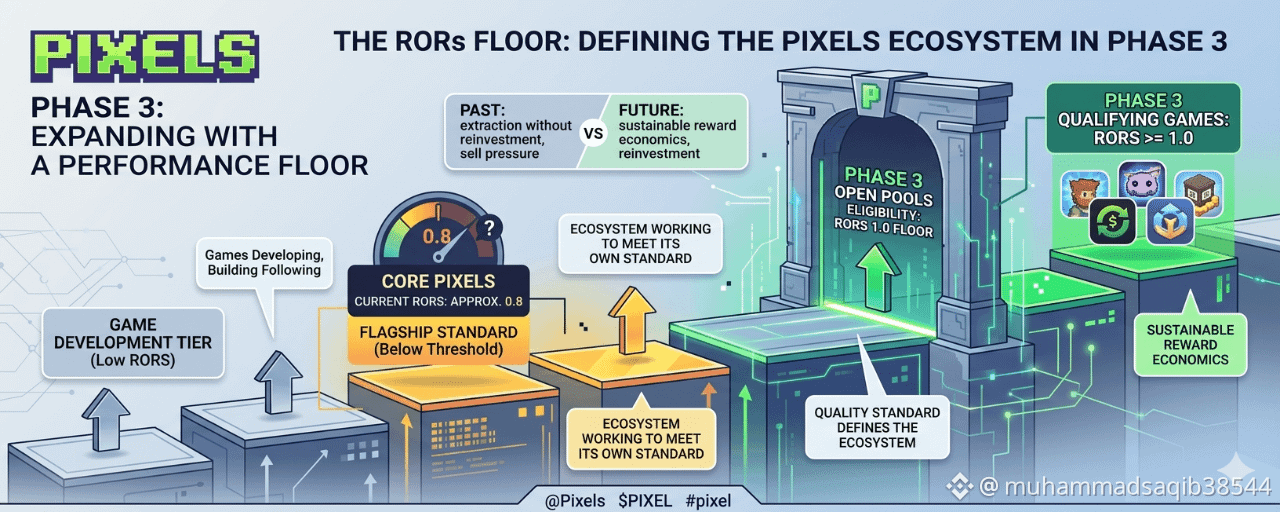
Because Phase 3 isn't really just about opening up. It's about opening up to a very specific kind of game. A game that has already demonstrated its reward spending generates at least as much value as it costs.
RORS of 1.0 means every token distributed to players has come back as net-positive revenue for the ecosystem.
That's not a low bar.
It's a bar that Core Pixels itself, the flagship game that built all of this infrastructure, is currently sitting below.
That's the detail I keep returning to.
The whitepaper is honest about it. Current RORS across the ecosystem is approximately 0.8. The team describes surpassing 1.0 as their clear and ambitious goal.
So Phase 3, the phase that opens the ecosystem to any qualifying game, sets a requirement that the game it was built around hasn't yet cleared.
Which means Phase 3 isn't just an expansion mechanism.
It's a quality standard that the whole ecosystem is still working toward meeting itself.
I've been trying to find the right way to frame what that means.
It reminds me of how certain professional leagues handle promotion and relegation...
A club can develop talent for years in lower divisions. Play well. Build a genuine following.
But until they meet the performance threshold that qualifies them for the top flight, that performance exists in a context that limits how much it can grow.
The threshold isn't arbitrary.
It reflects the standard the league believes is necessary for competition at that level to be meaningful.
Clubs below it aren't failed.
They're developing.
But the gate is real.
Phase 3 feels structurally similar.
External studios developing games that want to access $PIXEL's reward infrastructure aren't locked out by cost or exclusivity.
They're waiting to clear a performance standard that exists specifically because the ecosystem learned what happens when games without that standard participate.
The 2024 problems with Pixels, extraction without reinvestment, misaligned reward targeting, sell pressure from participants who weren't contributing value back— were essentially RORS problems before RORS existed as a metric.
Phase 3's floor is a direct institutional response to what those problems cost.
Which makes the floor itself worth taking seriously as a design decision rather than a technical detail.
Because floors define ecosystems over time.
Not immediately.
Not obviously.
But a system that only admits participants who have already demonstrated sustainable reward economics will look genuinely different after five years than one that admits participants based on enthusiasm or user count or narrative momentum.
The filter shapes the composition of everything inside it.
I'm not fully convinced the market has priced this in yet.
Most discussion about Phase 3 focuses on the expansion angle.
More games joining.
Broader $PIXEL demand surface.
Token utility growing across more titles.
That framing is accurate—
but it leaves out what doesn't get in.
And what stays out of a curated ecosystem matters as much as what enters.
There's also an uncomfortable tension I haven't resolved.
If Phase 3 requires RORS of 1.0 as the entry standard, and Core Pixels is currently at 0.8, then the ecosystem is in the position of building a qualification bar it hasn't cleared itself.
That's either an honest expression of ambition or an awkward contradiction depending on when Phase 3 actually launches and whether the flagship has crossed its own threshold by then.
I don't think it's a disqualifying tension.
But it does create an interesting question about sequencing.
If Phase 3 opens while RORS across existing games is still below 1.0, the floor becomes something the ecosystem is collectively aspiring toward rather than collectively enforcing from a position of achieved sustainability.
That changes what Phase 3 signals to external studios considering integration.
It's not a signal that says this ecosystem has proven what sustainable reward economics looks like at scale.
It's a signal that says this ecosystem knows what it wants that to look like,
has measured it honestly, and is using Phase 3 as the mechanism to accelerate toward it—
by requiring incoming games to help pull the average up rather than pull it down.
Whether that works depends entirely on how many games exist that can clear 1.0 within the timeframe after integration.
If the qualifying population is large, Phase 3 accelerates the ecosystem's health.
If it's small, Phase 3 is less an open ecosystem and more a very selective club with sophisticated membership criteria.
Right now I don't know which of those it is.
I don't think anyone fully does yet.
What I do know is that the RORS floor isn't just a technical threshold.
It's a statement about what kind of ecosystem Pixels is trying to build.
And statements like that tend to define things in ways that only become fully visible much later.