
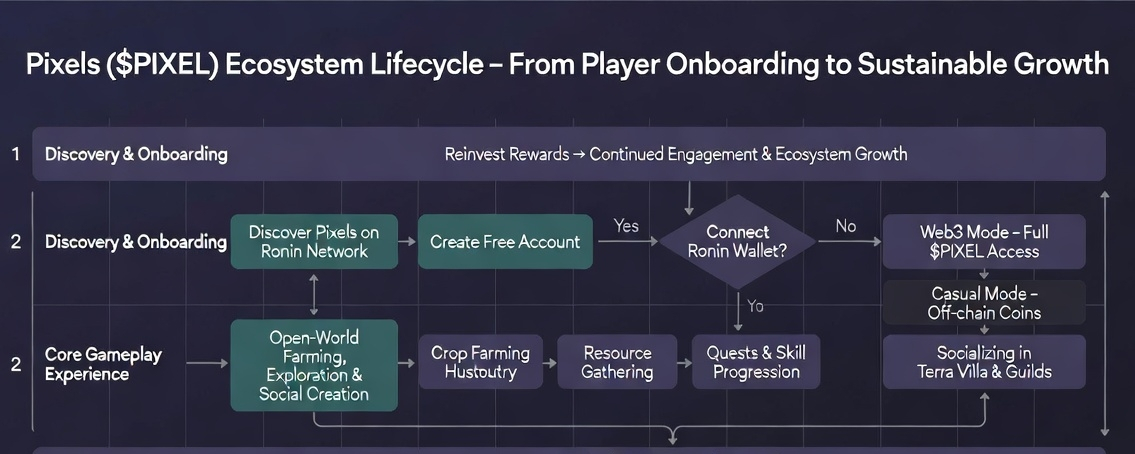
I've been diving deeper into Pixels lately, wandering its open-world farmlands and chatting with players in shared spaces like Terra Villa, and it's given me a fresh perspective on what makes this Ronin-based project stand out in the Web3 gaming space. What started as a charming pixel-art farming sim has quietly grown into something more layered—a social platform where creation, exploration, and community decisions feel increasingly intertwined with the $PIXEL token itself.
Here are a few titles that capture my thoughts on it:
"Wandering the Pixels Fields: How Pixel Is Quietly Building a Sustainable Web3 Ecosystem"
"My Take on Pixels in 2026: Staking, vPIXEL, and the Shift Toward Player-Driven Growth"
"Why Pixels Feels Different: Reflections on a Ronin Game That's Evolving Its Token Utility Organically"
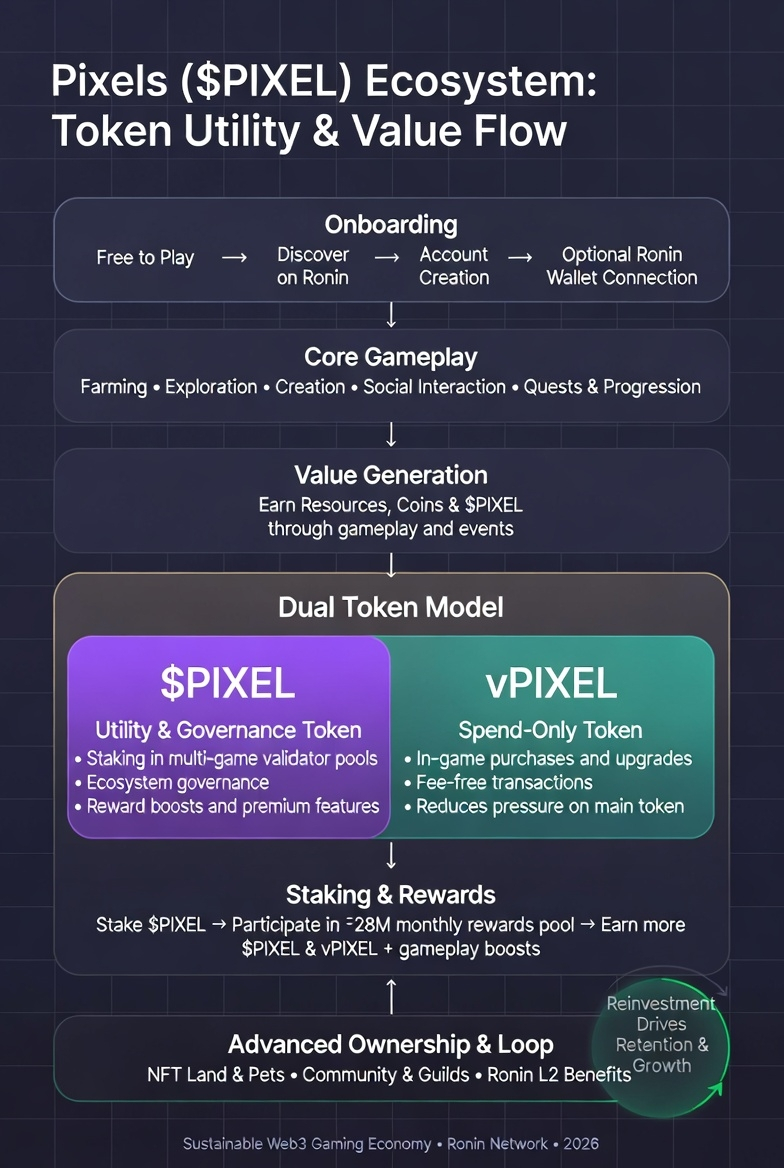
One idea keeps coming back to me as I play and follow the updates: Pixels is turning the $PIXEL token into a practical bridge between casual gameplay and ecosystem health, using tools like multi-game staking and vPIXEL to align incentives without over-relying on hype cycles. It's not about chasing overnight virality anymore; recent moves show the team focusing on real participation signals, and the data backs that up in measurable ways.
Take the staking system, for instance. Players allocate Pixel directly into game-specific validator pools, earning a proportional share of a fixed monthly rewards pool that currently sits at 28 million $PIXEL. Since the multi-game expansion rolled out and deepened through 2025 into early 2026, staked volume has climbed past 100 million tokens. This matters because it moves $PIXEL beyond simple in-game spending—it now helps determine which titles get boosted rewards and visibility in the broader ecosystem. The implication feels straightforward: as more partner games join (already spanning several on Ronin and beyond), demand for $PIXEL could stabilize around genuine utility rather than one-off events.
On the supply side, roughly 3.38 billion Pixel are now in circulation out of the 5 billion maximum—about 67.6 percent. That's a notable shift from earlier phases when unlocks represented larger slices of the total. With the most aggressive dilution periods behind us, the token's role as the ecosystem's core currency gains clarity. It suggests future growth will hinge more on how players actually use and hold $PIXEL in farming, crafting, and social features, potentially creating a steadier foundation for the whole Ronin-powered platform.
Daily active users have held steady above 150,000, even as the project moved past initial launch excitement and into deeper Chapter updates like Tier 5's land management and industry expansions. This isn't just a headline number; it reflects players returning for the core loop of planting crops, raising animals, exploring new realms, and collaborating in guilds. For Pixel specifically, it translates to consistent on-chain activity—whether spending on premium items, joining guilds that require token commitments, or participating in events. The direction points toward higher-quality engagement, which could mean the ecosystem keeps expanding its user base organically rather than through short-term incentives.
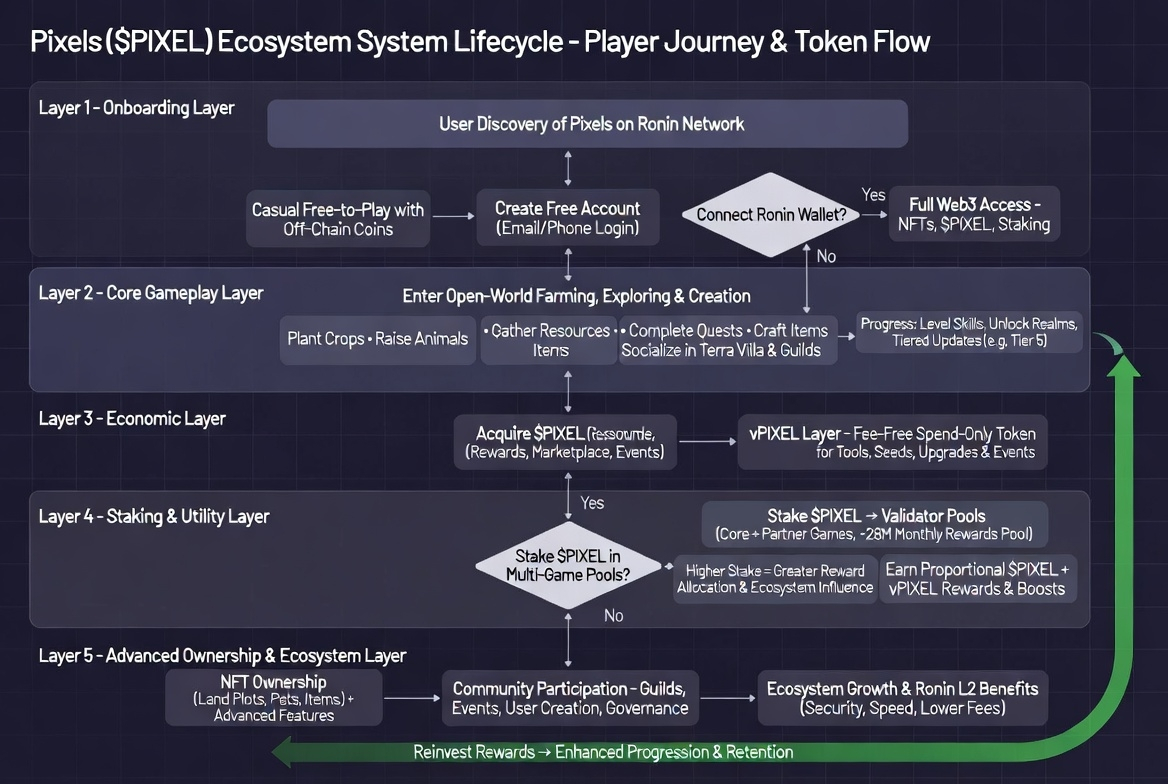
Then there's vPIXEL, the spend-only companion token introduced to smooth out the economy. Backed in alignment with Pixel but designed for fee-free in-game transactions across partner experiences, it helps separate everyday spending (like buying tools, seeds, or event passes) from the core utility and governance layer. By reducing friction and sell pressure on the main token, it lets players enjoy the creation side—customizing farms, trading resources, or building in shared spaces—without constantly worrying about market timing. In practice, this has shown up in smoother progression for casual users while keeping $PIXEL central to staking and higher-level decisions.
The upcoming Ronin network migration to a full Ethereum Layer-2 on May 12 adds another layer. It promises tighter security, drastically lower RON inflation, and automated rewards for builders—all of which flow into the Pixels environment as faster, cheaper interactions. Recent behavior around Tier 5 updates (new industries, deconstruction mechanics, and exclusive tasks) already demonstrates how these infrastructure improvements support richer gameplay without inflating token emissions. It's evidence that the ecosystem is treating Pixel as a long-term governance and allocation tool rather than a fleeting reward.
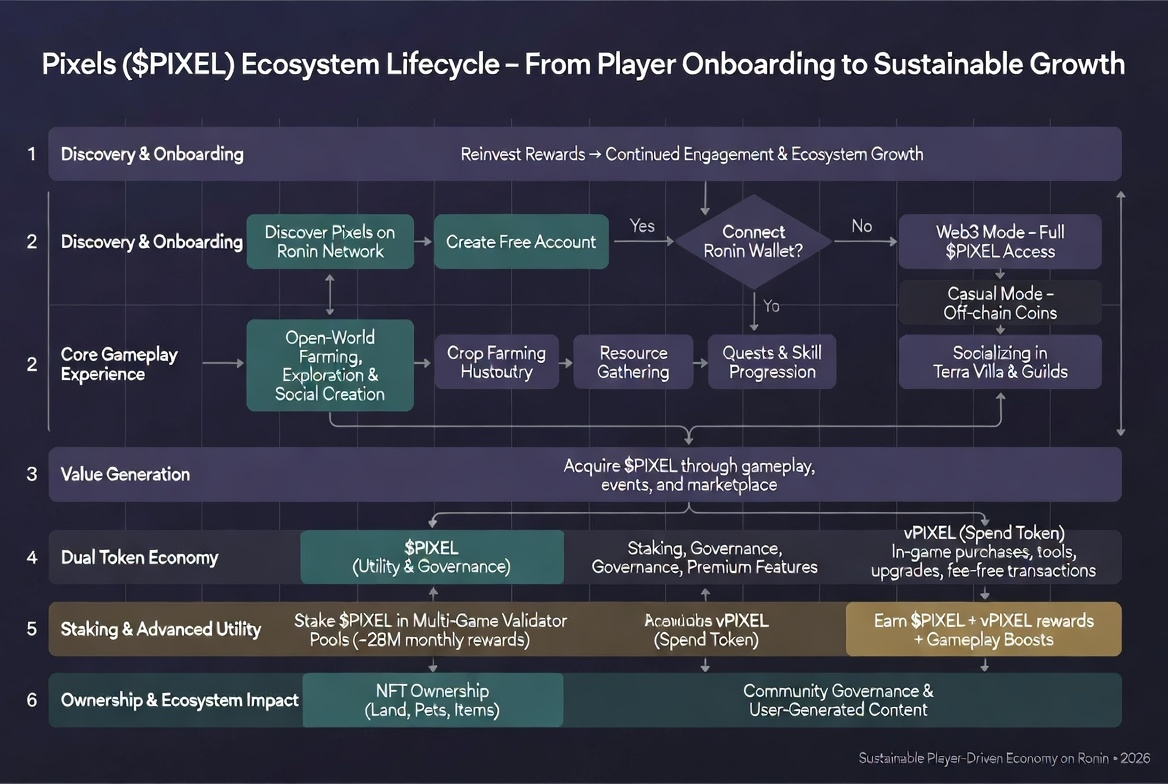
Of course, like any Web3 project, Pixels operates in a competitive landscape where broader market sentiment and new entrants can shift attention. Yet the data on sustained DAU, growing stake lockups, and deliberate design choices around vPIXEL suggest a focus on retention that many peers have struggled to maintain. The logic holds: when players see their Pixel stakes influencing real ecosystem outcomes and their vPIXEL enabling seamless fun, participation becomes self-reinforcing.
In the end, what stands out most from my time with Pixels is how the Pixel token, the staking mechanics, and vPIXEL together create a practical feedback loop for a social farming world on Ronin. It isn't perfect, and growth will depend on continued execution, but the current signals point to a project that's prioritizing usable features and ecosystem data over flash. For anyone curious about Web3 games that feel built to last, it's worth exploring firsthand—the fields are still growing, one pixel at a time.
