
Pixels is trying to do something difficult.
It is trying to make a crypto game feel normal.
That might sound simple, but it is not. Most Web3 games struggle because the financial layer shows up too early and too loudly. Before the player has a reason to care about the world, they are already being asked to care about assets, tokens, rewards, and economic participation.
Pixels feels more natural than that.
It gives players a simple farming loop, a friendly world, and a social environment that does not immediately feel like a financial dashboard. That makes it easier to understand why someone might actually spend time there.
That is its strength.
But it is also where the tension begins.
Because once fun becomes financial, fun changes.
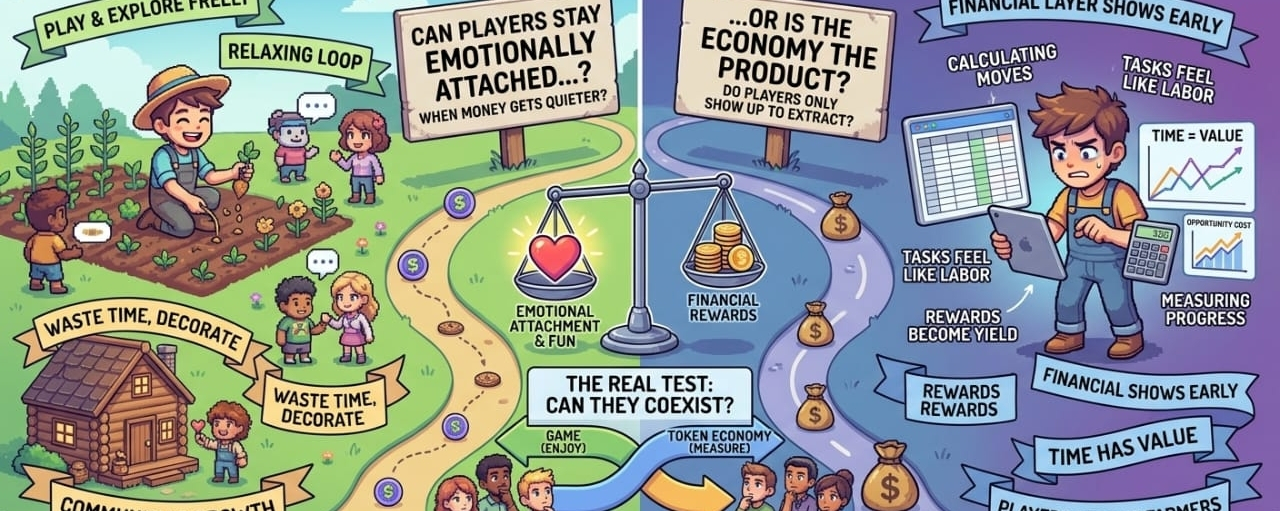
A normal game lets players behave freely. They can explore slowly, waste time, decorate, talk to people, try inefficient strategies, and enjoy progress at their own pace. None of that has to be rational. It just has to feel good.
A tokenized game makes those actions feel heavier.
Suddenly, time has a value. Items have a value. Progress has a value. Choices have opportunity costs. Players are not just playing anymore. They are calculating.
That calculation can quietly reshape the whole experience.
A task that should feel relaxing starts to feel like labor. A reward that should feel satisfying starts to feel like yield. A game economy that should support the world starts becoming the thing players care about most.
This is the old play-to-earn trap.
And Pixels is not immune to it.
To be fair, Pixels seems more thoughtful than many earlier projects. It does not feel like a crude reward printer with pixel art attached. It has a better sense of accessibility, social design, and long-term engagement. It understands that a game cannot survive if the only reason people show up is extraction.
That matters.
But the hard question remains the same.
Can Pixels keep players emotionally attached when financial rewards are less exciting?
That is where the real test lives.
If people keep logging in because they enjoy the rhythm, the community, the land, the progression, and the world itself, then $PIXEL can become a useful layer around a real game.
But if people mainly stay because rewards are worth farming, then the economy is still the product.
And once the economy becomes the product, the game starts losing control.
Players optimize. Farmers dominate. Token performance shapes the mood. Updates get judged by whether they improve demand or reduce sell pressure. The community becomes less about the world and more about the chart.
That is not the same as a healthy game.
Pixels deserves attention because it is one of the better attempts to avoid this outcome. It feels softer, smarter, and more playable than the first wave of play-to-earn.
But better design does not erase the basic conflict.
A game wants players to enjoy.
A token economy wants players to measure.
Pixels is trying to make those two ideas coexist.
Maybe it can.
But until the game proves it can stay meaningful when the money gets quieter, the honest take is simple:
Pixels may be a better crypto game.
But it still has to prove that making fun financial does not eventually make it less fun.
