I keep coming back to this one moment I’ve had more times than I can count: logging into a game that looks alive at first glance players moving around, crops being harvested, tokens changing hands, notifications constantly pulling your attention and yet, after a while, something starts to feel off. Not broken, just… empty. Like everything is happening, but nothing is really sticking. You go through the motions, you collect, you progress, but there’s this quiet realization sitting in the background that if the rewards slowed down even slightly, most of it would stop. And that thought lingers, because it forces a harder question were people ever here for the world itself, or just for what they could take from it while it was still worth something?
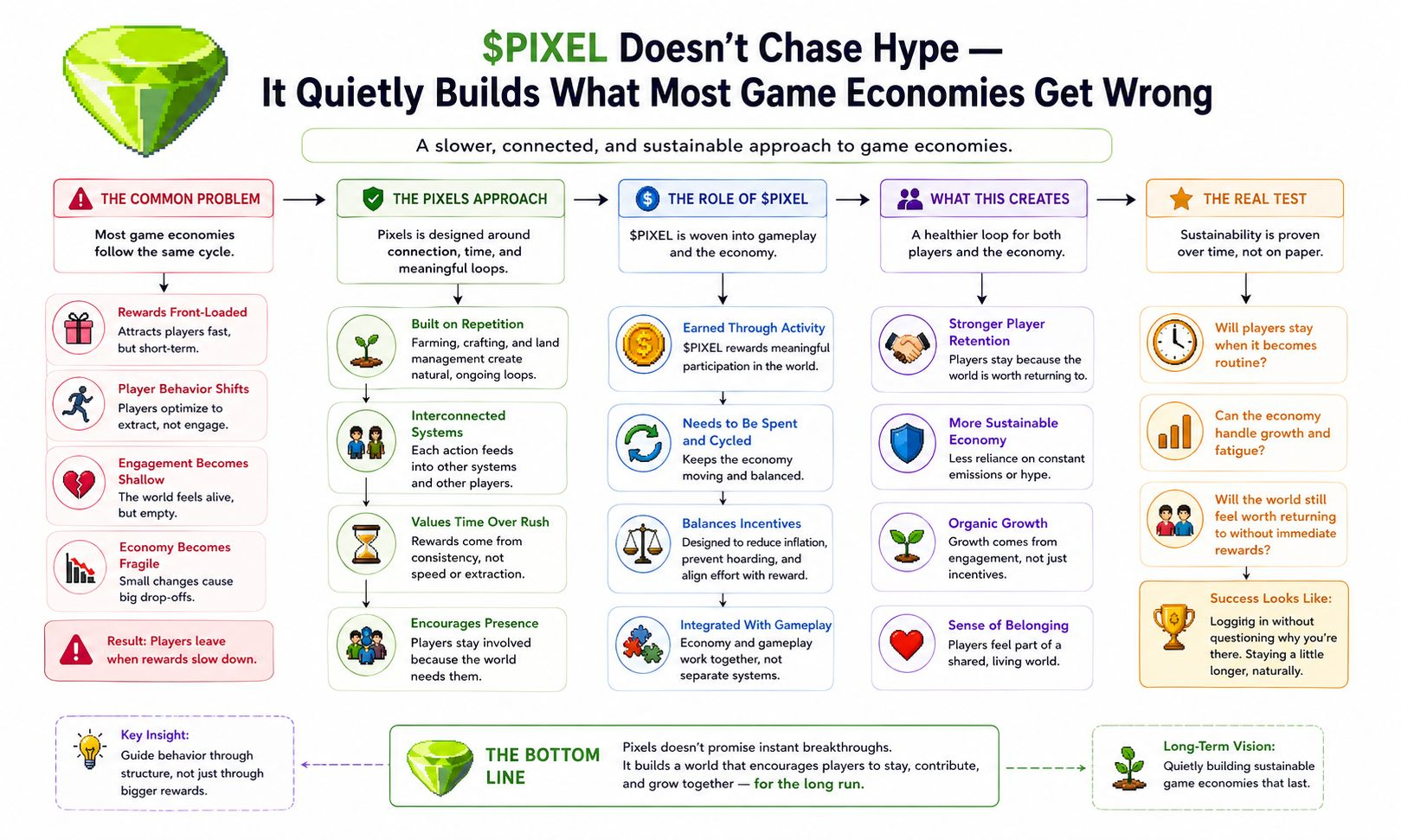
The more time I’ve spent in these systems, the harder it is to ignore the pattern. It’s not usually a failure of design in the obvious sense. In fact, a lot of these economies are carefully thought out. On paper, they make sense. Incentives are aligned, loops are optimized, participation is rewarded. But once real players step in, something shifts. Behavior doesn’t follow intention it follows opportunity. Rewards get front loaded to attract attention, which works for a while, but it also teaches players how to approach the system: move fast, extract efficiently, and don’t get too attached. And over time, that mindset reshapes everything. What started as a game slowly turns into something closer to a routine almost mechanical, where the goal isn’t to engage, but to outpace the moment before it changes.
That’s the backdrop I carry when I look at something like Pixels. So I don’t approach it expecting a solution I approach it expecting another variation of the same cycle. But the longer I sit with it, the more it feels like it’s at least trying to push in a different direction. Not loudly, not in a way that demands attention, but quietly, through how the system is structured. At its core, it’s still simple: farming, crafting, managing land, interacting with other players. None of that is new. But the way those pieces rely on each other and more importantly, the way they rely on time starts to change how the whole thing behaves.
There’s something subtle about systems built on repetition. They don’t create urgency in the same way. They don’t need constant spikes to stay relevant. Instead, they ask for something slower consistency, presence, a willingness to come back and continue rather than rush through and leave. When you farm, you’re not just completing a task; you’re feeding into another layer. When you manage land, it’s not just ownership it’s responsibility, coordination, sometimes even dependency on others. And that dependency matters, because it pulls players out of isolation. You’re not just optimizing your own loop you’re existing inside a shared one.
The more I think about it, the more I realize that this kind of structure doesn’t try to fight player behavior directly it tries to guide it. If the only way to benefit is to stay involved, then leaving early becomes less attractive. Not impossible, just less natural. And that’s a very different kind of pressure than most systems create.
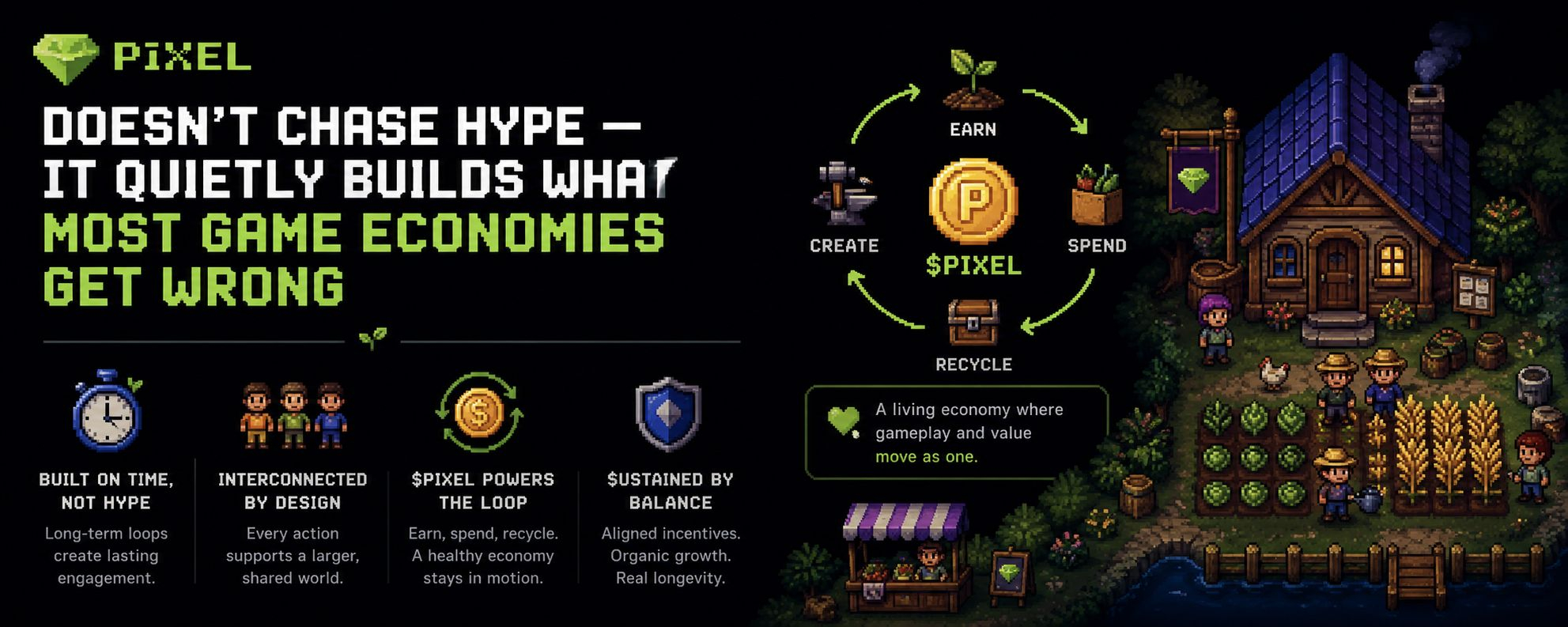
But then there’s the part that always complicates everything: the token itself. PIXEL isn’t just sitting outside the system it’s woven into it. It rewards activity, but it also needs to be spent, cycled back, absorbed. And this is where things usually start to break down in other projects. It’s easy to distribute value. It’s much harder to keep it moving in a way that doesn’t slowly drain the system or distort behavior. If earning feels too easy, the economy inflates. If spending feels forced, players disengage. And if there’s any gap between effort and reward, people notice it immediately.
So even here, I can’t say the problem is solved. It rarely is. What Pixels seems to be doing, though, is narrowing the gap between gameplay and economy trying to make them feel like part of the same loop instead of two separate systems stitched together. Whether that holds under real pressure is something no design can guarantee.
And that’s where my skepticism stays. Not in a dismissive way, but in a cautious one. I’ve seen systems feel stable early on, only to drift once behavior scales and incentives start to stretch. The real test isn’t whether the structure makes sense it’s whether it survives contact with players over time. Will people stay when things become routine instead of exciting? Will the economy absorb both growth and fatigue without tipping too far in either direction? Will the world still feel worth returning to when there’s no immediate advantage to doing so?
Those answers don’t come quickly. They show up slowly, in patterns, in what players choose to do when no one is watching.
What I see in Pixels, at least right now, isn’t something trying to impress me. It feels more like something trying to hold together. And strangely, that makes it more interesting. Because in a space that often overpromises and overextends, restraint is rare.
If it works, I don’t think it’ll feel like a breakthrough moment. There won’t be a sudden realization that everything has changed. It’ll be quieter than that. It’ll feel like logging in and not questioning why you’re there. Like staying a little longer without thinking about when to leave.
And honestly, that might be the closest thing to something real this space has seen in a while.