
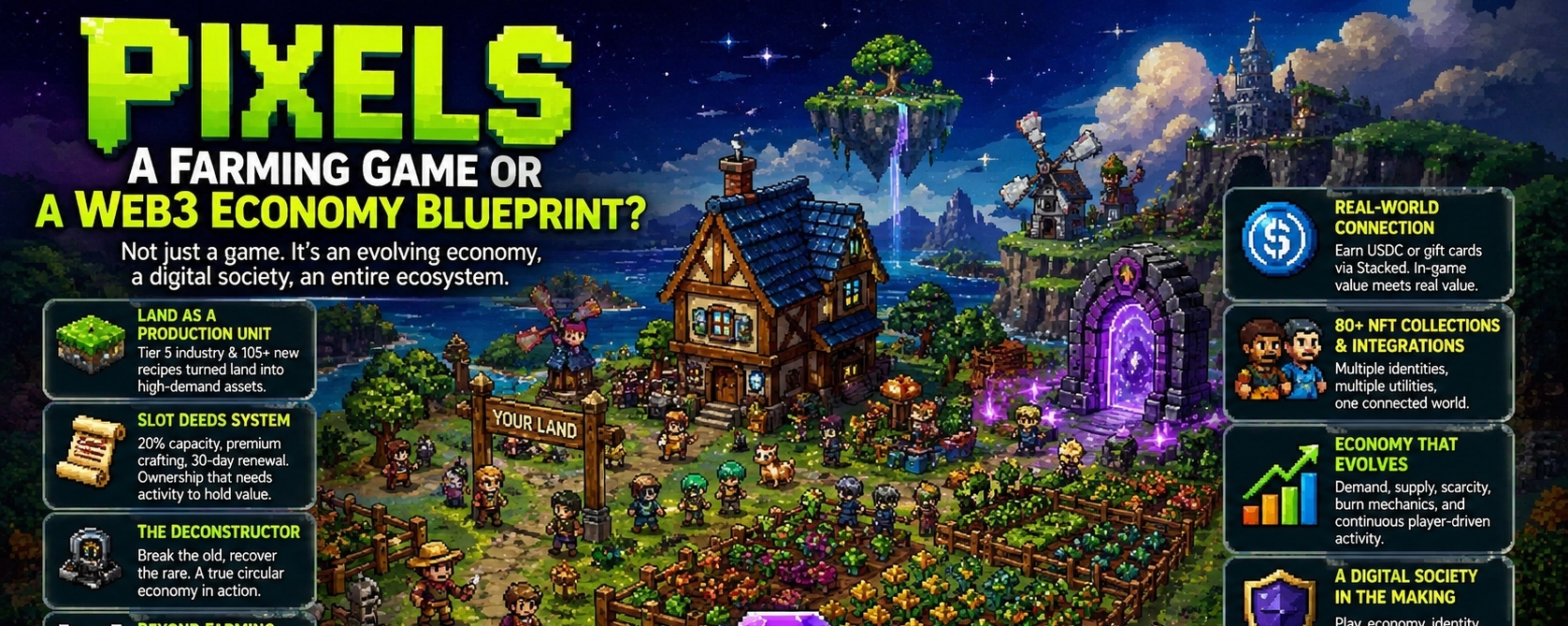
@Pixels There’s one thought I keep returning to whenever I look at @Pixels, and honestly it refuses to leave my mind. Is this still just a farming game, or is it slowly becoming something far beyond that? From the outside, it still carries the same familiar image people know so well—fields to harvest, land to manage, NFTs to collect, tokens to earn. It all appears simple enough. But the deeper you spend time inside it, the more it starts to feel less like a normal game and more like a living system that keeps reshaping itself. Especially after the 2026 updates, the entire atmosphere feels different, almost as if the game is quietly moving into a new identity while most people are still calling it by the old one.
The clearest sign of that shift can be seen in how land works now. Land doesn’t feel like cosmetic ownership anymore. With Tier 5 industry and a huge wave of new recipes, it has become something closer to a productive asset. Certain resources and outputs now depend on having access to specific lands, which creates a demand cycle that feels natural because it is tied to actual use. That changes how players think. Instead of simply collecting items for status, many now think in terms of efficiency, production, scarcity, and future returns. Not every land holds equal value, and that imbalance gives the economy a strangely realistic pulse. Of course, there is still the question of whether this demand is fully organic or partly shaped by update-driven scarcity. That debate will always exist. But one thing is obvious—the player mindset has changed. People are no longer only playing. They are analyzing, planning, and calculating every move.
When a Simple Farming Game Starts Feeling Like Something Much Bigger
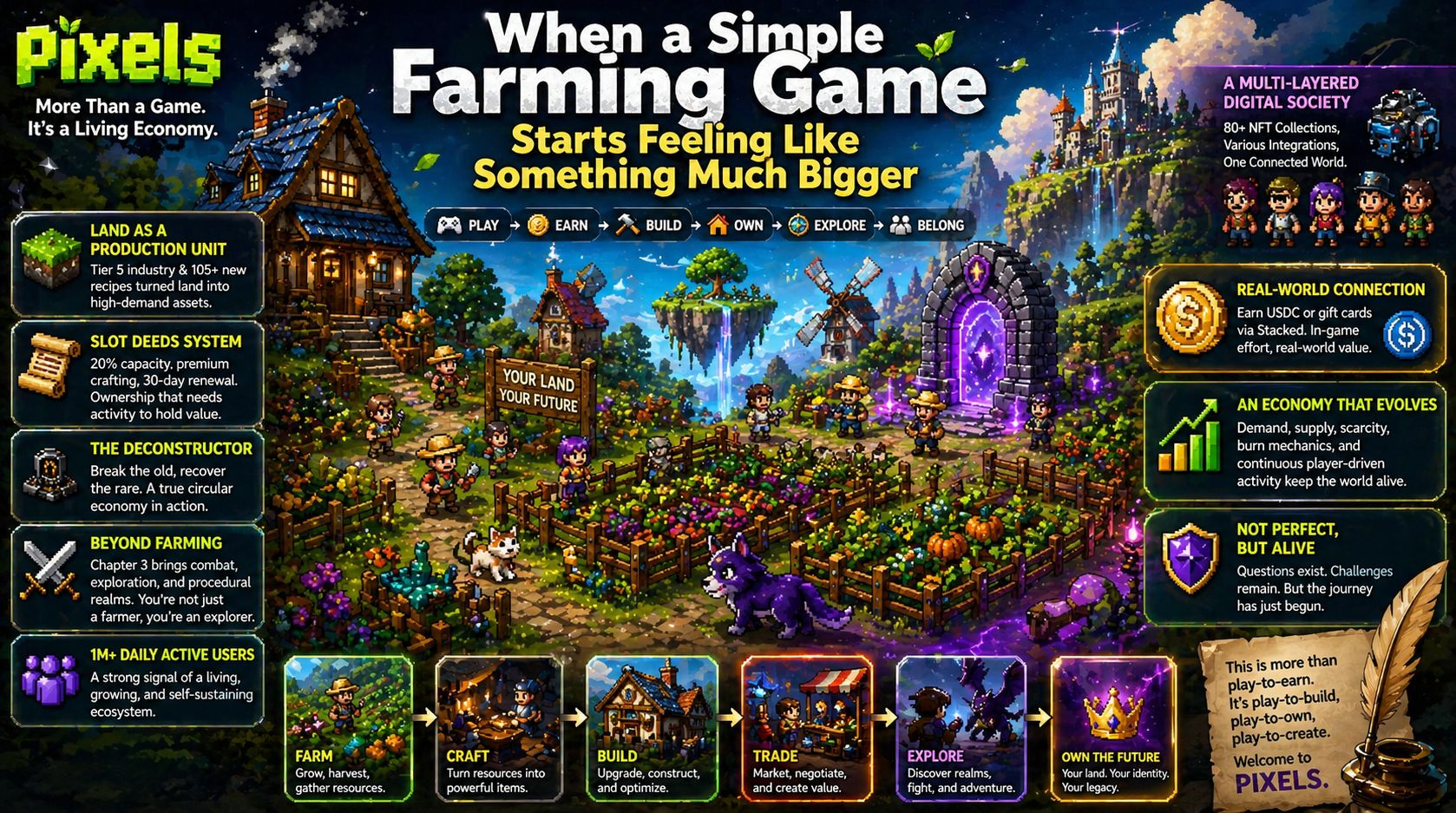
The Slot Deeds system pushes that idea even further. At first it can look complicated, maybe even overwhelming, but underneath it introduces something important: ownership without activity is no longer enough. Value now depends on participation. Capacity has to be maintained, systems need attention, and progress requires consistency. That creates a subtle but powerful tension. On one side, it helps control inflation and keeps inactive wealth from dominating the ecosystem. On the other side, it adds constant pressure because rewards are tied to regular involvement. Some players will see that as healthy design, while others may feel it turns leisure into obligation. Whether it becomes a strength or a weakness depends entirely on how balanced it remains over time.
Even smaller changes reveal a bigger philosophy. The move from “The Machine” to “The Deconstructor” feels symbolic. It’s not just a rename—it reflects a different approach. Older assets can be broken down, rare materials recovered, and forgotten progress turned into new opportunity. That creates the feeling of a circular economy where wasted value gets recycled back into the system. It’s clever, but it also raises another question. As mechanics become deeper and smarter, are they staying accessible to casual players, or slowly becoming a world mainly understood by advanced users? Complexity can make a game richer, but it can also quietly create barriers.
Then comes the expansion into combat, exploration, and procedural realms. This may be one of the most important transitions of all. Pixels no longer wants players to simply manage resources—it wants them to move through a world. NFT pets, new zones, discovery systems, and adventure mechanics give the project something economies alone cannot provide: emotional attachment. Players who explore and experience a world tend to stay longer than players who only farm rewards. That shift matters. Strong numbers and user growth are impressive, but the deeper question is always retention. Are people staying because the rewards are good, or because the world itself feels worth returning to?
The connection to real-world value through USDC rewards and gift cards adds another fascinating layer. Once effort inside the game can convert into something useful outside the game, the meaning of in-game labor changes completely. Tokens stop feeling isolated and begin interacting with reality. That can reduce pressure on internal reward systems and increase utility, but it also means the ecosystem becomes more sensitive to outside market conditions. Real value creates real expectations.
What makes Pixels truly interesting to me is how all these layers combine. Farming, ownership, identity, economy, exploration, progression—they no longer feel separate. They are blending into something that resembles a digital society more than a simple game. It is not perfect, and there are still many unanswered questions around sustainability, fairness, and long-term balance. But perfection was never the most attractive part of it.
The real attraction is that Pixels feels alive. It is still changing, still experimenting, still growing into something even its own players may not fully understand yet. And maybe that is why so many people keep watching it. Not because it has already become the future, but because it might be building one in real time.