

Bitcoin crossed $80,000 in Asian trading hours on May 4, 2026, its first breach of that level since late January, propelled by a dual-engine catalyst: nine consecutive days of net inflows into the various US spot Bitcoin ETF products, totaling approximately $2.7Bn over three weeks.
A concurrent buildup of leveraged long positions in derivatives markets amplified the move through key resistance. The return to $80,000 represents a roughly 30% recovery from April lows near $60,000, and the rally’s structure distinguishes it sharply from prior cycles.
The scale of institutional participation behind this move is not incidental. Total net assets held across US spot Bitcoin ETFs have now surpassed $100Bn, a threshold that frames this rally as a structural shift in how capital accesses the asset rather than a single-session speculative spike.
Cumulative net inflows since the launch of spot Bitcoin ETFs have reached $58Bn, positioning this product category among the most successful ETF launches in market history.
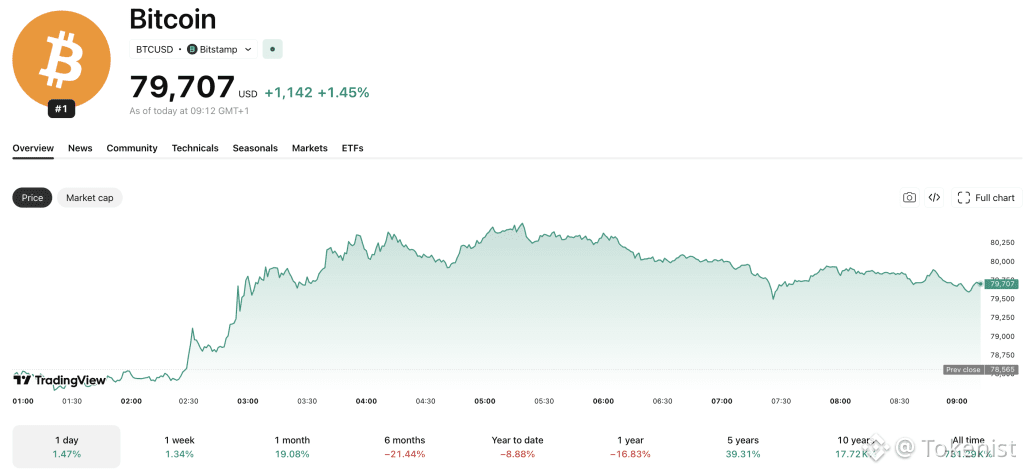 SOURCE: TradingView IBIT Leads Spot Bitcoin ETF Inflows as Total AUM Clears $100Bn
BlackRock’s iShares Bitcoin Trust (IBIT) has led the recent inflow cycle, attracting over $22M on April 24 and accumulating $2.14Bn in monthly inflows, ranking in the top 1% of all global ETFs.
IBIT now holds around 809,870 BTC, accounting for about 62% of total Bitcoin ETF assets and nearly 7% of total Bitcoin supply. This concentration in a single regulated product is a notable feature of the current market.
The broader ETF sector experienced its eighth consecutive inflow session, with over $2.4Bn in net new capital since early April, exceeding March’s record of $1.2Bn. Morgan Stanley’s Bitcoin Trust (MSBT), launched on April 8, contributed $95M during this period, with no outflows.
US spot Bitcoin ETFs absorbed an estimated 19,000 BTC in the last five days of April, creating a “disciplined floor” by channeling supply into structured portfolios amid macro uncertainty. For more on April’s fund-level flow data, refer to Bitcoin ETF News: April 2026 Inflows and Institutional Demand.
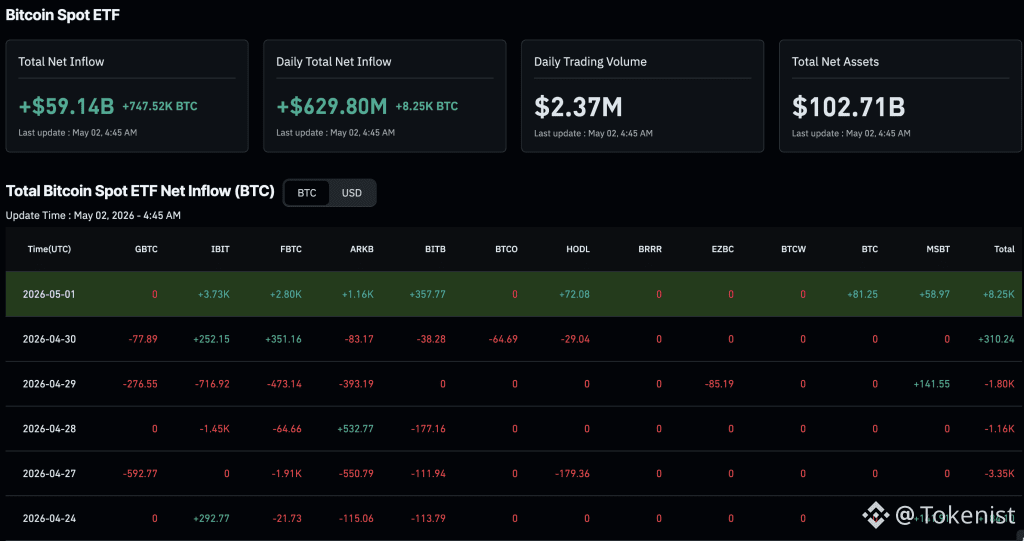 SOURCE: CoinGlass Institutional Bitcoin Adoption Deepens as ETF Mechanics Build a Structural Bid
The inflow streak indicates a structural re-entry by institutional investors, who had been net sellers in Q1 2026. Institutional crypto adoption has grown since the launch of spot Bitcoin ETFs, with asset managers now viewing BTC as a regulated portfolio allocation.
Morgan Stanley’s entry into direct Bitcoin ETF issuance with MSBT, priced below IBIT, signals increased competition for institutional flows. Their recent 13F filing highlights the mainstream nature of Bitcoin allocations.
ETFs are currently absorbing significantly more than the 450 BTC mined daily, creating supply pressure on exchange reserves. Bulls cite declining exchange balances and long-term holder accumulation as signs of a durable bid.
However, bears warn that ETF inflows are sensitive to market sentiment, with a potential reversal in macro conditions or BTC price declines risking redemptions and diminishing support for prices.
Crypto Market Leverage Amplifies the $80,000 Breakout and Flags the Downside Risk
$BTC I've been preemptively bullish but I think these are the levels at which sentiment and market behavior will shift notably 78k$+ – People will finally start being cautiously bullish 87k$+ – Full blown bullish, bullish acceleration likely 70k$- – High likelihood of death pic.twitter.com/a7isYdeoUU
— DonAlt (@DonAlt) May 3, 2026
CryptoQuant reported on April 30 that Bitcoin’s April rally was fueled solely by demand for perpetual futures, while spot demand declined, raising questions about sustainability.
Open interest surged during the breakout above $78,000, driven by leveraged long positions rather than spot purchases. FlowDesk noted rising demand for leveraged longs across BTC, ETH, and NEAR, indicating a broad leverage buildup.
The liquidation cascade works both ways: heightened long open interest pushed prices above $80,000 as shorts covered, but could lead to rapid retracement if BTC fails to hold that level.
Bitcoin ETF inflows may provide stable support amid volatility from derivatives, contingent on institutional spot buyers absorbing potential futures liquidations. Monitoring high positive funding rates on major exchanges is crucial as the $80,000 support level is tested.
$80,000 as Resistance-Turned-Support: Key Levels and What Comes Next
The $80,000 level aligns with the 21-week exponential moving average and has rejected multiple breakout attempts since February 2026. A daily close above this level would indicate a significant trend change, potentially leading to a challenge of the 200-day EMA at $84,000.
Polymarket predicts a 56% chance that Bitcoin will reach $85,000 and a 23% chance of $90,000 by May 2026, suggesting a measured continuation rather than a rapid rise to the $109,000 all-time high.
Bulls cite reduced exchange supply, a nine-session streak of ETF inflows, and significant BTC absorption by ETFs as signs that the $80,000 level could turn into support.
Bears argue that the April rally’s derivatives-driven nature, with diminishing spot demand, could reverse institutional flows if macro conditions worsen. The 200-day EMA around $84,000 will be crucial in determining whether the current move is a breakout or a retest.
Disclaimer: The author does not hold or have a position in any securities discussed in the article. All stock prices were quoted at the time of writing.
The post BTC Hits $80,000: Tracking Bitcoin ETF Inflows appeared first on Tokenist.