

Main Takeaways
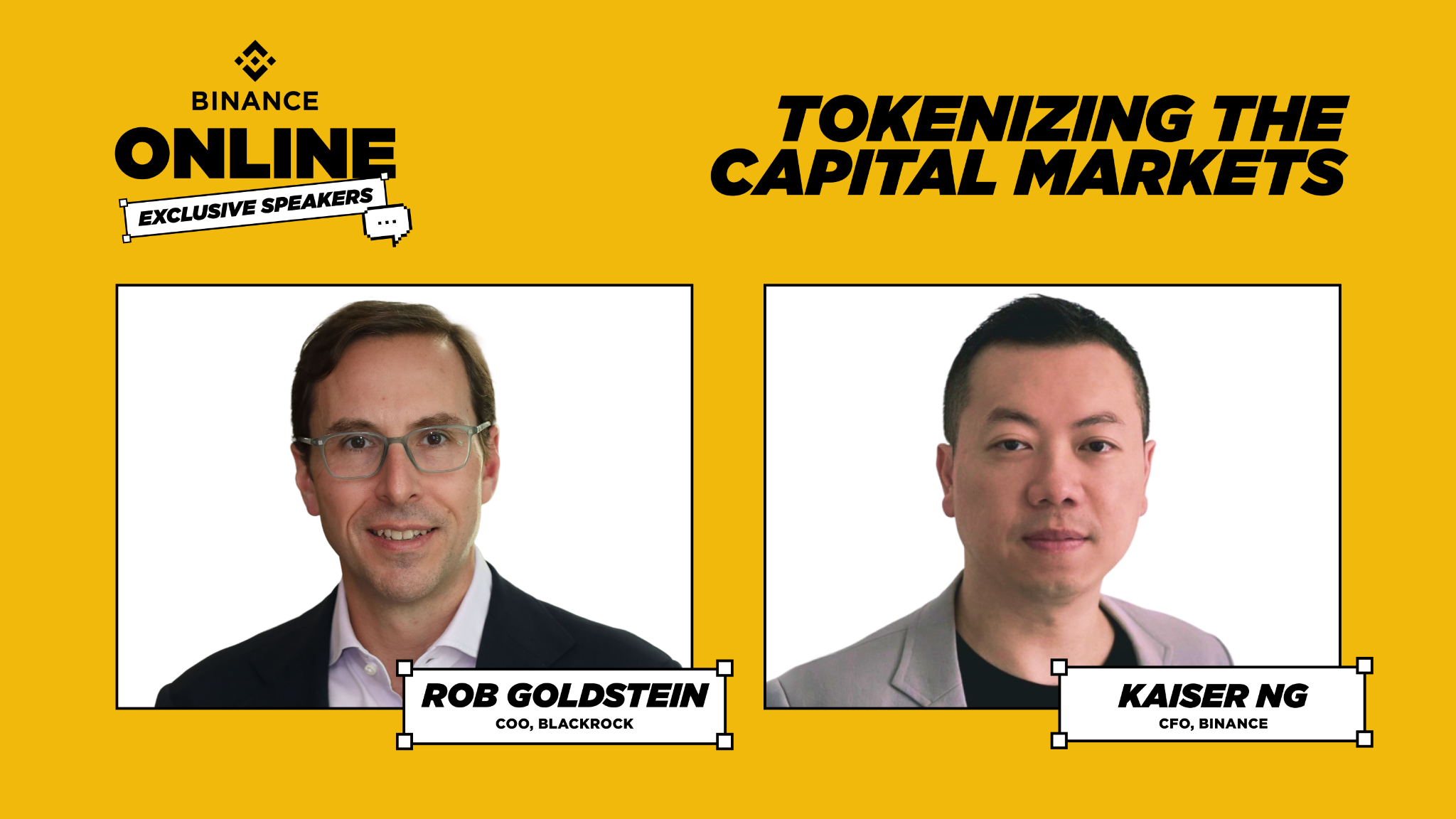
At Binance Online, BlackRock COO Rob Goldstein joined Binance CFO Kaiser Ng to discuss tokenization, digital assets, and the future of capital markets.
The conversation highlighted a broad dynamic: traditional finance and Web3 are increasingly being connected through ETFs, tokenized funds, digital wallets, collateral use cases, and institutional infrastructure.
Binance Research scenario analysis suggests tokenization could grow meaningfully by 2030, but adoption will depend on regulation, custody, liquidity, and distribution maturing together.
The future of finance is unlikely to arrive through one system replacing another. A more feasible scenario is that it will be built through bridges between traditional portfolios and digital assets, capital markets and digital wallets, and regulated financial products and crypto-native infrastructure.
That was the central theme of a Binance Online conversation between Rob Goldstein, Chief Operating Officer of BlackRock, and Kaiser Ng, Chief Financial Officer of Binance. The session focused on tokenizing capital markets, but its significance went beyond any single fund, token, or ticker.
A BlackRock COO appearing at a Binance event is itself a sign of how far the digital-asset industry has reached. The world’s largest asset manager and the world’s largest crypto ecosystem serve different histories and user bases, but the conversation reflected a reality that is becoming harder to ignore: traditional finance and digital-asset infrastructure are no longer moving on separate tracks. The question now is how the two systems connect, and which institutions can make that connection useful.
Two Directions Of The Same Bridge
Digital assets have long been framed as a choice between two worlds: traditional finance on one side, crypto on the other. Goldstein rejected that binary framing.
“Our strategy from the beginning has been very, very, very simple – very hard to execute, I don't want to take anything away from what we've accomplished – but a very simple strategy, which is to effectively be that bridge between the capital markets and this alternate universe,” he said. “To provide, in a BlackRock quality way, digital assets exposures in the capital markets. And to provide, in a BlackRock quality way, as tokens, capital markets exposures in this alternate digital-asset universe.”
That bridge moves in both directions. IBIT brought Bitcoin exposure into a familiar traditional ETF wrapper. BUIDL represents the reverse flow: capital-markets exposure made available as a token on digital rails.
At the same time, Goldstein noted that digital assets enter institutional portfolios as a matter of a “natural cycle”:
It's a very natural cycle that as time goes on, as people get more educated, it'll enter more and more model portfolios. There'll be more and more of a track record, and the portfolio utility, the diversification utility will become more and more clear to institutions.
Why Tokenization is Central
The core promise of tokenization is making financial products easier to access, transfer, use, and settle. Goldstein framed the opportunity through a client lens: better, faster, cheaper.
“We feel there is a great value proposition that tokenization provides relative to some existing structures, particularly with regard to the fund ecosystem,” he said. “When we think of opportunities, we're always thinking within BlackRock: how do we make access better, faster, cheaper for clients and end-clients?”
The point is that many parts of today’s financial infrastructure remain slow, fragmented, expensive, or operationally complex. Fund distribution, transfer agency, collateral mobility, settlement cycles, cross-border access, and portfolio operations all contain inefficiencies that digital rails may help reduce over time.
Tokenization can make assets more programmable and usable across platforms. It can also create new forms of collateral, liquidity, and access for users who already operate inside digital financial ecosystems.
What Adoption Could Look Like By 2030
Tokenization remains early. As Kaiser Ng noted during the conversation, the current tokenized asset market is still small relative to the scale of global capital markets. Goldstein also emphasized that tokenization could see “3x, 5x growth rates” for many years while still representing only a small minority of traditional financial infrastructure.
That is the right way to understand the opportunity. The base is small, but the addressable market is vast. The pace of adoption will depend on whether several conditions mature together: regulation, institutional-grade custody, secondary-market liquidity, and distribution.
Binance Research scenario analysis illustrates how wide the range of outcomes could be by 2030.
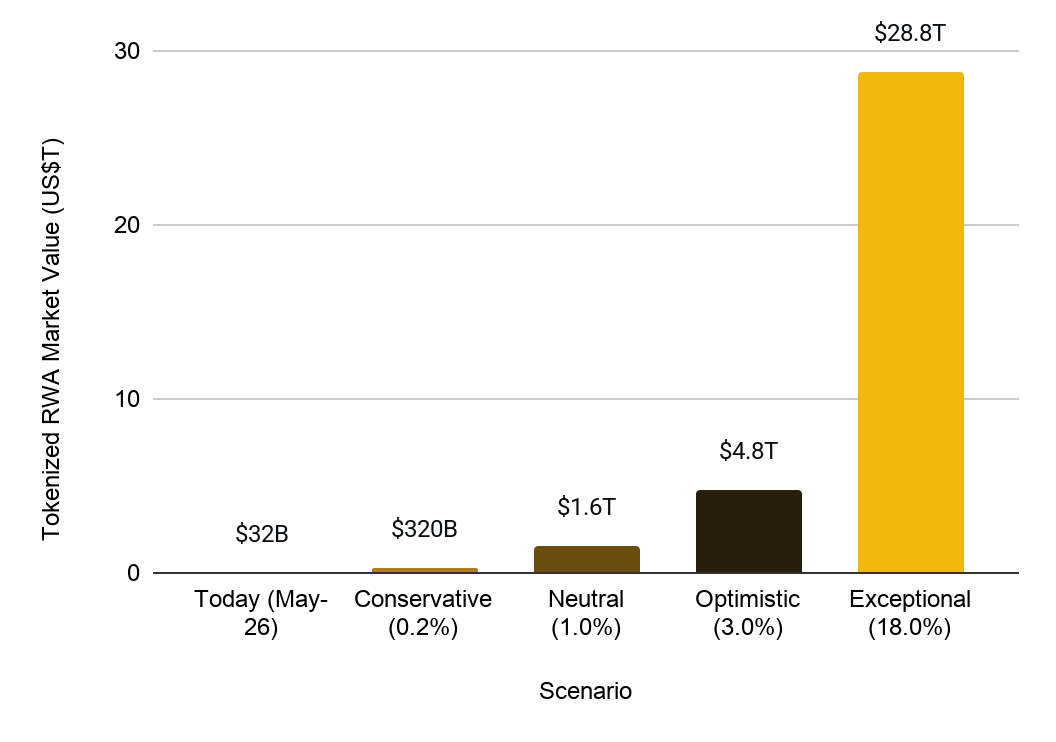
Penetration rate scenario assumptions (0.2% → 18%) are benchmarked against two historical references: ETFs taking 30 years to penetrate 12% of total stock market cap since inception, and mobile payments scaling from 3% to 77% in just 3 years. Based on these assumptions, the potential market size of tokenized RWAs is projected to range between US$1.6 trillion and US$28.8 trillion.
Among all segments, the tokenized equities and government bonds markets are the most significant. Under the baseline scenario, each is expected to surpass $300 billion – yet today, the two combined stand at just ~$18 billion.
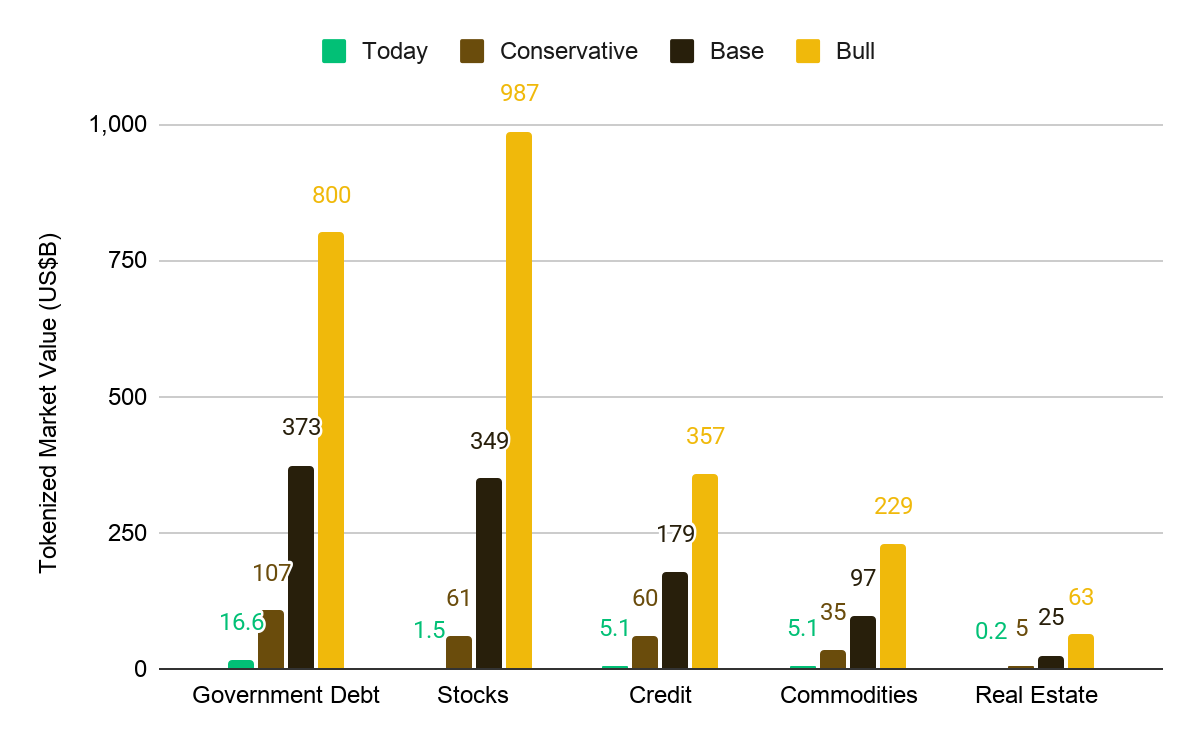
These figures should be read as projections rather than guarantees, but tokenization should be measured against the scale of global capital markets, rather than only against today’s on-chain tokenized asset base. Even low-single-digit penetration would represent a major expansion.
Binance’s Role: From Issuance To Adoption
To transform finance, technology has first to be implemented, explained, and made trusted by and useful to a critical mass of adopters.
Binance has a unique combination of user base, liquidity, infrastructure, institutions, and education. It is where millions of people already access digital assets and where new product categories can be tested and scaled. Goldstein made that point directly.
“I do think Binance plays an important role in helping to really provide that better, faster, cheaper value proposition, because at the end of the day, technology needs to be properly implemented and properly explained to people. And Binance is going to play such an important role in that.”
The 2030 opportunity depends less on tokenization as a concept than on tokenization as a functioning market. A tokenized asset without liquidity, custody, collateral utility, user access, and risk controls remains a proof of concept; a tokenized asset connected to deep markets and global distribution can become part of everyday financial reality.
This is where Binance can help move the industry from issuance to adoption: building bridges between users who think in crypto terms and institutions that think in terms of portfolios, risk, and settlement.
The Next Layer: AI, Wallets, And Digital Finance
The conversation also pointed toward an even larger convergence: digital assets and artificial intelligence.
As enterprises begin using AI agents for increasingly complex tasks, those agents may eventually need ways to transact and coordinate value. Traditional financial infrastructure was not built for machine-native activity at global internet speed. Digital tools and rails may become part of the financial layer that allows AI agents to operate in the real economy.
For Binance, this convergence is central to the next phase of growth. The industry is moving beyond a narrow definition of crypto as trading alone. The addressable market is widening toward digital finance: storing and moving value, accessing markets, managing portfolios, using tokenized assets, and eventually interacting with AI-enabled financial tools.
Final Thoughts
Tokenization will not mature overnight, but the overall direction is unmistakable. Digital assets are entering traditional portfolios while traditional products are entering digital wallets. Institutions are looking very seriously at tokenized infrastructure while crypto-native platforms are developing the liquidity and user experience needed to make these products genuinely usable.
The Binance Online conversation between Rob Goldstein and Kaiser Ng captured this moment well, offering a glimpse of how the next financial architecture may be built by connecting the two worlds they represent. As tokenization moves from concept to infrastructure, Binance is positioned to help build that bridge for the people and institutions who will use it.