

But in reality, most traders lose for a much simpler reason:
They enter the market without a real plan.
They trade based on emotions.
They chase green candles.
They follow hype.
They react instead of thinking.
And in a fast-moving market, emotional decisions become very expensive.
A professional trader and a gambler can use the same chart, the same exchange, and even the same amount of capital — but their mindset is completely different.
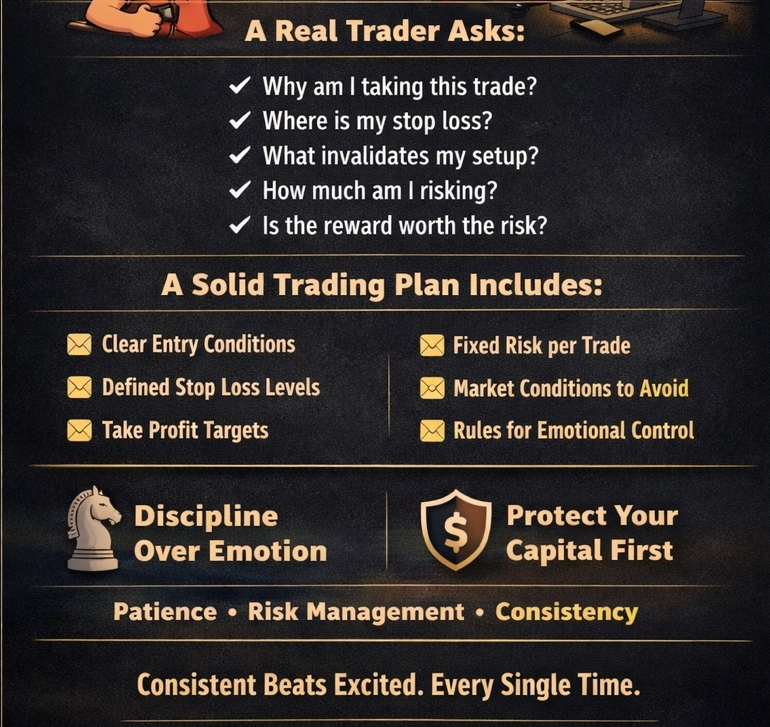
A disciplined trader asks questions before entering any trade:
• Why am I taking this position?
• Where is my stop loss?
• What invalidates my setup?
• How much am I risking?
• Is the reward worth the risk?
These questions create structure.
And structure creates discipline.
Gamblers think differently.
“What if it keeps pumping?”
 That single sentence explains why most people fail.
Because hope is not a strategy.
The market punishes emotional trading every single day.
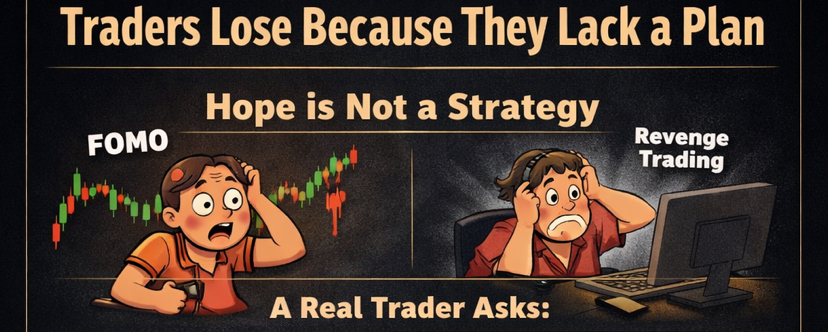
One of the biggest mistakes is revenge trading.
A trader takes a loss, gets frustrated, and immediately jumps into another trade trying to recover faster. Logic disappears and emotions take control.
Another common trap is FOMO.
A coin pumps hard, social media becomes euphoric, and traders rush in late because they fear missing profits. In many cases, they buy exactly where experienced traders are already taking profit.
Then comes overleveraging.
People risk too much chasing fast money. A small move against them suddenly wipes out weeks or months of progress.
And maybe the most dangerous habit of all:
Holding losing positions with blind hope.
The market keeps moving against them, but they refuse to exit. They remove stop losses and convince themselves the price will recover.
Sometimes it does.
Many times it doesn’t.
This is how trading accounts disappear.
Without a plan, every trade becomes random.
And random behavior eventually destroys capital.
A trading plan will never guarantee profits every day.
No strategy can do that.
But a good plan does something more important:
It protects traders from themselves.
That is what most beginners fail to understand.
Professional traders are not obsessed with being right all the time.
They focus on protecting capital.
Because survival comes first.
If you protect your capital, you stay in the game long enough to improve, adapt, and grow.
But when emotions control decisions, the market eventually removes you.
A solid trading plan should always include:
• Clear entry conditions
• Defined stop loss levels
• Take profit targets
• Fixed risk per trade
• Market conditions to avoid
• Rules for emotional control
These concepts sound simple.
But applying them consistently is what separates serious traders from temporary lucky winners.
The market rewards discipline far more than excitement.
Most people search for secret indicators, magic signals, or hidden strategies.
But long-term success usually comes from mastering simple habits repeatedly:
Patience.
Risk management.
Emotional control.
Consistency.
Trading is not about proving you are right.
It is about protecting yourself when you are wrong.
Because nobody wins every trade.
The traders who survive for years are not always the smartest people in the room.
They are usually the most disciplined.
In trading, consistency will always outperform excitement.
Every single time.$BTC
#Binance #BinanceSquare #Crypto #Trading #RiskManagement #BTC #Altcoins #Investing $ETH
