
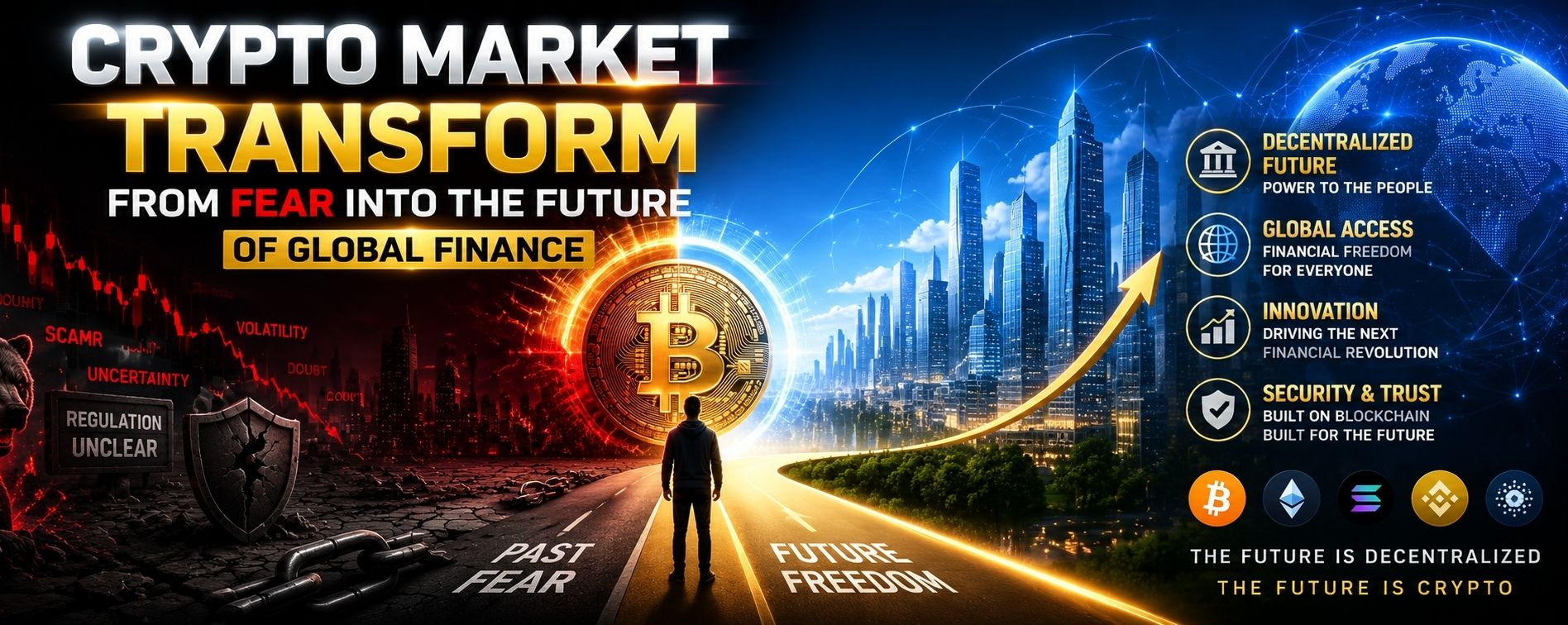

I have watched the crypto market evolve from a misunderstood digital experiment into one of the most revolutionary financial movements of modern history, and the deeper I study it, the more I realize that cryptocurrency is no longer just about trading coins or chasing fast profits because it represents a complete transformation in the way humanity thinks about money, ownership, trust, and freedom. The story truly began in 2009 when Bitcoin was introduced by the mysterious creator known as Satoshi Nakamoto shortly after the global financial crisis had shattered public confidence in banks and centralized financial systems, and what made Bitcoin different from every previous attempt at digital money was the invention of blockchain technology, a decentralized public ledger capable of recording transactions permanently across thousands of computers around the world without requiring permission from governments or financial institutions. I see this moment as more than a technological breakthrough because it symbolized a rebellion against a system where ordinary people often felt powerless while a small number of institutions controlled the movement of wealth and information.
As the years passed, I watched the crypto market expand far beyond Bitcoin into an enormous ecosystem filled with innovation, ambition, risk, and endless experimentation, and networks like Ethereum completely changed the direction of blockchain development by introducing smart contracts that allowed developers to create decentralized applications capable of operating automatically through code instead of relying on centralized companies. This opened the door for decentralized finance, NFT marketplaces, blockchain gaming, tokenized assets, and digital economies that function twenty-four hours a day without borders or traditional banking limitations. I believe the design philosophy behind crypto is what makes it so powerful because decentralization removes single points of failure while transparency allows every transaction to be verified publicly on-chain, creating a financial environment where trust is built through mathematics and cryptography rather than institutional promises. The mechanism itself is fascinating because systems like Proof-of-Work and Proof-of-Stake secure networks through distributed participation, rewarding users for helping validate transactions while protecting blockchains from manipulation or attacks.
At the same time, I cannot ignore the reality that the crypto market is still one of the most volatile and emotionally intense environments in the financial world because rapid price swings, fear-driven selling, speculative hype, exchange collapses, scams, and regulatory uncertainty continue to create massive instability across the industry. I have seen people become incredibly wealthy during bullish market cycles and I have also seen devastating crashes erase billions of dollars within days, proving that crypto remains a high-risk environment where emotions often move faster than logic. Many projects entered the market with unrealistic promises and weak foundations, and the collapse of several major crypto companies reminded investors that innovation alone cannot replace proper security, transparency, and responsible management. Even so, I believe these painful moments are shaping the industry into something stronger because every major crash forces the market to mature, improve infrastructure, and eliminate unsustainable models that were built purely on speculation instead of long-term utility.
What excites me most about the future of crypto is the possibility that blockchain technology could eventually become invisible infrastructure powering everyday life without most people even realizing it, because tokenized financial systems, decentralized artificial intelligence, digital identity solutions, stablecoin payment networks, and real-world asset tokenization are already beginning to reshape industries far beyond simple
@Binance Square Official #Binance #BinanceSquare #CryptoMarkets


