

Welcome back. This week’s edition centers on one of the more forward-looking experiments we’ve seen emerge from the Tezos ecosystem in a while.
TzEL brings post-quantum private payments into a live testnet environment, turning a problem that usually lives in research papers and long-term security discussions into something developers can actually interact with today. It touches on a question that is becoming harder to ignore across the broader industry: what happens to blockchain privacy when the cryptography protecting today’s transactions eventually becomes vulnerable tomorrow?
What makes this especially interesting is that the conversation stays grounded in real infrastructure. The rollup is already live on testnet, the DAL is being used to support large proof payloads, and the system explores how long-term transaction privacy could actually function in practice.
This week is focused entirely on that direction. Privacy, post-quantum security, and a closer look at how Tezos continues to approach long-term infrastructure challenges before they become immediate problems.
Let’s get into it.
 TzEL Brings Post-Quantum Private Payments to Tezos
This week, the spotlight is entirely on TzEL, a new experimental rollup exploring what private payments could look like in a post-quantum world.
Announced by the teams at Nomadic Labs and Trilitech, TzEL is now live on Tezos testnet as a working research implementation for private, quantum-resistant transactions.
What makes this especially important is the problem it is trying to solve.
Most blockchain privacy systems today rely on elliptic-curve cryptography. That works under current conditions, though quantum computers are expected to eventually break those standards. The challenge becomes much bigger when you remember how blockchains operate. Transaction data, encrypted memos, and note payloads are stored permanently onchain. That creates a real long-term concern where encrypted information captured today could potentially be decrypted years from now once quantum systems become powerful enough.
TzEL approaches privacy from the beginning with that future in mind. Instead of elliptic-curve cryptography, the system uses post-quantum cryptographic primitives together with zk-STARK proofs to protect transactions and associated data. It also includes features such as encrypted payment memos, viewing keys, detector keys, and delegated proving flows.
A few things stand out immediately:
• Private transactions designed for long-term quantum resistance • zk-STARK proofs secured through post-quantum cryptography • Encrypted memos and viewing controls for transaction privacy • Delegated proving that allows proof generation to be outsourced securely • A live rollup stack already operating on Tezos Shadownet
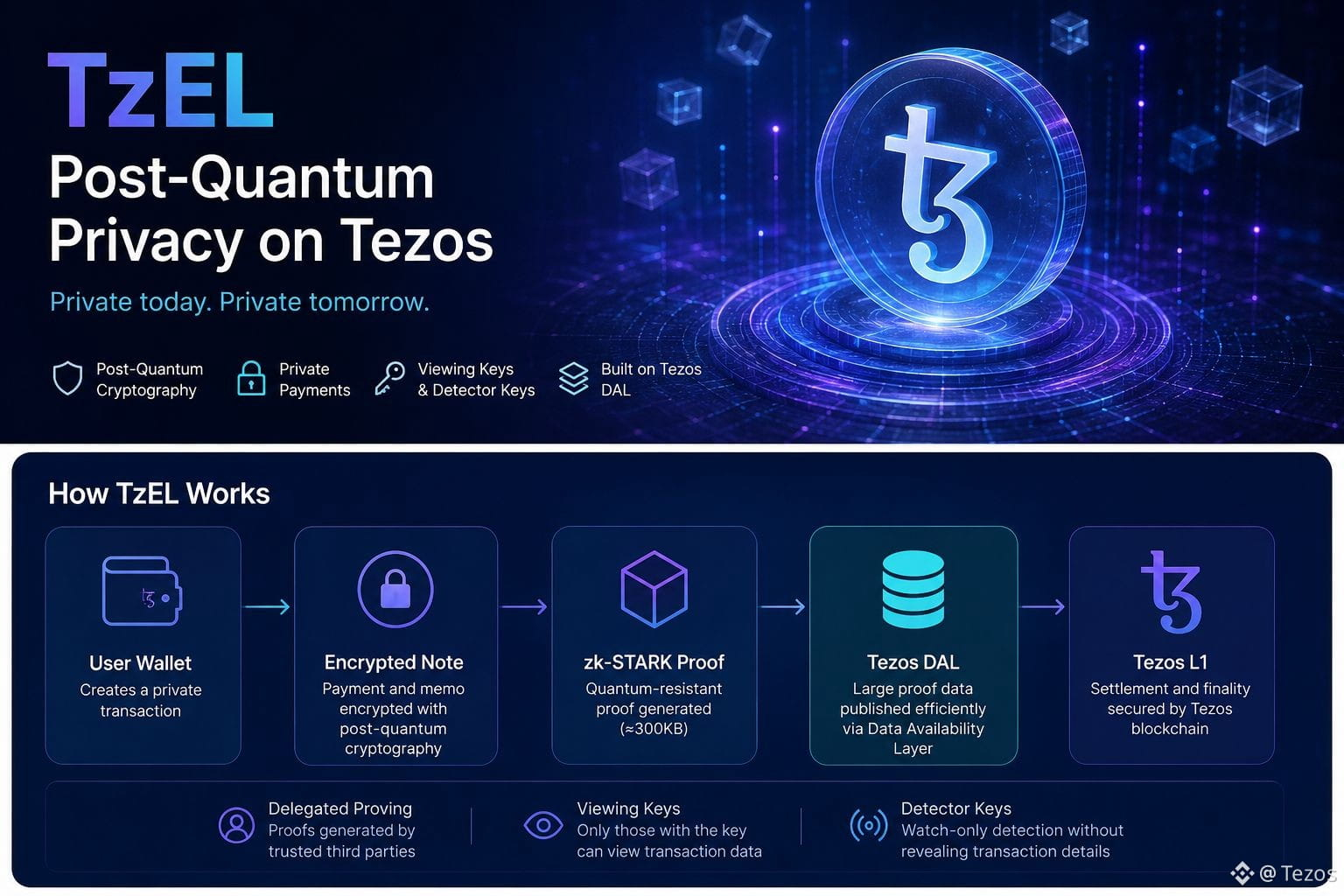
One of the major technical hurdles around post-quantum privacy systems is proof size. The proofs generated here are roughly 300KB, far larger than what most existing privacy systems use. On many chains, that becomes difficult and expensive to handle at scale.
This is where Tezos’ Data Availability Layer becomes particularly relevant. DAL was designed to support large-scale data publication efficiently, and TzEL can post these much larger proof payloads without congesting the network itself. It turns a piece of infrastructure that has mostly been discussed in terms of scaling into something with a very direct application for privacy systems.
Arthur Breitman described it clearly, “Private transactions have a long memory: the data encrypted today may still be around when tomorrow’s attacks arrive. With TzEL, we set out to build a shielded ledger for Tezos whose privacy stack is post-quantum end to end.”
That framing captures why this matters. TzEL is still experimental research infrastructure and should be viewed that way. It is not production-ready, audited, or intended for real value today. What it does provide is something much more important at this stage: a live end-to-end prototype exploring how private blockchain transactions could remain private much further into the future.
And for a topic that has mostly lived in theory and academic discussion, seeing a working implementation live on Tezos testnet makes this week feel particularly significant.
You can go ahead and test the wallet today and go through the tutorial here.
 Tezos Upgrade Tracker: Ushuaia Advances
Alongside this week’s focus on post-quantum privacy, governance activity continues moving forward as the Ushuaia proposal approaches the end of its Exploration phase.
With two days remaining in the current voting period, the proposal has already successfully reached both quorum and supermajority thresholds, meaning it is now set to move into the next Cooldown phase once voting closes.
A big thank you goes out to the bakers participating in governance and helping move the process forward.
Ushuaia continues the broader direction the protocol has been taking over the past several upgrades, with a strong focus on scaling, rollup infrastructure, and long-term cryptographic preparation.
A few of the major features included in the proposal are:
• A 15x increase in DAL bandwidth, moving from ~0.66 MB/s to 10 MB/s • Faster DAL confirmation timing through dynamic attestations • More flexibility for rollup environments to evolve through governance • Early groundwork for quantum-resistant tz5 accounts • Experimental support around sTEZ and future staking infrastructure
Taken together, the proposal keeps building toward higher throughput, more flexible execution environments, and stronger long-term infrastructure across the network.
You can follow the live governance cycle here.
Tezos Spring Events
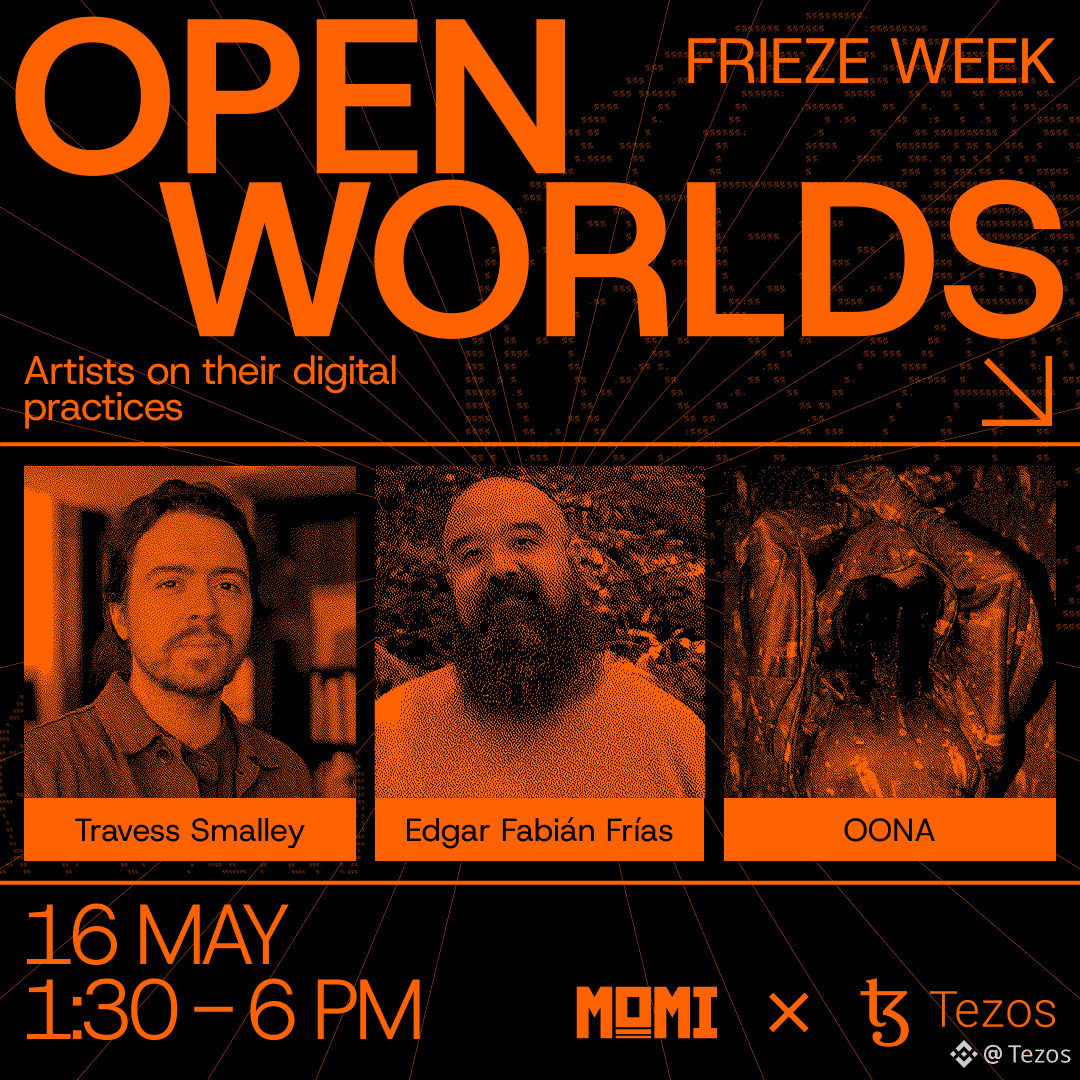 Open Worlds: Digital Art at MoMI During Frieze Week
During Frieze Week in New York, Museum of the Moving Image will host Open Worlds: An Afternoon of Digital Art Encounters, organized in collaboration with Art on Tezos and supported by the Tezos Foundation.
The event brings together talks, performances, and a book signing across three distinct artistic practices, offering a closer look at how digital art continues to evolve within the Tezos ecosystem.
The afternoon includes:
• Travess Smalley presenting a talk and book signing for Pixel Rugs • Edgar Fabián Frías leading a live performance with local Indigenous artists • OONA sharing a performance and talk
The program wraps with drinks, snacks, and time to connect with the artists in a more informal setting.
Events like this highlight another layer of the ecosystem. Alongside infrastructure and applications, there is a continued focus on creative expression and real-world engagement, bringing digital work into physical spaces and conversations.
If you’re in New York, it’s a chance to step into that intersection firsthand.
🗓 May 16, 1:30–6 PM EST 📍 Museum of the Moving Image 🎟 Free with RSVP
 🔴 Now Streaming: How Ushuaia Prepares Tezos for Shared Applications
This week on TezTalks Radio, we’re joined by Yann Régis-Gianas to unpack Ushuaia, a new Tezos protocol proposal that sits directly in the path toward Tezos X.
From the outside, Tezos X promises something simple: a more unified Tezos experience where EVM and Michelson applications can interact more directly without the awkward fragmentation users are used to across chains, rollups, wallets, and app environments.
Ushuaia is part of the infrastructure underneath that promise. This episode focuses on what Ushuaia actually unlocks, what becomes harder without it, and how the clean roadmap for Tezos X meets the reality of engineering constraints.
Now streaming on YouTube.
Powered by beehiiv