
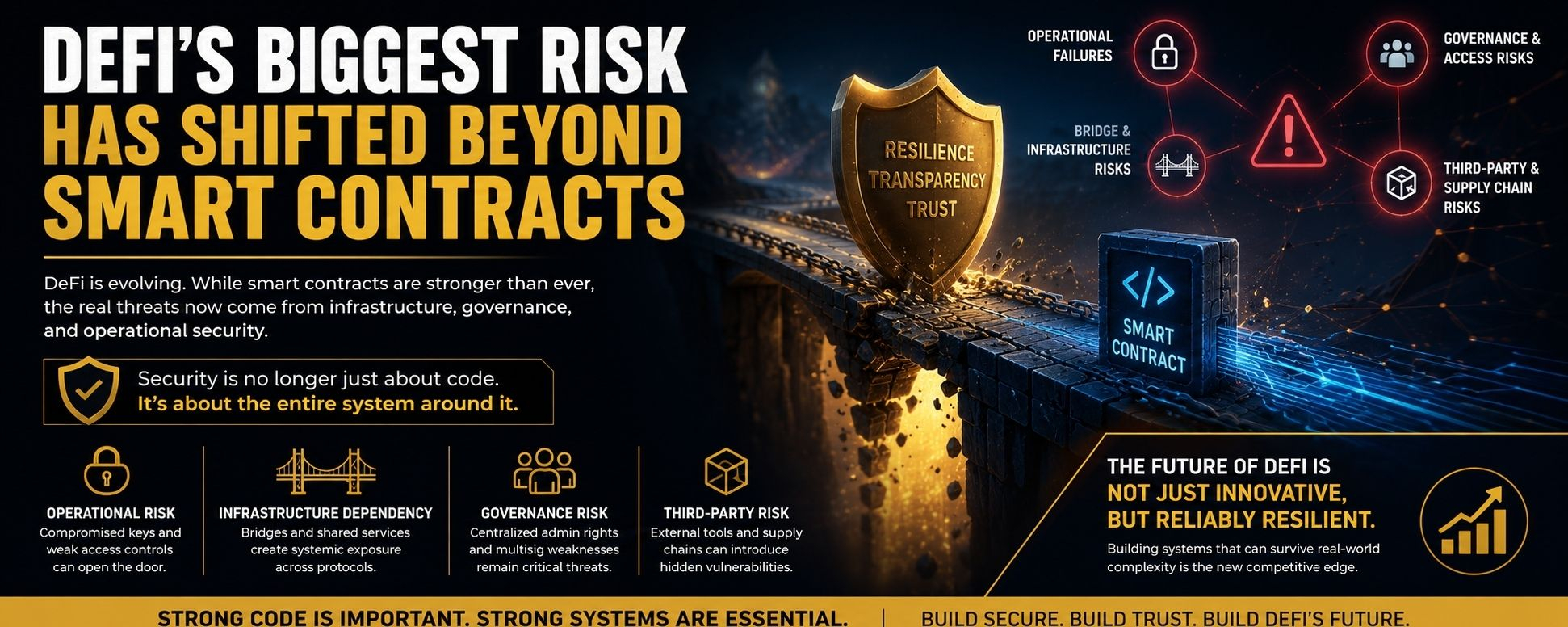

Decentralized Finance was built on a simple promise: trustless systems powered by smart contracts, where code replaces intermediaries and removes human dependency. For years, most attention in the industry focused on eliminating bugs in contract logic.
That focus is now expanding, because the most serious risks in DeFi are increasingly coming from outside the smart contract layer itself.
Modern DeFi has evolved into a highly interconnected ecosystem built on bridges, cross-chain messaging systems, governance modules, multisignature wallets, cloud services, and third-party dependencies. This complexity has created a wider attack surface where failures often originate from operational and infrastructure weaknesses rather than the code itself.
In many cases, smart contracts continue to function exactly as intended, but the systems around them introduce vulnerabilities. A compromised private key, misconfigured access control, or failure in external infrastructure can spread across multiple protocols due to shared dependencies and interconnected design.
This also introduces systemic risk across the ecosystem. When multiple protocols rely on the same underlying services, a single point of failure can affect several platforms at once instead of remaining isolated.
Key risks in today’s DeFi landscape include:
Operational security failures and compromised access control
Dependence on shared infrastructure such as bridges and messaging layers
Centralized administrative permissions within governance systems
Vulnerabilities in third-party tools and software supply chains
At the same time, market behavior is shifting. After years of aggressive experimentation and high-risk strategies, capital is increasingly moving toward protocols that emphasize stability, transparency, and predictable design over complexity and maximum yield.
This reflects a broader transition in DeFi’s maturity. Security is no longer only a smart contract concern—it is an operational discipline. Strong key management, distributed governance, timelocks, and structured incident response systems are becoming just as critical as secure code.
DeFi is not losing innovation, but it is entering a more mature phase where resilience matters as much as performance. The next stage of growth will depend on how effectively protocols manage both technical correctness and real-world operational risk.